FREE ASSISTANCE FOR THE INQUISITIVE PEOPLE









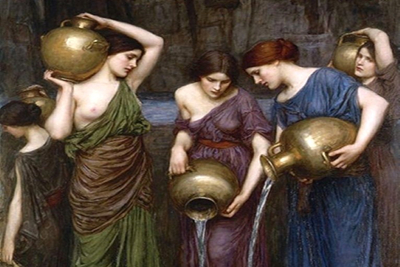
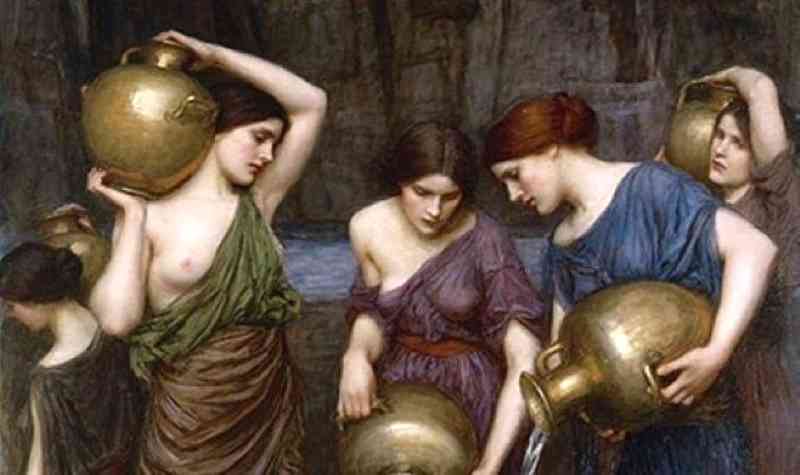
The Danaïdes, an evocative oil painting created by English Pre-Raphaelite artist John William Waterhouse between 1903 and 1906, depicts the fifty mythological daughters of King Danaus of Argos, known as the Danaids, who were condemned to spend eternity in the underworld filling a leaky vessel with water as punishment for murdering their husbands on their wedding night. The most complete version of the myth of Danaid is found in Bibliotheca, written by Apollodorus of Athens, and also documented by Pindar, a lyric poet of Thebes in his Pythian Odes. Aeschylus, of ancient Greek, often described as the father of tragedy, devoted a dramatic trilogy which includes The Suppliants, to the Danaids' flight from Egypt to Argos. Ovid, the Roman poet, detailed the eternal punishment of the fifty Danaid sisters in Hades in his Metamorphoses, while The Fabulae, a Latin handbook of mythology, attributed to an author named Hyginus, also provides a direct catalogue of the sisters and their husbands.
In Greek mythology, King Belus, the son of the sea god Poseidon and a mortal princess Libya, best known as the daughter of the legendary King Epaphus of Egypt, married the Naiad Achiroe or Anchinoe, the daughter of the river-god Nilus, and consequently fathered the famous twin brothers Danaus and Aegyptus. Following the death of Belus, Aegyptus became the king of Arabia and later conquered the land he renamed Egypt, while Danaus became the king of Libya. Interestingly, legend says, Danaus fathered fifty daughters, known as the Danaides, from four different women, such as Polyxo, Pieria, and others, while Aegyptus had fifty sons. To acquire the kingdom of Danaus easily, Aegyptus cunningly hatched a plan and proposed his sons get married to the Danaides. However, Danaus realized the real intention of his greedy brother and decided not to gift his beautiful daughters to his nephews, in lieu of a truce. However, as he did not want his country to suffer the hazards of an imminent war, he decided to give his kingdom peacefully to his brother and fled to Argo in Greece by ship with his fifty daughters.
After arriving at Argo, Danaus became the king of the country, as he was the rightful owner of his ancestral throne, since Argos was the birthplace of his great-grandmother, the Argian princess Io. However, he did not get a respite. Enraged by the escape of Danaus with his daughters from his trap, Aegyptus sent his army to Argo, headed by his fifty sons, and made it very clear that they would go any extent, until Danaus consented to let his sons marry the Danaids. Unable to find any other option to avoid a war and its consequent disastrous bloodshed, he agreed to his brother’s proposal for the wedding and accordingly organized a low-profile wedding party. However, at the same time, he carefully devised a secret plan to get rid of Aegyptus and his sons forever, and before the scheduled wedding, presented each of his daughters a dagger, instructing them to kill their spouses on their wedding night. Consequently, all the Danaides except one, decapitated their spouses on their wedding night, and according to Apollodorus of Athens, their heads were buried at a place called Lema, where the Danaids performed the traditional funeral rites in front of the city.
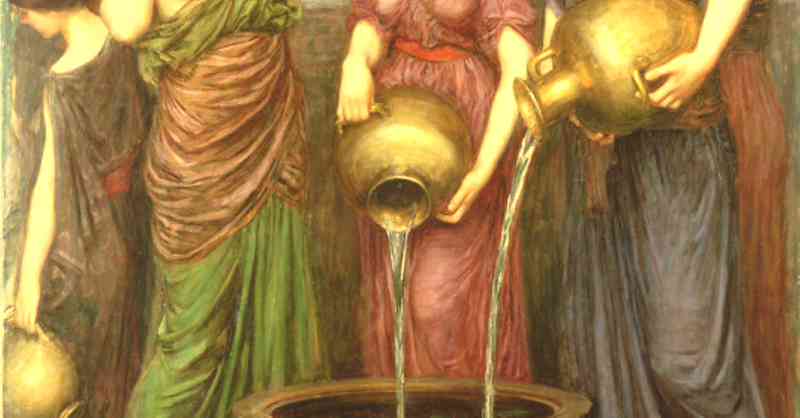
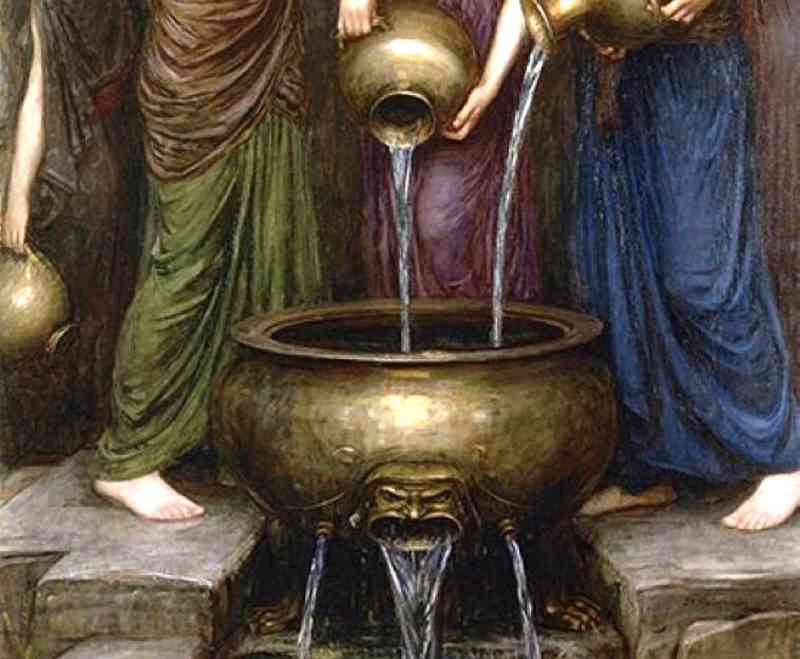
However, the punishment conferred on the maidens for their crimes was the fruitless labour for eternity in Hades, endlessly replenishing a leaking container with water, which is the subject of John William Waterhouse’s captioned painting. In the painting, Waterhouse has the maidens pouring water into a pot, embellishing it by transforming the water escape hole into a scowling face and mounting it on clawed feet, giving the pot an aura of menace. He painted two versions, and the 1906 version, featuring seven figures, was the only painting that he submitted to the Royal Academy exhibition that year, which was purchased by magnate James Murray and later acquired by the Aberdeen Art Gallery.