FREE ASSISTANCE FOR THE INQUISITIVE PEOPLE









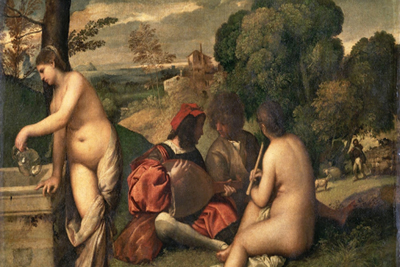
The Pastoral Concert, the mysterious oil painting in the Louvre in Paris, depicts a fashionably-dressed young man with long, dark locks, a full-sleeved red and black garment, sitting with a lute in his hands on a shady hillside overlooking sunny glens and a distant mountain vista. While playing his lute, he has turned his attention to his companion, another young man with unruly hair and bare feet wearing a simple garment of ordinary brown fabric. They were leaning toward each other, their heads almost touching and though their faces are in shadow, the intimacy of this moment is palpable. Off in the distance, there is another man, under a grove of trees, a herdsman tends his sheep.

The first two men deeply engaged in unknown conversation seem to be oblivious about the presence of the two other conspicuous figures very near to them, the two plum and nude women. While one of the two nude women on the left is in the process of pouring water from a glass pitcher into a stone well, the other on the right, sitting right in front of the men and forming part of their intimate group with her back turned toward the viewer, has just paused of playing her flute.
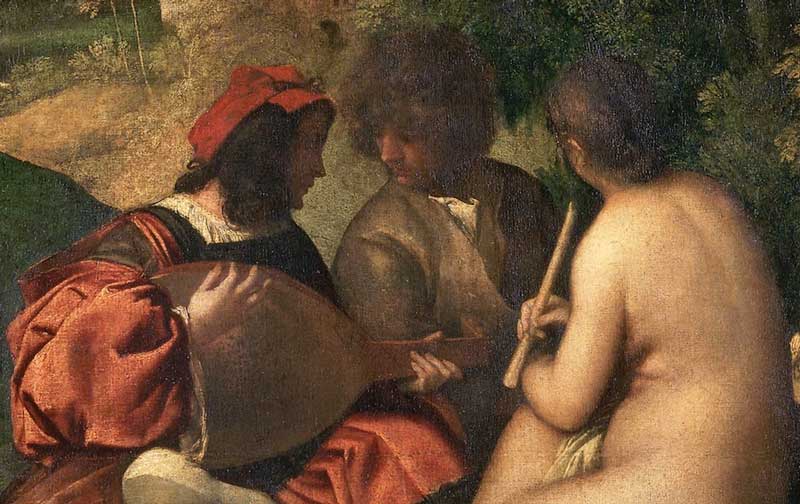
The subject matter of the painting appears to be a depiction of allegory of poetry and music. The strangeness of the meeting of the two dressed men of apparently two different social statuses and the presence of two nude female figures on the canvas suggests a complex meaning. It seems that the artist wanted to present the two contrasting worlds of Venetian aristocracy and the life of the nymphs and shepherds to confront each other on the scene. However, all of them are speechless and they communicate only through music. It reminds the myths of the happy life of the shepherds of Arcadia, whose existence was centered around music and song.

It is considered by many critics that in the Pastoral Concert, the lute-player represents the member of a cultured city dweller, a fraternity of wealthy Venetian youth known for their fashionable attire and for organizing poetical or musical entertainment for aristocratic weddings, who has retreated beyond the city, in the background to the idyllic world of the pastoral poet. On the other hand, the nude women are the nymphs who embody the spirit of the place or the muses who inspire the poet or personifications of Poetry and Music.

The music created by the figures seems to create a type of harmony found in the universe, linking the scene to the cosmos. However, the arrival of the shepherd off in the distance interrupts the harmony of the music. Possibly he symbolizes the persons belonging to an unsophisticated class, who is unable to appreciate the sophistication of the music enjoyed by the so-called upper class.
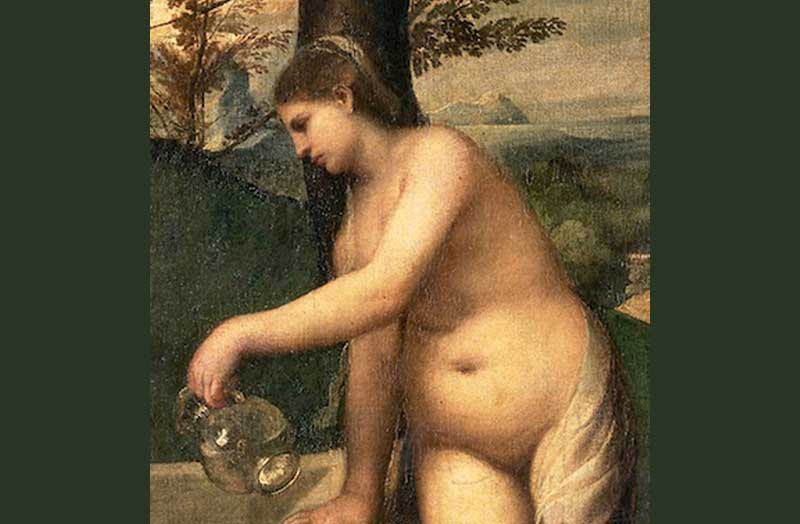
The nude female bodies depicted in the painting may be considered as overly plump from the modern concept of the ideal female figure. In all probability, they were painted from actual models and the artist seems to have emphasized their curvy bodies by using curvy forms in the billowing trees and hills in the landscape. He also painted the female figures from different points of vision, so that the viewer can see one of them from the front and the other from the back.
The Pastoral Concert is mysterious both in meaning and in authorship. Originally, it was attributed to Giorgione, the great Italian painter, known for the elusive poetic quality of his work. However, the modern critics attribute it to Titian, as the heavy and the fleshy shape of the female figures is thought more typical of his style.