FREE ASSISTANCE FOR THE INQUISITIVE PEOPLE













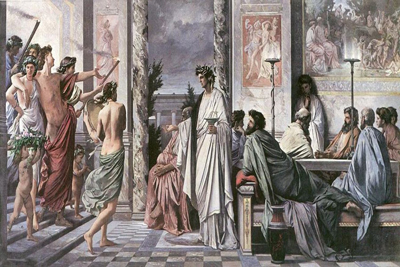
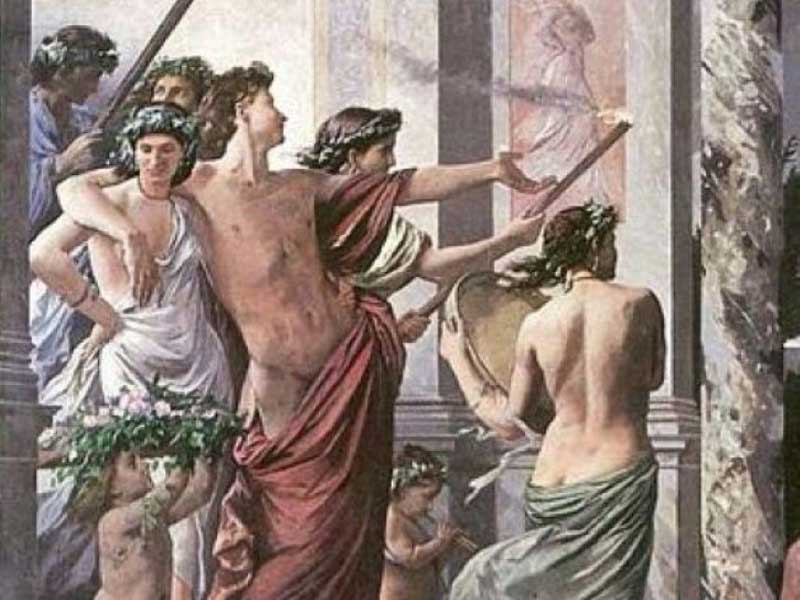
Das Gastmahl des Platon or The Banquet of Plato, painted in two different versions from 1869 and 1873–74 by the German artist Anselm Feuerbach, represents a dramatic moment when the garlanded and partially clad, drunken and reeling, Alcibiades, an Athenian statesman and general, along with his entourage were bursting into the drinking party, the Symposium of Plato, arranged for the gathering of refined, intellectual Athenian philosophers, for a friendly contest of extemporaneous speeches while attending a banquet, which include the famous philosopher Socrates, an Athenian statesman and general Alcibiades, and also the comic playwright Aristophanes, among others.
Although known as Plato’s Symposium, as described by Plato after the philosophical drinking party in 385–370 BC, it was arranged by Agathon on behalf of Plato in 416 BC, for the celebration of his first victory in Dionysia, a dramatic competition and also a major ancient Greek festivals held in honour of Dionysus, the god of wine, theatre, and fertility, in which Plato expounded his various theories of love, predominantly male homosexuality. Nevertheless, apart from Socrates, known as the teacher of Plato, the party included Agathon, a tragic poet and the host of the gathering, Alcibiades, a statesman and orator, and Aristophanes, a famous comic playwright, while the other participants of the distinguished drinking party included Phaedrus, an aristocrat and follower of Socrates, Pausanias, a legal expert, Eryximachus, a physician.
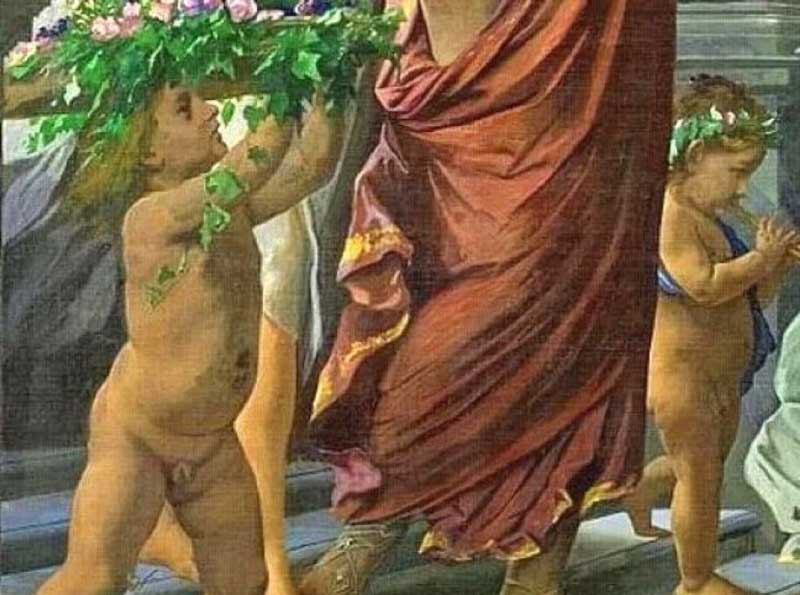
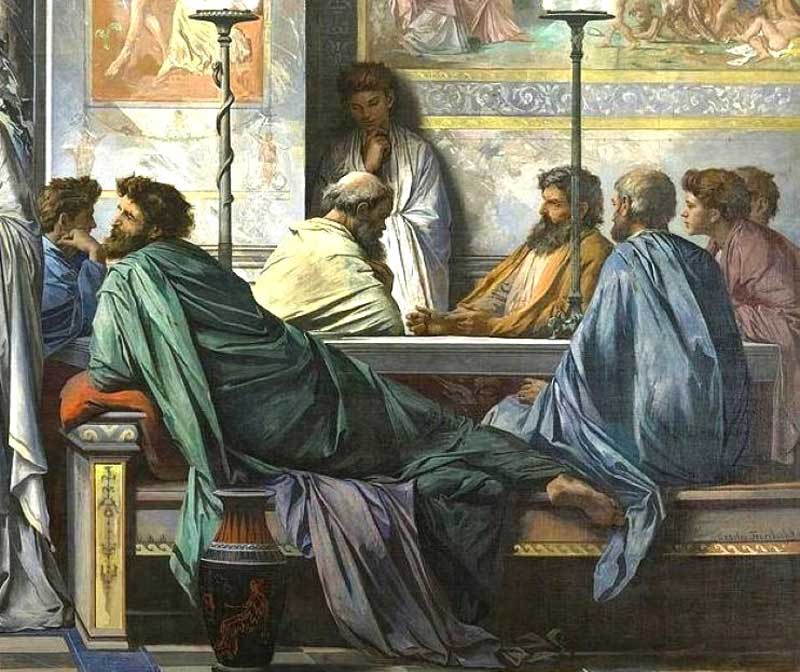
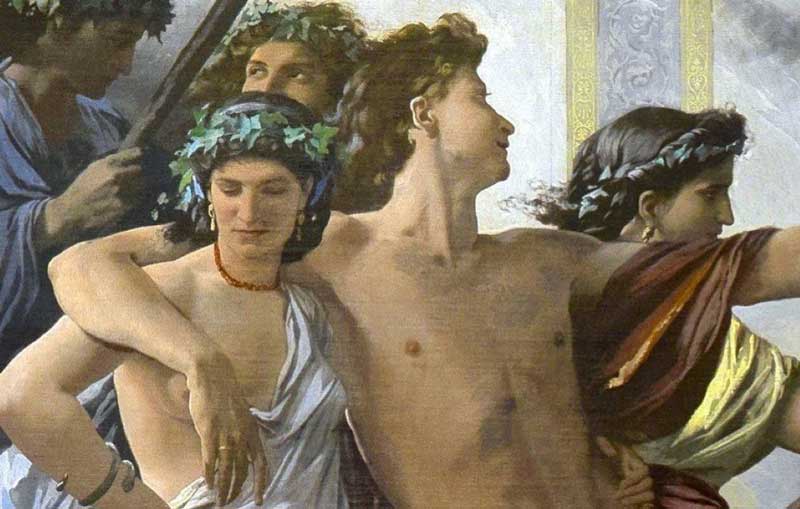
The scene of the banquet, as presented in the painting, is set in Agathon’s lavish home, in front of a richly painted back wall, based on archaeological findings from Pompeii, and depicts the drunken, garlanded and almost naked statesman and orator Alcibiades, entering the room from the left down the short flight of steps, with his right arm cast around a partially unclad female companion with one partially exposed bosom, along with a group of revellers, including two persons carrying smoking torches, while another partially undressed woman with a tambourine, and a pair of chubby male toddlers, one with a wreath, the other with a double-flute. In contrast to the gaiety and movement of the group of Bacchants, the laurel-crowned Agathon is seen holding a cup in his left hand, extending his right hand in greeting his guests, bifurcating from them the calm and serenity of the philosophers on the right side of the painting, which include the predominantly older men, comprising Phaedrus, Pausanias, Eryximachus, Aristophanes, Aristodemus, Socrates, and perhaps Plato, seated on benches around an oblong table, and seem to be completely absorbed in their conversation, and hardly seem to be disturbed by the noisy arrivals.
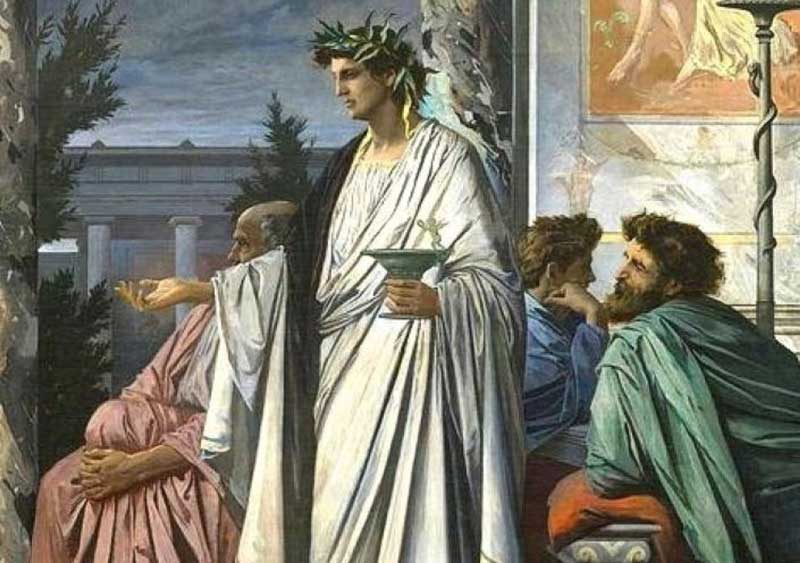
It is evident that the artist deliberately depicted the two extremities on the two sides of the canvas, and while the left side represents the love, laughter and abundance of life, the right side depicts the embodiment of calm, barrenness and thoughtfulness of life, and the two polarities are united in the centrally positioned figure of Agathon, the personification of patience and tolerance. Unfortunately, the first version of the painting, created by Anselm Feuerbach, was harshly criticized as an extreme of ugliness in form and colour which borders on vulgarity and filth when it was first displayed in 1869 at the Great International Art Exhibition in Munich, and ended up in the private collection of a female painter, instead of in the collection of an art gallery. Naturally, Feuerbach was shocked and deeply hurt by the undeserved, devastating assessment of his work, but after almost a decade, he painted a second, more colourful version of the work, which since 1878 is in the collection of the National Art Gallery in Berlin. Interestingly, much later, some critics considered the earlier 1869 version to be the superior of the two works.