FREE ASSISTANCE FOR THE INQUISITIVE PEOPLE













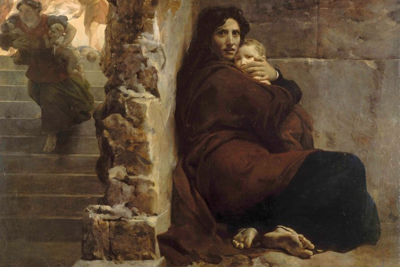
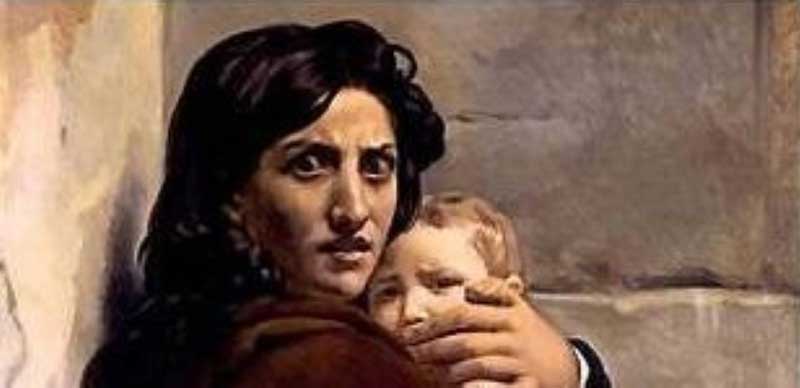
The Massacre of the Innocents, a painting by Léon Cogniet, has its reference to a Biblical story as recounted in the Gospel of Matthew. According to the story, Herod the Great, the King of Judea, ordered indiscriminate slaughtering of all the male children under the age of two born in and near the town of Bethlehem, as the Magi, the three wise men from the East who followed a star to Bethlehem, had told him that a child destined to eliminate him and become the king of the Jews had been born in the city, who would later be revealed as Jesus Christ. However, by that time, Joseph escaped to Egypt, with the child and his mother, as instructed by the angel of the Lord, who appeared to Joseph in a dream. Due to the dramatic storyline, the massacre of the innocents has been a popular theme to depict throughout the history of art, and almost all the artists who depicted the situation on canvas displayed a very broad scene with numerous figures, which include Roman soldiers mercilessly killing the children, while people ran in horror and women screaming in lamentation.
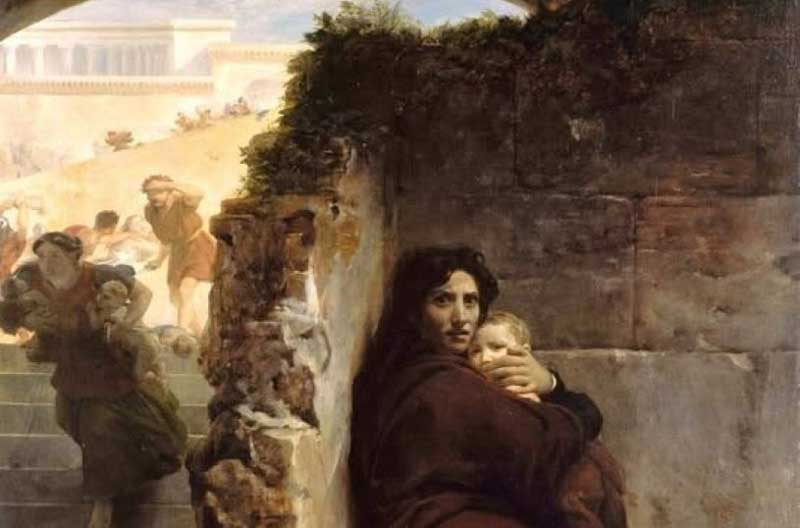
However, Léon Cogniet, a French painter, in his creation titled The Massacre of the Innocents, departed from the typical large-scale biblical scenes of chaos and bloodshed, and captured a moment of pure horror of a mother who crouches in a dark corner clutching her baby, desperately trying to hide to save her child from the rage of the slaughtering soldiers of Herod. Although another mother is seen carrying her own children down the stairs to the left, running for their lives, Cogniet did not show us the carnage, but only hinted at the rushing figures in the background without overtly showing violence. Instead, he focused the viewer’s attention to the wide, terrified eyes of the woman crouching in a dark corner with her baby, almost as if making us complicit in the horror unfolding, and emphasising a personal tragedy within a larger historical event.
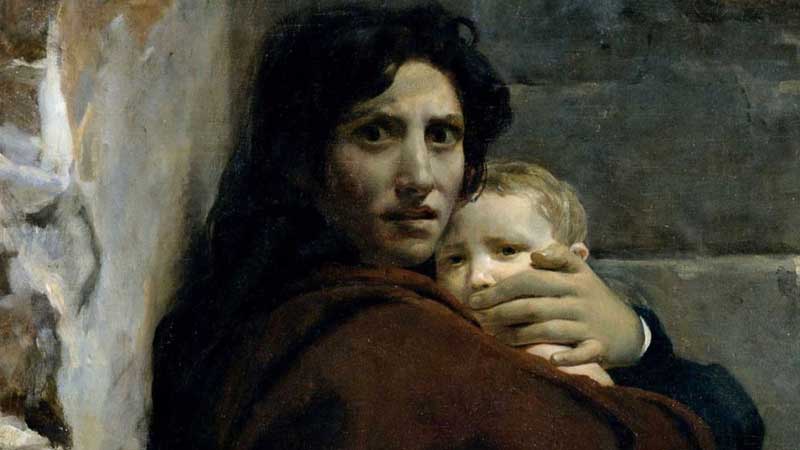
The composition of The Massacre of the Innocents, created by Léon Cogniet, represents a hunting scene in which the bright sunlight and grand architecture in the background made a sharp contrast with the dark corner where a woman, a mother, is crouched, pressed against a crumbling wall, with her arms wrapping tightly around her child and her hand covering the mouth of her child to keep him shut. She is aware that she is cornered, but she is also aware that hiding is her only chance to escape, and running is a sure way to die. She is bareheaded and barefoot, which made her look even more vulnerable, while her eyes are filled with a kind of fear, which is rather incredible. The muted colours of the overall painting, along with the rushing figures in the background, made the scene frozen in terror, which traps the viewers in an unbearable tension, and this emotional intensity gave the painting its profound impact, emphasising the personal tragedy within a much larger Biblical incident. In addition, by narrowing the scope to a single moment and the single character of a mother, Léon Cogniet has transformed a biblical episode into a universally relevant scene of a mother’s desperate love and concern for her child.