FREE ASSISTANCE FOR THE INQUISITIVE PEOPLE










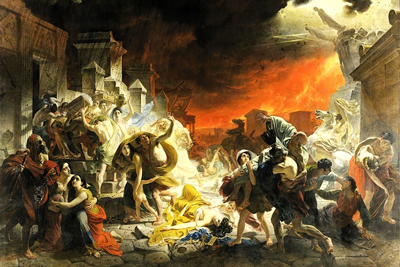
Reflecting the fusion of Neoclassicism, the predominant style in Russia at the time, and the emotional intensity of Romanticism that was increasingly peaking up in Europe, The Last Day of Pompeii, created by the Russian painter Karl Bryullov from 1830 to 1833, is a large-scale historical painting, depicting the destruction of the ancient Roman town of Pompeii in 79 AD by a catastrophic eruption of the volcano Vesuvius. The scene of the action during the destruction is the Strada dei Sepolcri, meaning the Road of Tombs, the Pompeii necropolis, located near the Herculaneum gate, which Bryullov sketched during his visit to Pompeii in 1828, and later filled the massive canvas with numerous figures in panic, each a small vignette showing individual reactions to the collective catastrophe. However, the scene he depicted in the painting was based on the two famous letters of the ancient Roman historian Pliny the Younger, a witness of the catastrophe, to Tacitus, widely regarded as one of the greatest Roman historians by modern scholars, which provide the only surviving firsthand account of the death of his uncle while trying to rescue people, and the pathetic destruction of Pompeii. Those two letters are considered the earliest and most detailed eyewitness accounts of the event, and invaluable source for understanding the details and impact of the catastrophic eruption and the human experience of living through it, along with the study of the ruins of Pompeii, where archaeological excavations had begun in the middle of the eighteenth century.
During the eruption, the 17-year-old Pliny the Younger was not at Pompeii, he was at Misenum, across the Bay of Naples, along with his mother and his uncle, Pliny the Elder. It was Pliny's mother who first noticed an unusual cloud rising from Mount Vesuvius, described by Pliny as resembling a pine tree, with a tall trunk splitting into branches at the top. During that time, Pliny the Elder, an admiral, sailed to investigate the unusual cloud and rescue people, if necessary. However, he was overcome by the ash-laden air and sulphur fumes while trying to save others, and died at Stabiae, although his body was found untouched by the eruption, looking as if he were asleep. Nevertheless, the letters of Pliny the Younger, written to Tacitus, present a vivid sense of the disaster and the human response to the catastrophe, which spared none, irrespective of sex, wealth and nobility. His depictions were so precise that modern volcanologists named a specific type of widespread and explosive eruption as Plinian.
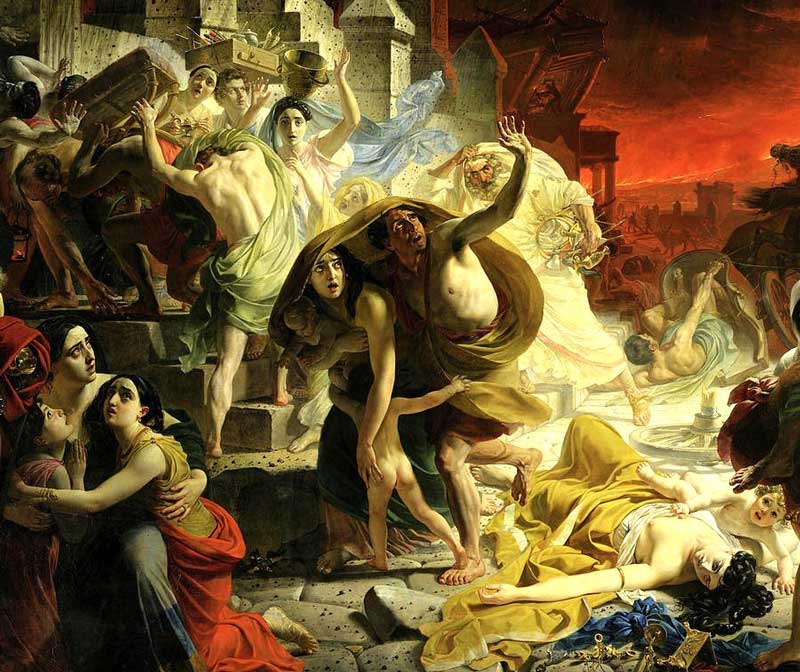
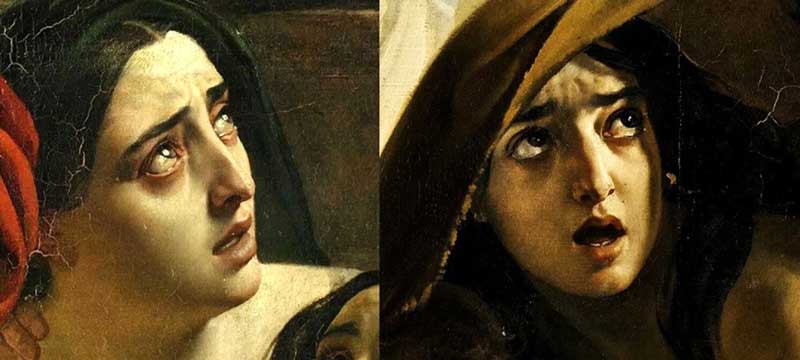
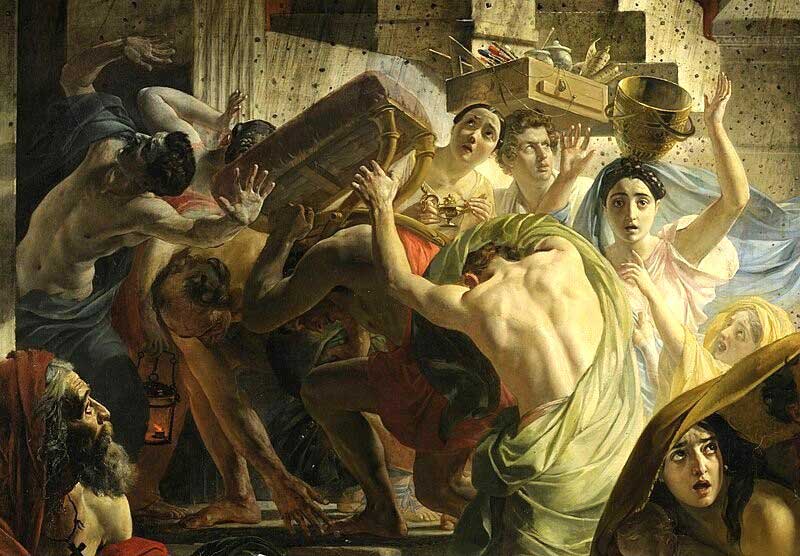
In his strikingly historical large-scale artwork, titled The Last Day of Pompeii, Karl Bryullov depicted the violent power of nature, demonstrated by the dramatic toppling of the classical statues of pagan gods from their pedestals, along with the thematic contrasting depiction of a pagan priest selfishly flying away with the treasures of his temple, while a calm Christian priest walking in the opposite direction, prepared to meet his fate, signifying the end of an old order with the emerging Christian era. Each segment of the huge canvas displays a story within a story, a private moment in the face of a highly collective tragedy, abundant with narrative moments in the face of the cataclysm, when the people of Pompeii are in despair and in panic, when some are hugging each other in fear of the eruption, and several other performing acts of profound humanism.
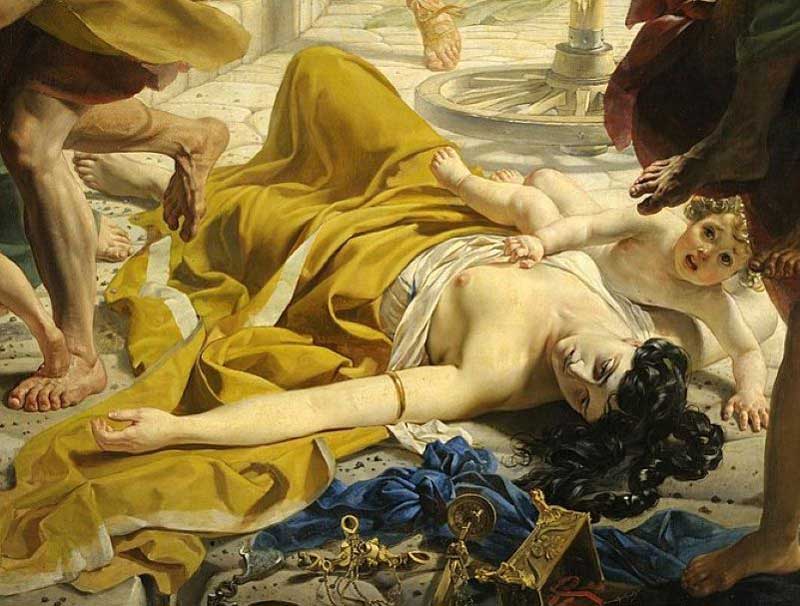
The Last Day of Pompeii displayed a wide range of human responses to death and destruction, while they are in the swirling panic of a disastrous natural calamity. It shows some people praying for deliverance, while others fall to the ground in grief, but despite everything, a man shields his children from the ash, a young man carrying his elderly father, while a husband protects his wife and children with a cloak, and a mother embraces her daughters. There is even the inclusion of a very neoclassical-looking white stallion in the upper right-hand corner of the canvas, while in the upper left corner, a figure is included, holding up the paint supplies, which is believed to be a self-portrait of Bryullov. The central figure of the canvas is a woman who fell from a chariot and crashed to death, while her baby gazes out, unaware of the horror, and behind the fallen woman lies a broken wheel from the chariot from which she presumably fell. Interestingly, Countess Yuliya Samoylova, a wealthy aristocrat and socialite, who shared a deeply intimate and significant friendship with Bryullov, was the model for several figures in the work, including the dead woman fallen from her chariot.
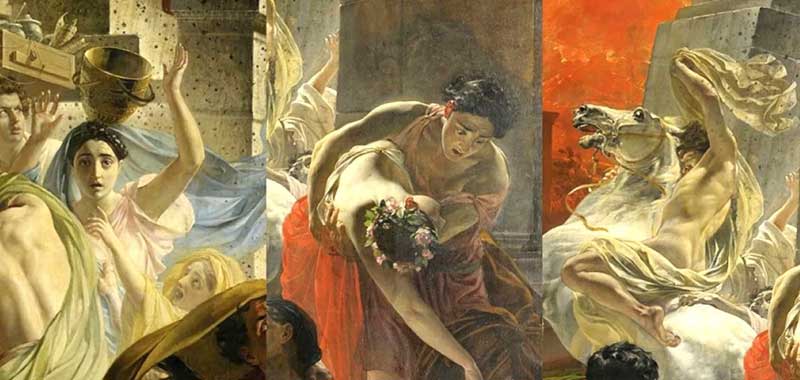
Bryullov used dramatic lighting to heighten the tragic and dramatic atmosphere of the scene, and used contrasting colours to emphasise the destructive forces at play. The background is dominated by the menacing red glow of the erupting volcano, while a cool, but eerie greenish-yellow light from the ash-filled sky illuminates the figures. The streaks of lightning pierce the dark, volcanic cloud, providing intermittent flashes of illumination on the terrified faces of the people, creating a hellish effect for the painting. The ominous red colour of the lava in the foreground emphasises the general feeling of a global natural disaster, and contrasts sharply with the dark clouds in the upper left corner on the left side of the painting. Despite the fact that the action takes place at night, everything is perfectly visible, as the figures in the foreground, are illuminated by a flash of lightning, which also creates depth and volume.
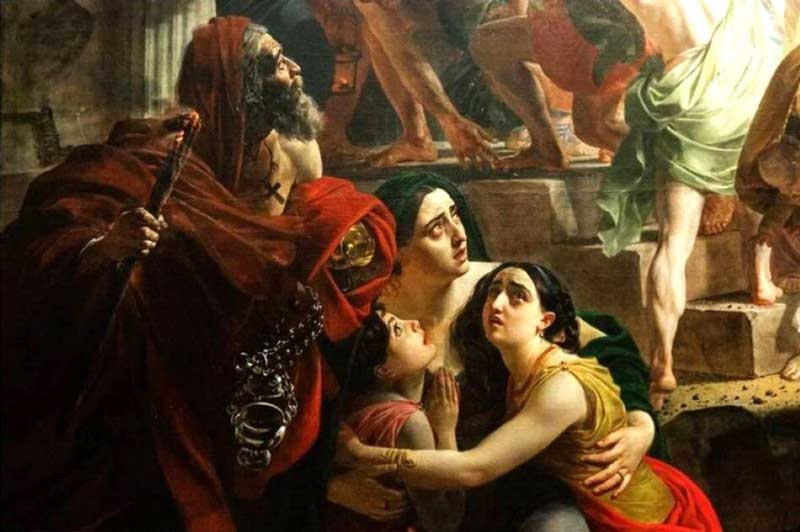
The Last Day of Pompeii received a rapturous response when it was first shown at Bryullov's studio in Rome. It is believed that Sir Walter Scott, the famous novelist, studied the painting for an hour before declaring it a flaming colossus. It also inspired Edward Bulwer-Lytton’s famous novel The Last Day of Pompeii. Currently housed in the State Russian Museum in Saint Petersburg, the painting made Bryullov the first Russian painter to have an international reputation.