FREE ASSISTANCE FOR THE INQUISITIVE PEOPLE


















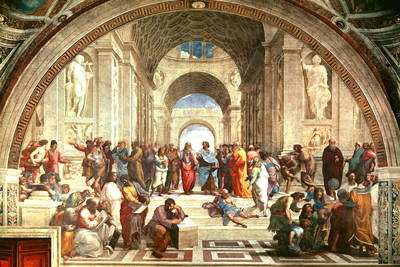
Painted between 1509 and 1511, by Raffaello Sanzio, popularly known as Raphael, one of the most famous Renaissance artists, The School of Athens, a fresco decorating the rooms now called the Stanze di Raffaello or Raphael Rooms, the four interconnected suites of reception rooms in the Apostolic Palace at the Vatican, is perhaps one of the most significant artworks of the artist, as well as of the Renaissance. Towards the end of 1508, when Pope Julius II planned to rebuild St. Peter's Basillica, and invited Raphael to Rome at the suggestion of Donato Bramante, the planner and chief architect of the project, Raphael was in Florence and was little known in Rome, and moreover, at that point he had never executed fresco works as the commission would require. But soon he made a deep impression on the Pope, after his first task of painting a cycle of frescoes in a suite of medium-sized rooms in the Vatican papal apartments, which later came to be known as the Stanze di Raffaello or Raphael’s Rooms. After that, he also decorated the Stanza della Segnatura or Room of the Signature and Stanza d’Eliodoro, Room of Heliodorus, practically all by himself, with frescoes representing the harmony of Truth, Good, and Beauty through Theology, Philosophy, Justice, and Poetry. Located in the Stanza della Segnatura, in the Apostolic Palace, and set in a classical, vaulted hall, The School of Athens, a fresco depicting a congregation of Ancient Greek philosophers, mathematicians, scientists, and poets belonging to different ages, is a complex allegory of knowledge, or philosophy.
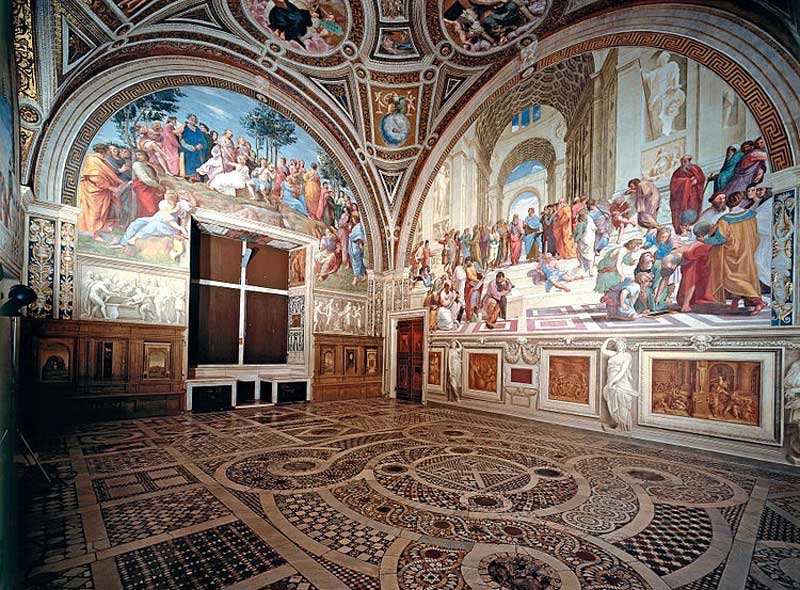
After finishing Disputa, representing theology, and Parnassus, signifying literature, Raphael completed The School of Athens, positioned facing Disputa and symbolizing philosophy, setting up a contrast between religious and lay beliefs, and in that one painting, he used groupings of figures to lay out a complex lesson on the history of philosophy and the different beliefs that were developed by the great ancient Greek philosophers. However, although the identities of some of the philosophers in the painting, like Plato and Aristotle, have been ascertained, several other figures have been the subject of speculation.
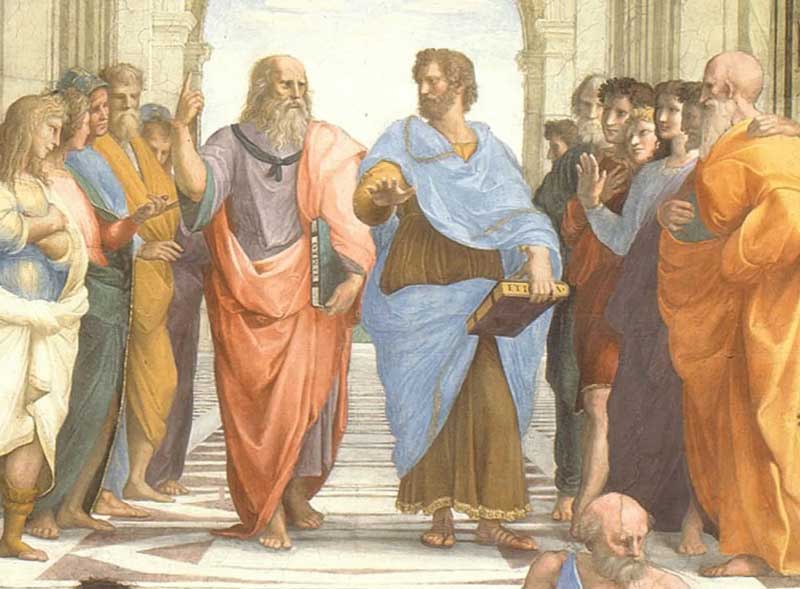
The School of Athens is one of four wall frescoes in the Stanza della Segnatura, and the two main figures in the work, figures of Plato on the left and his student Aristotle on the right, are placed directly under the archway, to draw the viewer’s eye to the most important part of the painting, who effectively represent the different schools of philosophy. Plato engaged with such spiritual ideas as truth, beauty, and justice, while Aristotle was concerned with worldly reality. In the painting, Plato is depicted as old, grey, and barefoot, holding a copy of his book Nicomachean Ethics in his left hand, and pointing his right-hand finger to the sky, which is thought to indicate his Theory of Forms, the philosophy that argues that the so-called real world is not the physical one, but a spiritual realm of ideas filled with abstract concepts. In contrast, Aristotle, slightly ahead of him, and a man in mature manhood, wearing sandals and gold-trimmed robes, holding a copy of his book Nicomachean Ethics in his left hand, and with his right hand extended forward, signifying his emphasis on practical and observable knowledge that comes from experience, and humans must have concrete evidence to support their ideas and is very much grounded in the physical world. Nevertheless, it is maintained by many that the core theme of Raphael's School of Athens is the contrasting philosophies of the two great philosophers of Ancient Greece.
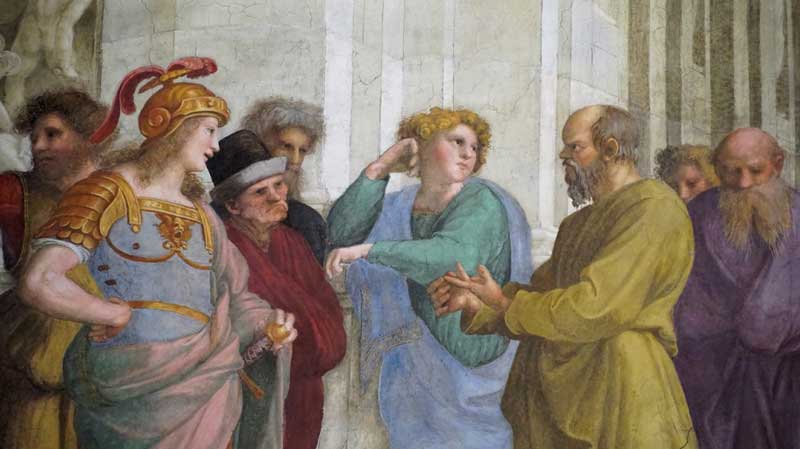
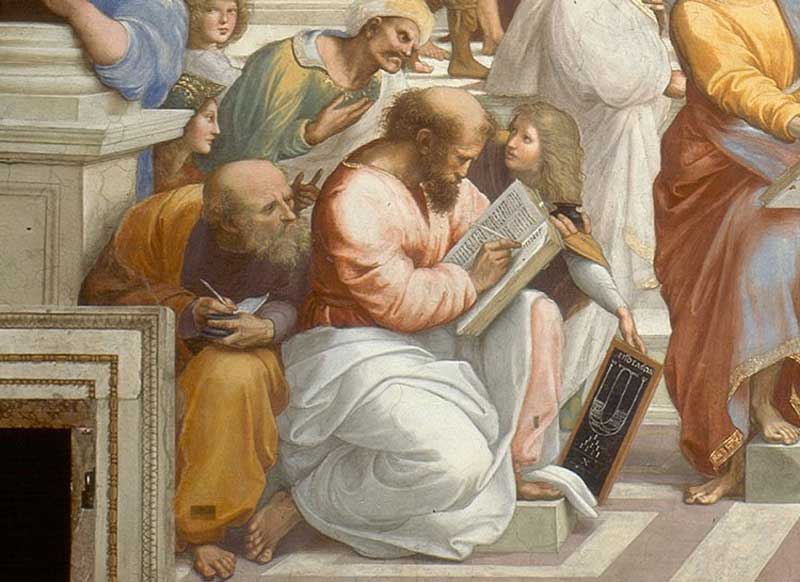
In the fresco, Socrates is depicted standing to the left of Plato, identified by his distinct features and his particular hand gesture, and also by the students surrounding him, which included the generals Alcibiades and Aeschines of Sphettus, while Pythagoras can be seen in the foreground, sitting with a book and an inkwell, also surrounded by students. Interestingly, though Pythagoras is famous for his mathematical and scientific discoveries, he was also a firm believer of metempsychosis, the philosophy which states that every soul is immortal, and upon death, it moves to a new physical body. Euclid, another Greek mathematician, known as the father of geometry, is shown on the other side, bent over demonstrating something with a compass, while his young students seemed to be eagerly trying to grasp the lessons.
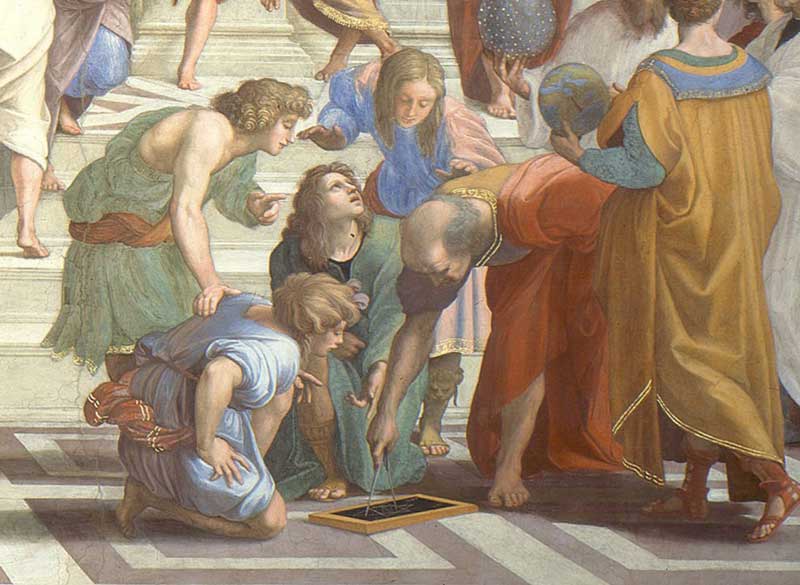

Standing right next to Euclid, wearing a yellow robe and with his back to the viewer, the great mathematician and astronomer Ptolemy is shown holding a terrestrial globe in his hand, and it is considered that the bearded man standing in front of him holding a celestial globe is the astronomer Zoroaster. It may seem strange, but the young man standing next to Zoroaster, peaking out at the viewer, is none other than Raphael himself. However, though it was a bold move for the artist to incorporate his likeness into a work of such intellectual complexity, incorporating this type of self-portrait was not unheard of at the time.
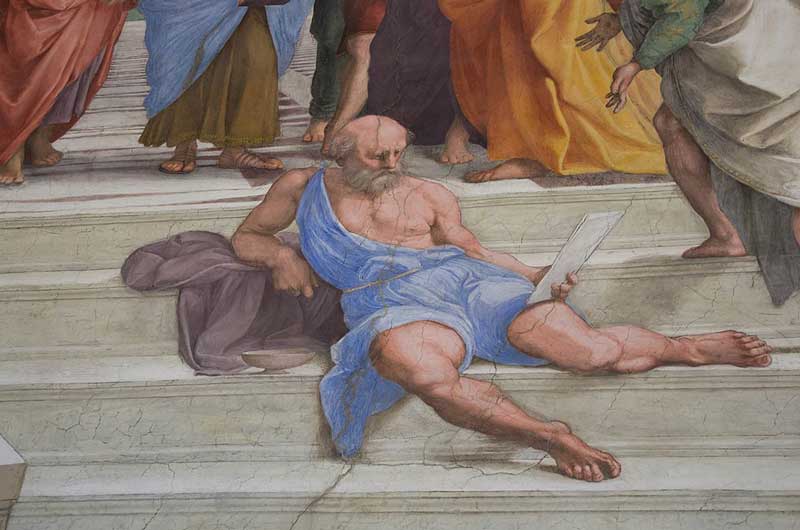
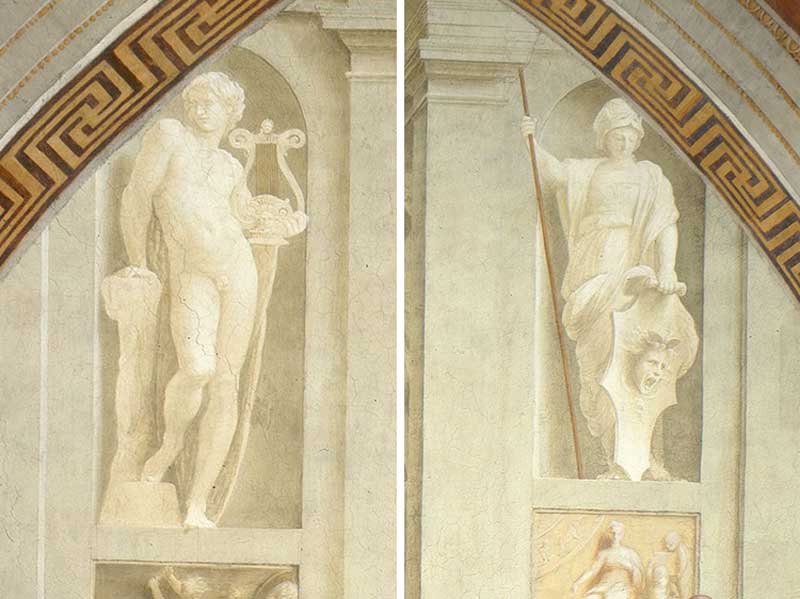
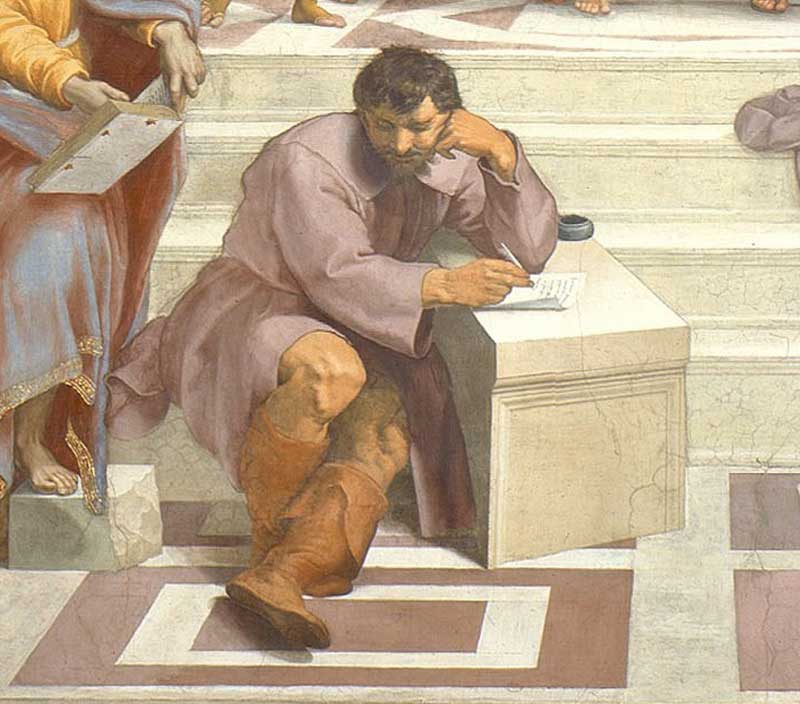
It is generally agreed that the older gentleman sprawled on the steps is Diogenes, a controversial figure in his day, living a simple life and criticizing cultural conventions, and famous as the founder of the Cynic philosophy. However, perhaps the most striking figure in the composition is a brooding man seated in the foreground, hand on his head in the classical position of a thinker. He was not in Raphael’s preliminary drawings and plaster analysis, and was added later. He is Heraclitus, a self-taught pioneer of wisdom in the realm of philosophy, a melancholy character, who did not enjoy the company of others, making him one of the few isolated characters in the fresco. Rounding out Raphael’s program, there are two large statues in niches at the back of the School of Athens, of which the one on the left is Apollo, the god of light, archery and music, holding a lyre, while the statue on the right is Athena, the goddess of wisdom and justice, and an apt representative of the moral philosophy, the Roman equivalent of Minerva.
The School of Athens, the monumental creation of Raphael, measuring 18X25 feet (5.5X7.7 m) that transformed a wall of the Stanza della Segnatura, a council room for the highest judicial authority in the Catholic Church, into a huge canvas, is regarded as one of Raphael's best-known works and has been described as his masterpiece, a perfect embodiment of the classical spirit of the Renaissance. While there are several modern reproductions of the fresco are abundant in many sizes, and a full-size one can be seen in the auditorium of Old Cabell Hall at the University of Virginia, The Victoria and Albert Museum in London has an old rectangular copy, measuring over 13.12 by 24 feet (4 by 8 m) in size, painted on canvas, dated 1755, on display in the eastern Cast Court.