FREE ASSISTANCE FOR THE INQUISITIVE PEOPLE












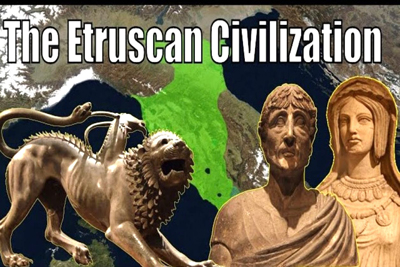
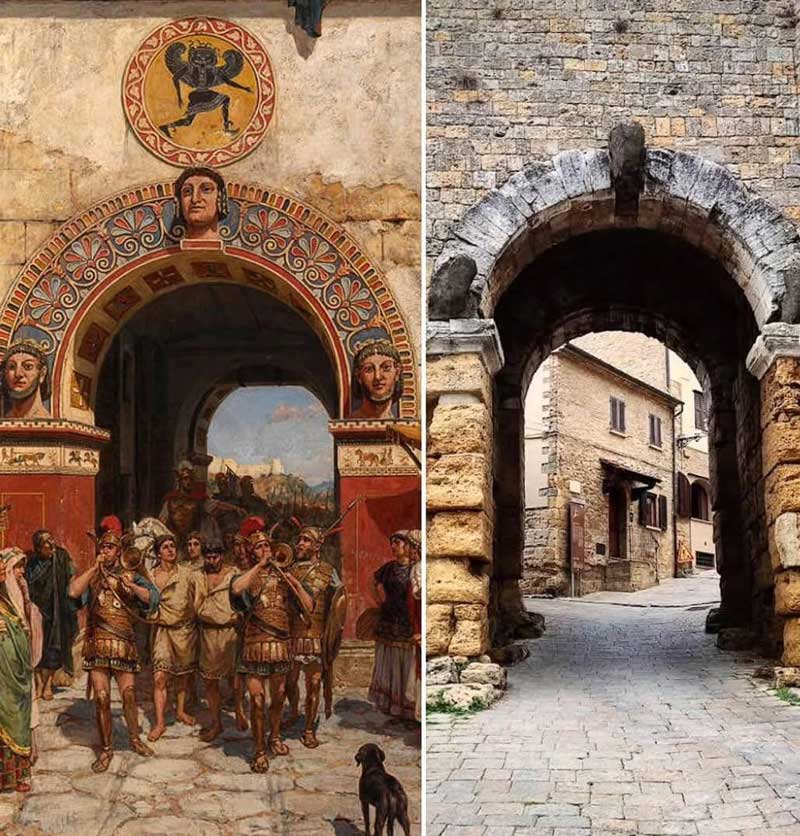
Before the rise of Ancient Rome, which began around 753 BC, the Italian peninsula was dominated by the advanced Etruscan civilization in the north, while Greek colonists occupied the south, known as Magna Graecia. The Etruscan civilization was a sophisticated, independent culture that flourished in central Italy, comprising the modern Tuscany, Umbria, and Lazio, from roughly 900 BC until being absorbed by the Romans by the 3rd century BC, was known for their advanced metallurgy, maritime trade, and distinct art. The Etruscans, a member of an ancient people of Etruria in Italy, located between the Tiber and Arno Rivers in the west and south of the Apennines, formed a confederation of city-states, and significantly influenced early Roman architecture, religion, and urban planning. Nevertheless, although much of its culture and even history was either obliterated or assimilated into that of its conquerors, the Romans, the surviving Etruscan tombs, their wall paintings, and architecture, as well as the Roman adoption of some of their clothing and religious practices, are convincing testament to the great prosperity and significant contribution to Mediterranean culture, whose achievements set the stage for the development of ancient Roman art and culture, as well as for the Italian Renaissance.
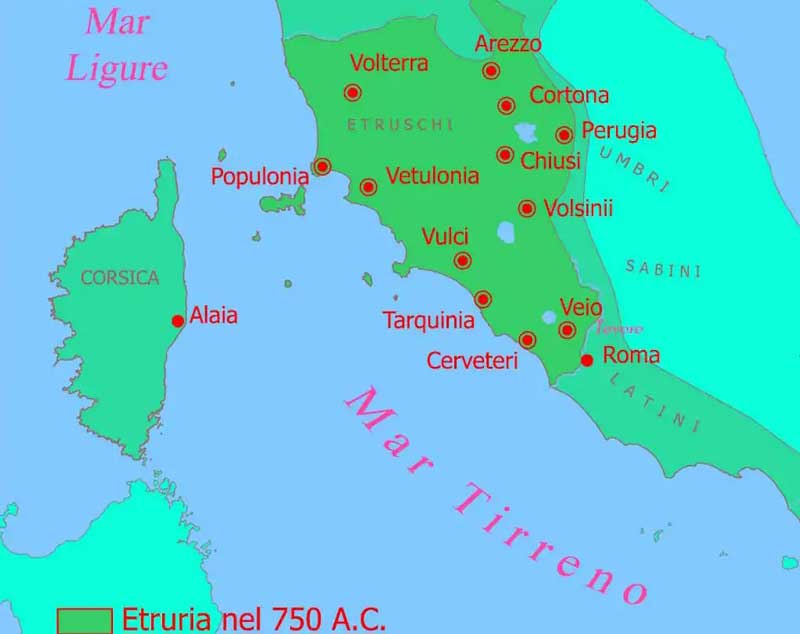
It is considered by many that the term Etruscans comes from the Latin term Etrusci or Tusci, but the origin of the Etruscans has been a subject of debate. It is not clear, whether they are indigenous to central Italy or if they originated from a group of immigrants who first passed through the Greek island of Lemnos before setting in Etruria, which is roughly the modern Tuscany. While Herodotus, the famous Greek historian and geographer from the Greek city of Halicarnassus, opined that the Etruscans descended from a people who invaded Etruria from Anatolia before 800 BC and established themselves over the native Iron Age inhabitants of the region, according to Dionysius of Halicarnassus, the Etruscans were of local Italian origin, and they called themselves Rasenna or Rasna, which probably stands simply for a person. Nevertheless, the Greeks called them Tirreni, named after a mythical leader who fled from Lydia, a region in present-day Turkey, to settle between Tuscany and Lazio, which is the origin of the name of the Tyrrhenian Sea, the part of the Mediterranean that overlooks Tuscany. But there is no archaeological or linguistic evidence of a migration and that the Etruscans were indigenous to Italy has been confirmed by DNA studies.
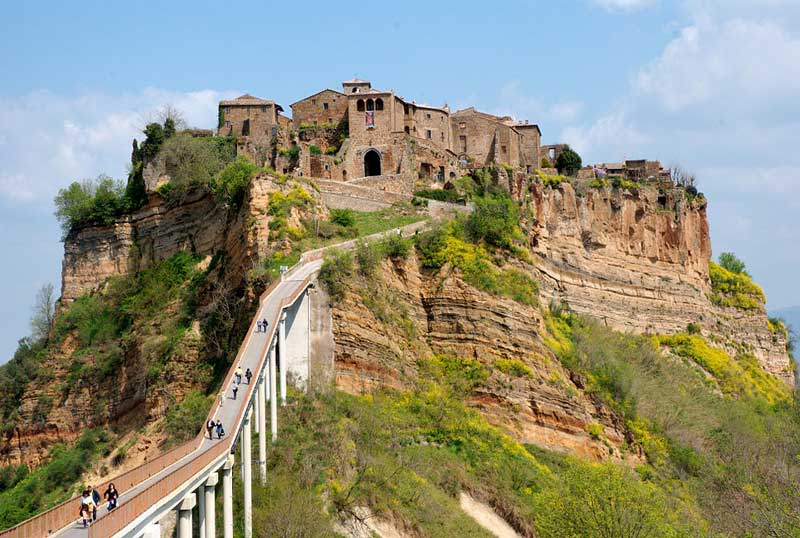
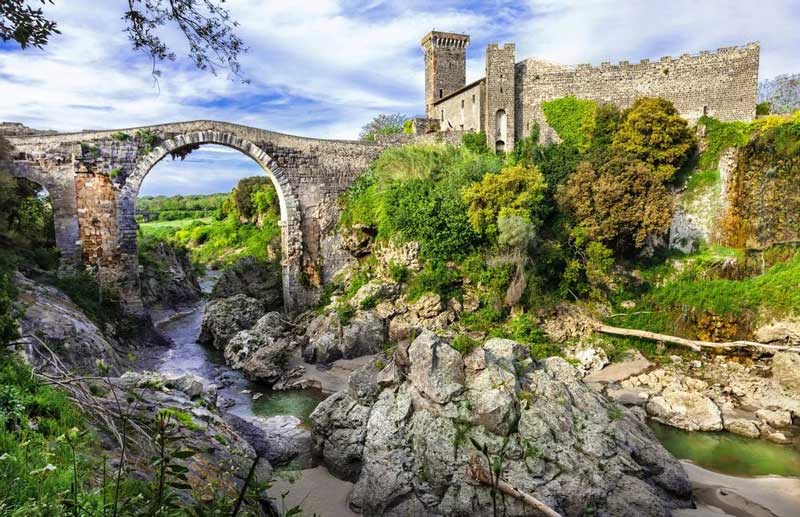
Geographically stretched from the Tiber River in the south to parts of the Po Valley in the north, the independent Etruscan cities were linked to each other only by a common religion, language, and culture. Due to fertile lands and improved agricultural tools, the coastal sites developed more quickly compared to the other adjacent areas, and made contact with the other contemporary cultures, which they eventually imparted to the inland areas. The early government of the Etruscan cities was based on a monarchy but later changed to rule by an oligarchy which ultimately controlled all public offices and dominated the political system. There is clear evidence that Etruscan cities sometimes fought against each other, and the comparatively stronger cities often displaced the populations of smaller ones.
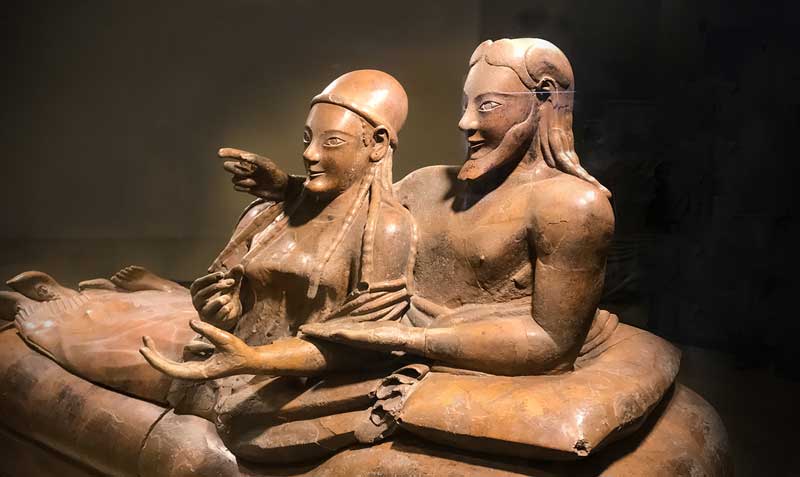
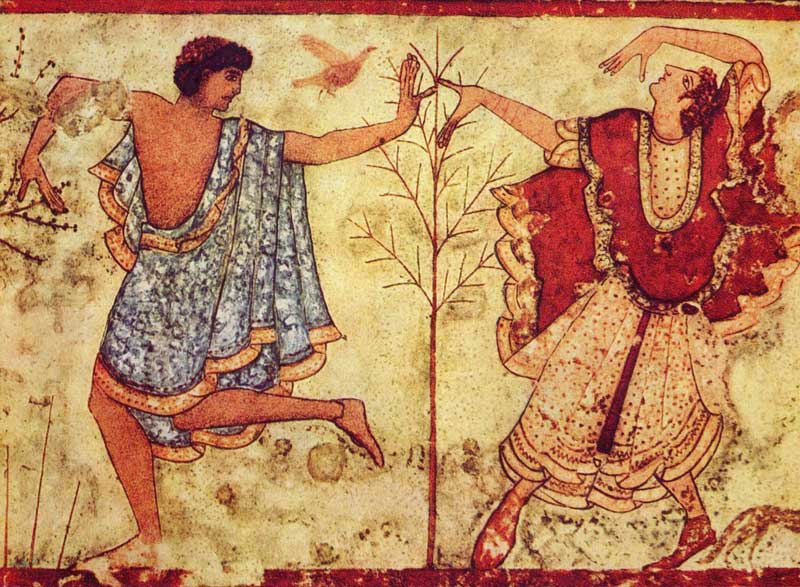
Etruscan society comprised several social statuses, which included foreigners and slaves, women and male citizens. While males of certain clan groups seem to have dominated key roles in the areas of politics, religion and justice, women enjoyed more freedom than in most other ancient cultures, like being able to inherit property in their own right, even though they were not equal to males and were not allowed to participate in public life beyond limited social and religious occasions.
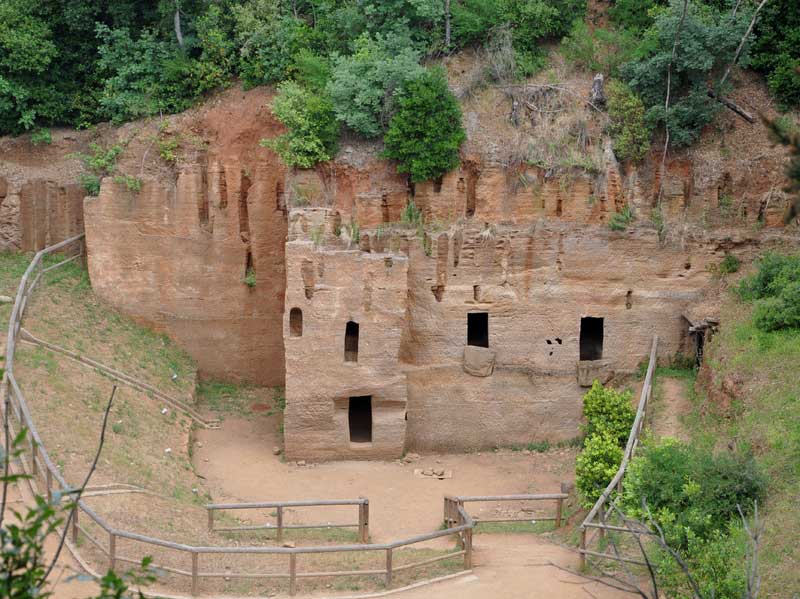
The Etruscans followed a religion that involved worshipping many gods, who were believed to influence or control everyday life. Tin was regarded as the most important god in their religious system, while Veltha, also called Veltune or Voltumna, was closely connected to plants and seems to have been the most significant Etruscan deity. Other gods and goddesses included Thanur, who was associated with childbirth; Aita, the god of the afterlife; Usil, the god of the sun; and the winged female figures known as Vanth, who were thought to carry messages about death. The Etruscans also adopted by renaming many Greek gods and heroes like Hercules, incorporating them into their own religious beliefs. Each Etruscan city had three major temples. Initially, their temples were built with dried mud bricks, wooden sticks, and thatched roofs, but by 600 BC, they had developed into stronger and more impressive structures made of stone, with Tuscan columns supporting them with a base, but without flutes. The Etruscan temples were much alike the design of Greek temples, but unlike Greek temples, only the front porches of Etruscan temples had columns, and the porches were extended further out. Other unique features included a higher base platform, a three-room inner chamber for holding statues of three different gods, a side entrance, and large terracotta decorations on the roof. Notably, two main features of the Etruscan religion were augury, referring to the practice of interpreting omens from birds and weather phenomena like lightning strikes.
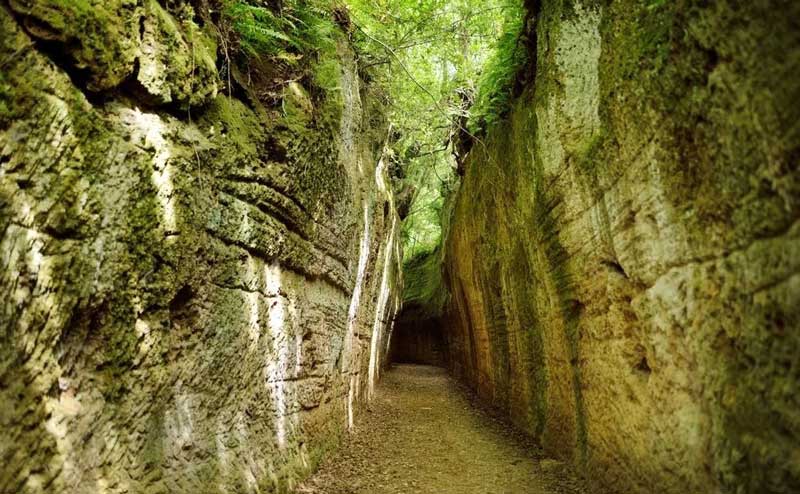
In 474 BCE, the Greeks defeated the Etruscan navy, destroying their maritime power, and concurrently, northern Gallic tribes invaded the Po Valley, disrupting trade and attacking the Etruscan cities. In addition, throughout the 4th and 3rd centuries BC, Rome was engaged in a series of wars against the Etruscan cities, with the last Etruscan city, Volsinii, falling in 264 BC. As Etruria was a loose confederation of 12 independent city-states, rather than a unified nation, they were unable to organize an effective and collective defense against its intruders, and ultimately, following several military defeats, loss of trade dominance, and pressure from Gallic invasions, the Etruscan civilization was gradually absorbed by the expanding Roman Republic between the 4th and 1st centuries BC. As a result, the Etruscans became Romanised, their culture and language giving way to Latin and Latin ways, and their history completely obliterated from the face of the earth. It would take 2,500 years, when after the almost miraculous discovery of Etruscan tombs, stuffed with exquisite artefacts and decorated with vibrant wall paintings, the world realised what had been lost.