FREE ASSISTANCE FOR THE INQUISITIVE PEOPLE












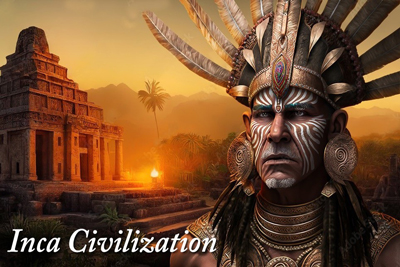
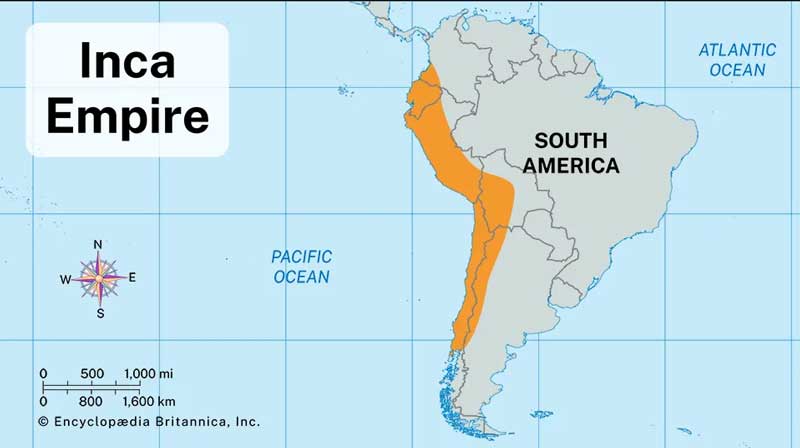
The Inca civilization, originated in the Peruvian highlands around the 13th century and expanded at its height into the vast Inca Empire with its centre at Cusco, located in modern-day Peru, under rulers like Pachacuti in the 15th century, was the largest empire in pre-Columbian America, known as Tahuantin Suyu or the Four Regions. Stretched over an area of 2,500 miles (4,000 km) from modern-day Colombia to Chile, it included several diverse landscapes from mountains to deserts and plains, characterised by its advanced road network, impressive terracing for agriculture, complex irrigation systems, and mountaintop settlements like the famous Machu Picchu. However, the arrival of Spanish Conquistadors, who ventured to the Americas, driven by a relentless quest for wealth, glory, and the spread of Christianity, signalled the decline of the Inca Empire, and finally, during the Inca civil war, a group of Spanish Conquistadors, led by Francisco Pizarro, defeated and captured the emperor Atahualpa in 1532, leading to the rapid decline of the Inca Empire.
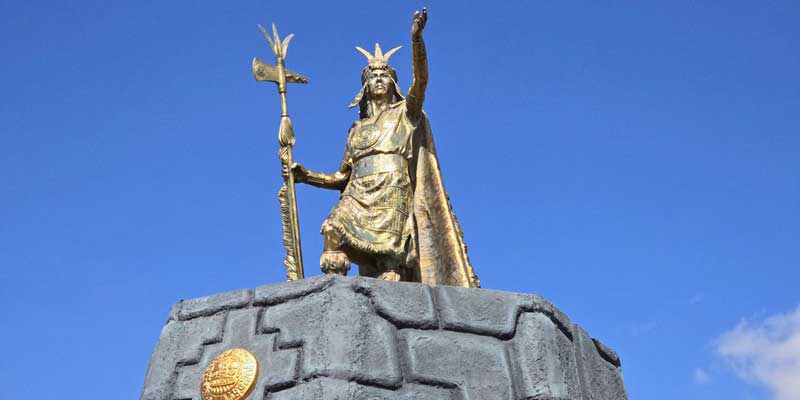
Traditionally, it is believed that the Inca originated in the village of Paqari-tampu, a mythological and geographical location in Inca tradition, located about 15 miles (24 km) south of Cusco, believed to be the birthplace of the Inca people, from where Manco Cápac, also known as Manqo Qhapaq, a central figure in Inca mythology, and the legendary founder of the Inca civilization, led the tribe to settle in Cusco, which eventually became the capital of the Kingdom of Cusco. However, there was little to distinguish the Inca from the many other tribes inhabiting small domains throughout the Andes, till the 14th century, when under Mayta Cápac, the fourth Sapa Inca of the Kingdom of Cusco and a member of the Hurin dynasty, began to expand his Kingdom beyond Cusco, by attacking and looting the villages of neighbouring peoples and probably assessing some sort of tribute. After that, under Capac or Qhapaq Yupanki, the fifth Sapa Inca of the Kingdom of Cusco, as well as the last of the Hurin dynasty, the Inca first extended their influence beyond the Cusco valley, and into the Sacred Valley, also known as Urubamba Valley, a valley in the Andes of Peru, located to the north of the Inca capital of Cusco. Nevertheless, the Incas began a program of permanent conquest by establishing garrisons among the settlements of the peoples whom they had conquered, under the rule of Wiraqocha Inca, the eighth Sapa Inca of the Kingdom of Cusco. During the rule of Topa Inca Yupanqui, the tenth Sapa Inca of the Inca Empire, the Inca Empire reached its southernmost extent in central Chile, but his death was followed by a struggle for succession, from which Wayna Qhapaq emerged successfully as the eleventh Sapa Inca, and pushed the northern boundary of the empire to the Ancasmayo River before dying in an epidemic, which was probably brought by a tribe from the east, infected by the Spanish at La Plata. However, his death set off another struggle for succession, which remained unresolved, till the Spanish arrival in Peru in 1532. Taking advantage of the disturbing conditions of civil war, Spanish conquistador Francisco Pizarro joined hands with the enemies of the Inca emperor, defeated and captured Atahualp, the last Sapa of the Inca Empire, and ultimately executed him in August 1533, marking the beginning of Spanish rule. The remnants of the empire retreated to the remote jungles of Vilcabamba, often called the Lost City of the Incas, which was consequently conquered by the Spanish in 1572.
The Inca people were mostly farmers or herders, looking after alpacas and llamas. Extended families lived together on the same land, and as they lived in the mountains, their homes were made of stone or adobe mud and topped with a roof of dried grass, and often had to build terraces, or flat areas cut into the hillside, to plant their crops. They made their own clothing and blankets from the wool of their herds of alpaca and llama, and also produced ceramics and metal sculptures, which were technically superior to any other previous Andean culture. The most common shape of their ceramics was the Urpu or Aryballos, a bulbous vessel with a long neck and two small handles low on the pot, which was mainly used for the production of Chicha, a local beverage. However, Inca artworks, created in their own distinctive style which was an instantly recognizable symbol of imperial dominance across the empire, is best seen in highly polished metalwork in gold, which was considered the sweat of the sun, and silver, considered the tears of the moon, and also copper.
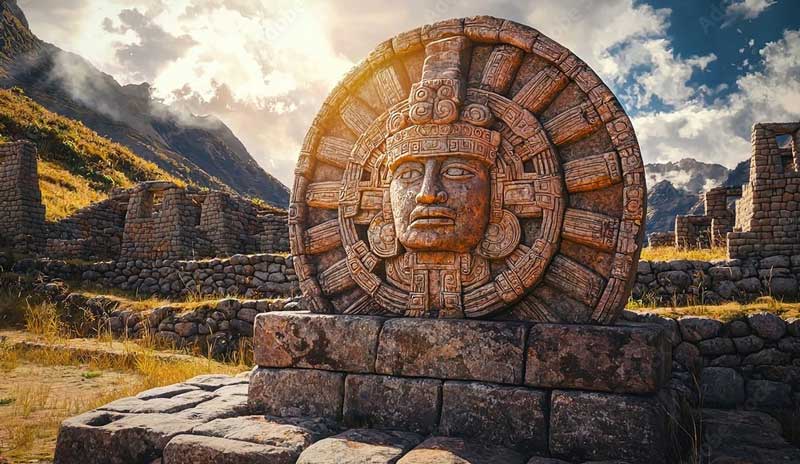
The Incas were polytheist, and they worshipped multiple gods, often linked to natural forces like the sun, rain, and earthquakes, and their key deities included Inti, the sun god, Viracocha, the creator god, and Pachamama, the earth. The other important Inca gods included Mama Killa, the moon goddess; Illapa, the god of thunder, and Mama Cocha, the goddess of the sea. According to their Cosmological Trilogy, the universe comprises three interconnected realms, which include Hanan Pacha or the upper world, the celestial realm, the abode of the gods, Kay Pacha, the earthly world of humans and animals, and Uku Pacha, the underworld of the dead.
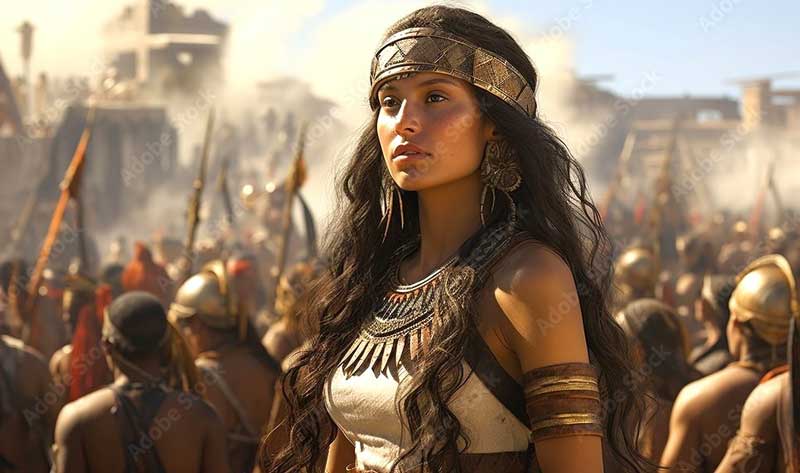
The Inca society, based on religion, was a rigid and highly organised hierarchical system with the emperor, the Sapa Inca at the top, considered a son of the sun god Inti, the most important deity after the creator god Viracocha, the supreme creator god of the cosmos, the sun, moon, stars, and all living things, followed by nobles, priests, artisans, and commoners like farmers and labourers. The Sapa Inca was an absolute ruler, who lived a life of great opulence, was even looked after following his death, as the Inca mummified their rulers, and stored it in the Coricancha temple in Cusco, dedicated to the sun god Inti. In the Inca hierarchical society, the Sapa Inca or the emperor was followed by the privileged noble class, who spoke in the Inca language, Quechua or Runasimi, and dominated all the important roles within the empire. Their culture, based on the worship of nature, with the sun god Inti on the top, was deeply religious, which also involved ancestor worship as seen through the practice of mummification and making offerings to the gods of food, drink, and precious materials, even sacrifices, which included both animals and humans, including children. Their culture also brought certain benefits like terraced farming, better storage facilities for foodstuffs, food redistribution in times of environmental disaster, state-sponsored religious feasts, complex engineering feats like extensive road systems, and a unique economy based on reciprocity and labour taxes. The Incas created a unified empire by imposing their language, religion, and standardised artistic style on conquered peoples, and extracted tribute, even moved loyal populations, known as Mitmaqs, to better integrate new territories into the empire.
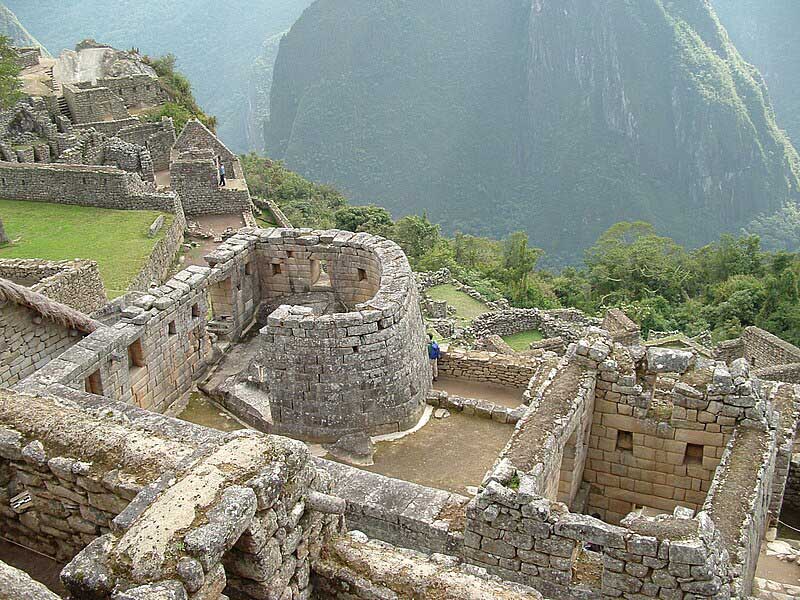
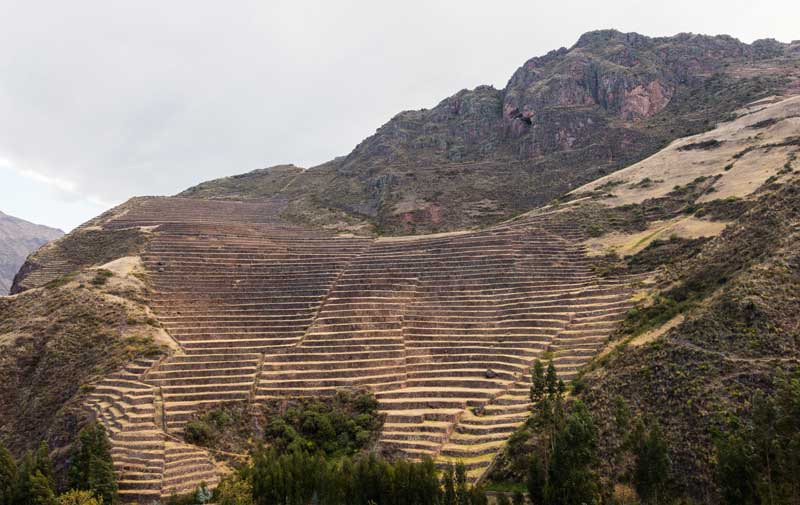
The Incas constructed large buildings, both regular and polygonal, walls and fortifications using finely-worked blocks, precisely fitted together without any mortar, incorporating natural features, so that they could withstand the powerful earthquakes which frequently hit the region. Apart from the gold-covered and emerald-studded Coricancha complex of the temple of the Sun, the Capital City of Cusco contained several other splendid temples, dedicated to Inti and Mama Kilya. Machu Picchu, a 15th-century Inca citadel, often referred to as the Lost City of the Incas, believed to have served as an estate for the Inca emperor Pachacuti, the ninth Sapa Inca, and renowned for its sophisticated dry-stone construction, agricultural terraces and containing the Temple of the Sun, the Temple of the Three Windows, and the Intihuatana ritual stone, associated with the astronomical clock or calendar of the Inca, is a testament to Inca engineering, featuring astronomical alignments, unique building techniques.
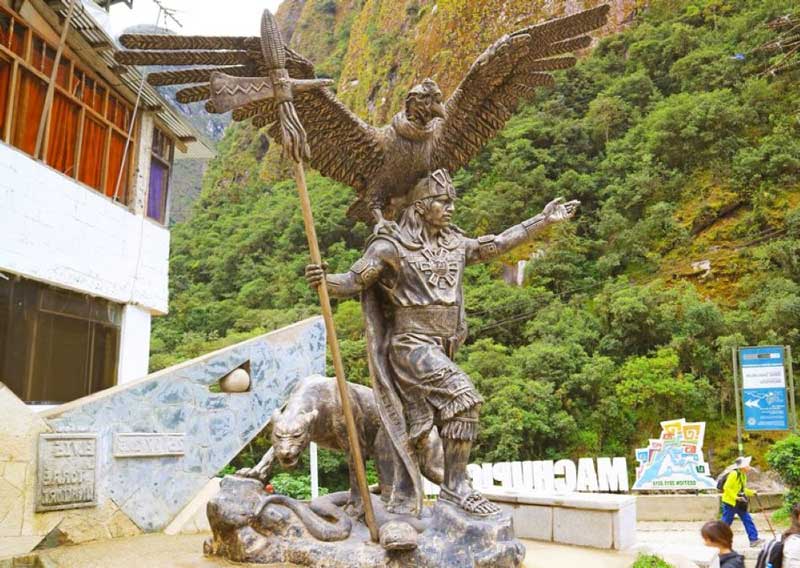
However, the Inca Empire was founded on, and maintained by savage force, which very often made the ruling Incas unpopular among the commoners, especially in the northern territories. It had still not reached a stage of consolidated maturity when it faced its greatest challenge of the civil war and the challenge by the Spanish invaders. In addition to that, the Incas were hit by an epidemic of European diseases like smallpox, which had spread even faster than the European invaders themselves, killing a staggering 65–90% of the population, along with Wayna Qhapaq, the eleventh Sapa Inca, while his sons, Waskar and Atahualpa battled in a damaging civil war for control of the empire, and at the same time, the European treasure-hunters arrived at the door. It was thus a combination of several factors, a perfect combination of storm of rebellion, disease, and invasion, that brought the downfall of the mighty Inca Empire, the largest and richest ever seen in the Americas.