FREE ASSISTANCE FOR THE INQUISITIVE PEOPLE















Regarded as one of the three earliest civilizations of the world, along with those of Mesopotamia, watered by the Euphrates and the Tigris, and ancient Egypt along the Nile, The Indus Valley Civilization, regularly flushed by the water of River Indus, was the most widespread of the three. Spanning a huge area which included much of Pakistan, northeast Afghanistan and northwest India, it evolved from the villages with irrigated agriculture and farming, supplemented by commerce, as well as by domesticating animals. It is presumed to be first developed as early as 7000 BC in a settlement called Mehrgarh, located in the foothills of the Bolan Pass in modern-day Balochistan in western Pakistan. However, The Indus Valley Civilization is also known as Harappa and Mohenjo-Daro Civilization, as it was first accidentally excavated at Harappa by the Railway workers of British India connecting the cities of Lahore and Karachi in 1921, and then in 1922 at Mohenjo-Daro, located in the Punjab and Sind provinces of Present-day Pakistan. It is considered that both the cities once had populations of between 40,000 and 50,000 people, which is stunning, because most ancient cities had an average of around 10,000 people living in them. The civilization flourished both in the alluvial plain, created by the deposition of sediment of Indus, as well as along a perennial system of monsoon-fed seasonal rivers like the Ghaggar-Hakra River, flowing through northwest India and eastern Pakistan.
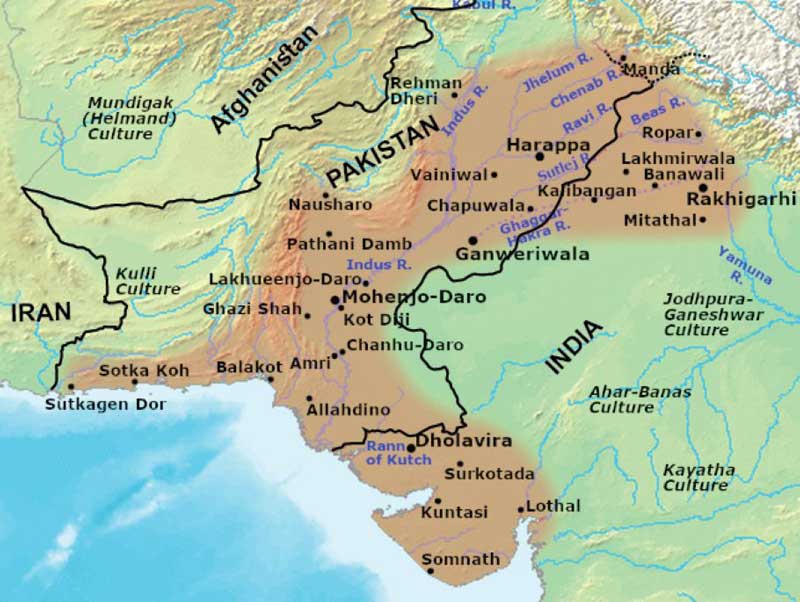
The discovery of ancient Harappan cities unsettled the earlier school of thought that the Indian civilization had begun in the Ganges valley as Aryan immigrants from Persia and central Asia populated the region around 1250 BC, and moved the timeline another 1500 years back. The area covered by the civilization stretched for more than 900 miles (1,500 km) along the banks of the Indus River and then in all other directions, remnants of which were found at Sutkagen Dor, in southwestern Balochistan, about 480 km west of Karachi, at Ropar or Rupar, also known as Rupnangar, in the Indian state of Punjab, located at the foot of the Shimla Hills, often referred to as the City of Seven Hills, some 1,000 miles (1,600 km) northeast of Sutkagen Dor, and even southward down the west coast of India, as far as the Gulf of Khambhat, also known as the Gulf of Cambay, which is 500 miles (800 km) southeast of Karachi, and as far east as the Yamuna River basin, also known as the Jumna River basin, located 30 miles (50 km) north of Delhi, spanning a total area of about 366,223 sq km.
The historians have separated the Indus Valley Civilization into three distinct phases, namely the Early Harappan Phase from 3300 to 2600 BC, the Mature Harappan Phase from 2600 to 1900 BC, and lastly, the Late Harappan Phase from 1900 to 1300 BC. Apart from agricultural development, domestication of animals, and creation of tools, the Early Harappan period evidences construction of warehouses near waterways, and firm establishment trade relationship with Egypt and Mesopotamia. However, large scale urbanisation took place during the Mature Harappan Phase when both Harappa and Mohenjo-Daro were flourished, along with Ganeriwala, Lothal, Dholavira, and many more, which were built according to the same models. However, the Late Harappan Phase is the declining period of the Indus Valley Civilization, evidencing loss of trade relations with Egypt and Mesopotamia, climatic change causing disastrous flooding, drought, and famine, and the consequent mass migration.

Among more than a thousand of the Mature Harappan sites, nearly a hundred are excavated, out of which five are major urban centres include Mohenjo-Daro in the lower Indus Valley, declared as a UNESCO World Heritage Site in 1980; Harappa in western Punjab. The other three important sites are, Ganweriwala in the Cholistan Desert, locally known as Rohi in southern Punjab, Dholavira in western Gujrat, which is the most prominent archaeological sites in India, declared a UNESCO World Heritage Site in 2021 as Dholavira: A Harappan City, and Rakhigarhi or Rakhi Garhi, a village in Haryana, located in the Ghaggar River plain. Interestingly, during its height, the civilization extended from Balochistan province of Pakistan in the west to western Uttar Pradesh of India in the east, as well as from northeastern Afghanistan in the north to Gujrat state of India in the south.
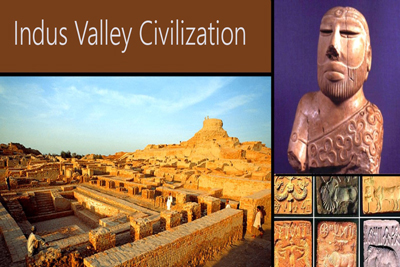
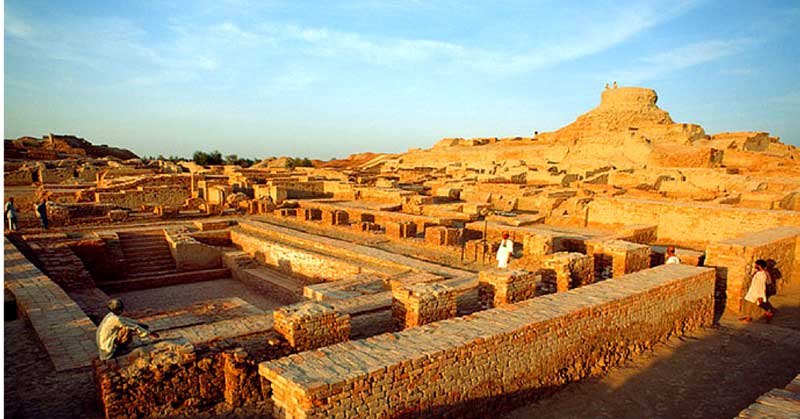
It is confirmed by the researchers that the innovative people of the Indus people were the first to use the complex multi-cropping strategies throughout the year, growing rice, millet, and beans during the summer, and wheat, barley, and pulses in winter, which required separate sorting management. They also developed the wheel, carts drawn by cattle, flat-bottomed boats to transport trade goods. Their irrigation systems included construction of artificial reservoirs and early canal systems. In addition, they also built the world’s first tide port at the head of the Gulf of Cambay in Lothal, Gujarat, which is a testimony of their engineering skill and high level of knowledge about the flow of water, as well as the flow of tides. The Indus cities are noted for their urban planning, complete with elaborate drainage systems, water supply systems, baked brick houses, systematically built in rows on both sides of the road, and clusters of large, public buildings, like granaries. Mohenjo-Daro also had a great public bath, surrounded by a courtyard, with steps leading down into it. Harappa, spread over 150 hectares, was a fortified city, believed to have around 23,500 residents living in sculpted houses with flat roofs made of red sand and clay, and had fortified administrative, religious centres and citadels of the same type used in Mohenjo-Daro.
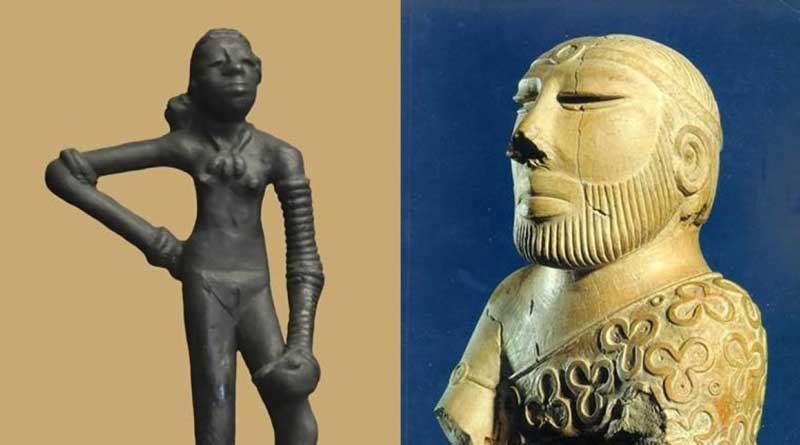
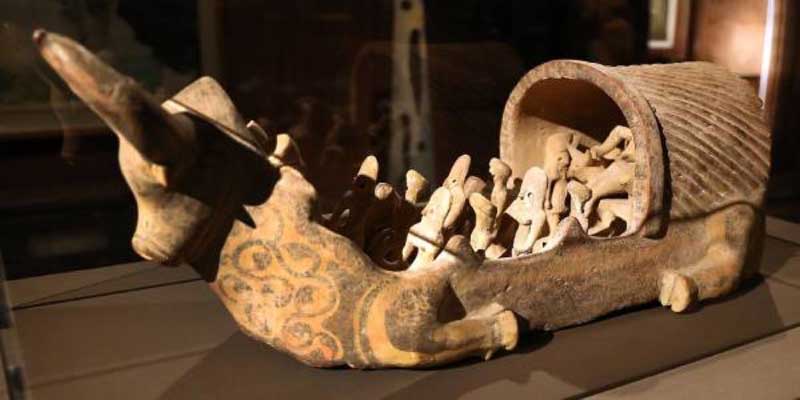
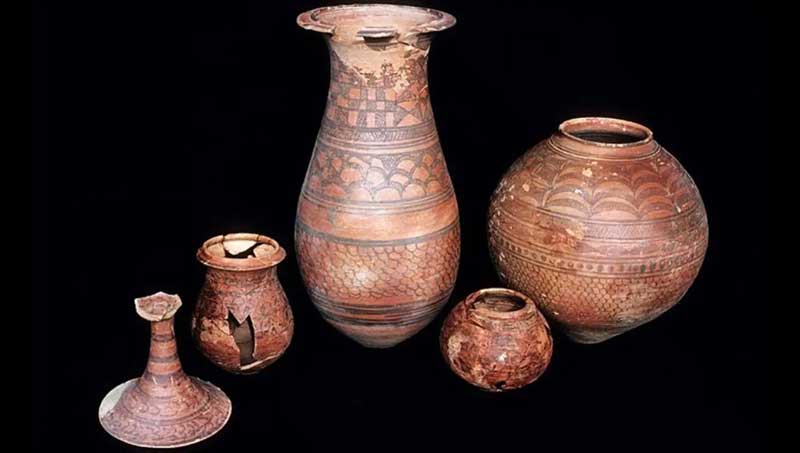
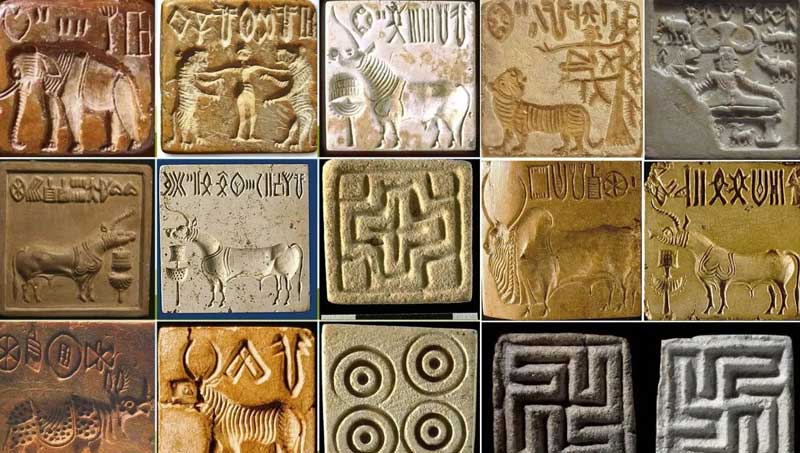
The people of the Indus Valley civilization had a good knowledge of metallurgy, and mainly used copper and bronze for making tools, utensils and weapons, like flat oblong axes and knives, spears and arrowheads, which were created by hammering sheets of metal. Lead was occasionally for making small vases and such objects like plumb bobs, a tool used to establish a vertical line. Other metals used were gold and silver, although gold was generally reserved for small ornamental items like beads, pendants, necklaces, bangles, and brooches. Excavations of Indus cities have produced much evidence of their artistic activity, which include sculptures, seals, pottery, gold jewellery, and anatomically detailed figurines in terracotta, bronze, and soapstone. The most famous artwork is the Dancing Girl, the 4 inches (10 cm) tall bronze standing statuette of a teenage girl, right hand on her hip, left on her knee, with chin raised, found at Mohenjo-Daro in 1926 AD. Another imposing piece is the 6 inches (17 cm) tall soapstone figure of a bearded man, wearing a headdress and ornamental armband, known as the Priest-King. However, perhaps the best-known artefacts of the Indus civilization are the small seals with various images, majority of which display a humpless unicorn or bull in profile, while others show the Indian humped bull, elephant, bison, tiger or rhinoceros. The seals also have markings which have been interpreted as Indus Script, a language consisting of symbols, which is yet to be deciphered. Their terracotta works also included cows, bears, monkeys, and dogs. Interestingly, the people of the Indus civilization were among the first to develop a system of equal weights and measures.
It is evident that the Indus Valley Civilization began to decline around 1800 BC, when according to Archaeological evidences, trade with Mesopotamia, located largely in modern Iraq, seemed to have ended. However, scholars are not sure about the factors responsible for its decline. Although theories about Aryan invasions have been proposed, most scholars believe that it was a gradual process caused by a combination of several environmental, economic, and social factors, and the consequent migration. It is believed by many that the collapse was mainly caused by climate change due to the drying of the Gaggar-Hakra River, which is identified with the Saraswati River that began around 1900 BC, and forced a major relocation of the people who had depended on it. However, it is also argued that critical silting at several sites like Mohenjo-Daro, resulting major floods, could be another good reason for the decline. Nevertheless, by around 1700 BC, most of the Indus Valley Civilization cities had been abandoned to become ghost cities.