FREE ASSISTANCE FOR THE INQUISITIVE PEOPLE













Located 490 feet (150 m) southwest of Hagia Sophia on the historical peninsula of Saraybumu, the Basilica Cistern, or Cisterna Basilica, known as Yerebatan Sarnıcı or Yerebatan Sarayı in the Turkish language, which means Sunken Palace, is the largest of several hundred ancient cisterns that lie beneath the city of Istanbul, in Turkey, built in the 6th century during the reign of the Byzantine emperor Justinian, and the only remaining structure of an important complex of buildings in the vicinity during Late Antique Constantinople. The cistern was named after the Basilica, often known as the Basilica Stoa or the Basilica of Illus that once located above it, built during the Early Roman Age between the 3rd and 4th centuries as a commercial, legal and artistic centre.
The Basilica was destroyed by a disastrous fire in 476, after which it was rebuilt probably by Illus, a prominent and powerful Byzantine general and statesman who served under Emperor Zeno during the late 5th century. Unfortunately, it was burnt again in the Nika Riot of 532, a week of rebellion sparked by chariot racing factions, during the reign of Justinian. However, the basilica was rebuilt again by the Urban Prefect Longinus, one of the highest-ranking civil officials in the ancient Roman and Byzantine Empires, by 542, during which time the Basilica Cistern was built underneath the Basilica. Construction of the cistern probably began between 527 and 528 and in all probability, it started functioning years before the Basilica was finished in 541.
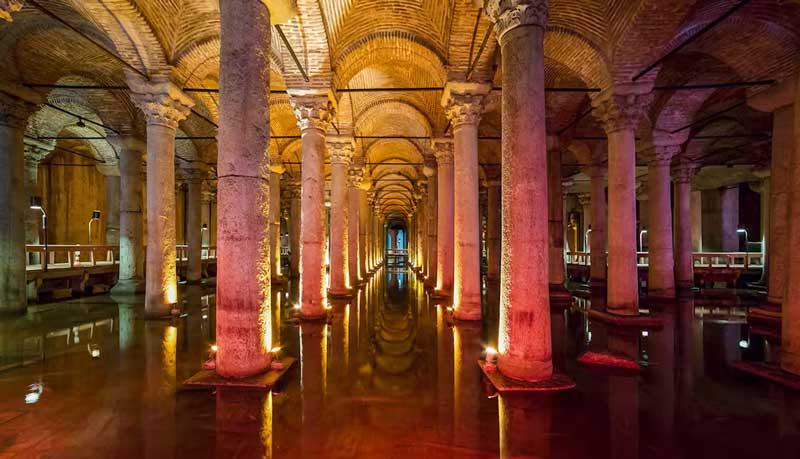
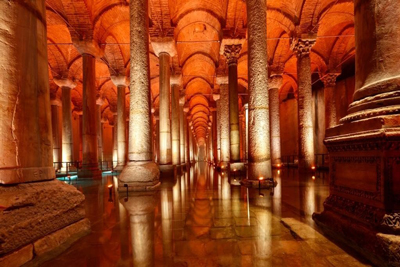
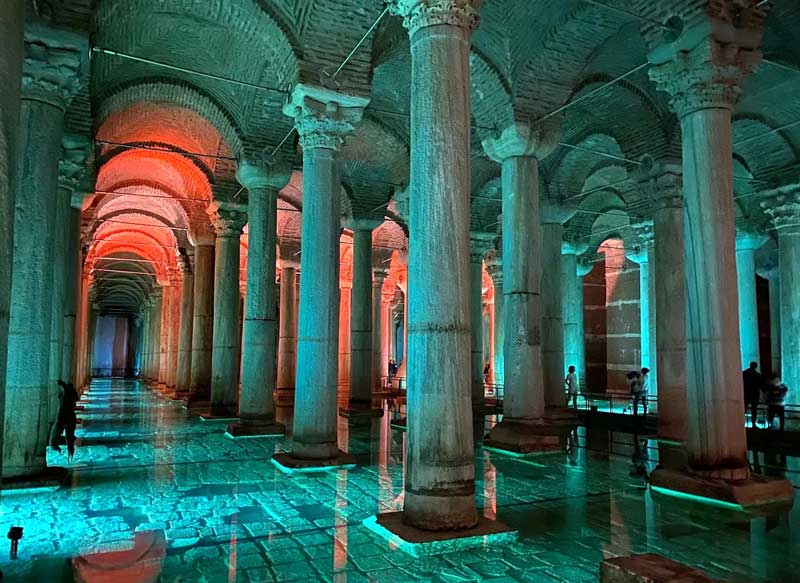
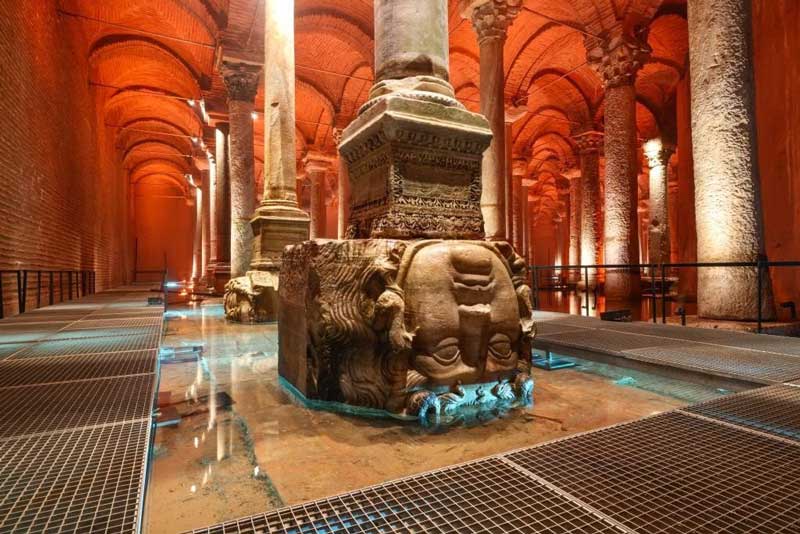
The cathedral-sized Basilica Cistern is a huge underground chamber, measuring 453 feet by 213 feet (138 m by 65 m), and covering around 105,000 square feet (9,800 sq m), with the capacity of holding almost 2,800,000 cubic feet (80,000 cu m) of water, consisting of bricks arranged in concentric squares up to its crown, supported by a forest of 336 marble columns. The columns, each with a height of 30 feet (9 m), are arranged in 12 rows of 28 columns each, spaced 16 feet (5 m) apart. Although the capitals of most of the columns are of the Ionic and Corinthian style, there are a few exceptions of Doric capitals with no engravings. However, the majority of the columns in the cistern appear to have been recycled from the ruins of older buildings, likely brought to Constantinople from various parts of the empire. The most notable examples of reused materials are the two columns decorated with Medusa heads, one is oriented sideways, while the other is completely inverted. There is also the so-called peacock-eyed column, decorated with knots of a tree, which resembles the 4th century Triumphal Arch of Theodosius, erected in the Forum Tauri Square, which is today’s Beyazit Square, officially named Hürriyet Meydanı or Freedom Square. Fifty-two stone steps lead to the underground cistern, surrounded by a 13-feet (4 m) thick wall, made of fire bricks and coated with a waterproofing mortar.
The water of Basilica Cistern came from the Eğrikapı Water Distribution Centre, located 12 miles (19 km) north of the city, and was carried through the 3186 feet (971 m) long Aqueduct of Valens, Aqueduct of Hadrian, and the original 377 feet (115 m) Mağlova Aqueduct, which was built by the Emperor Justinian. Procopius of Caesarea, a prominent Byzantine Greek scholar and historian, indicated that the cistern was built to store water for the dry summer seasons of the region, serving function similar to Binbirdirek Cistern, which was also fed by the Aqueduct of Valens. However, it is unclear whether the cistern provided water to the general public in the surrounding area or only to the palace complex. As there was already a large open-air cisterns, it is likely that the newly constructed Basilica Cistern provided cleaner water than the older open-air cistern.
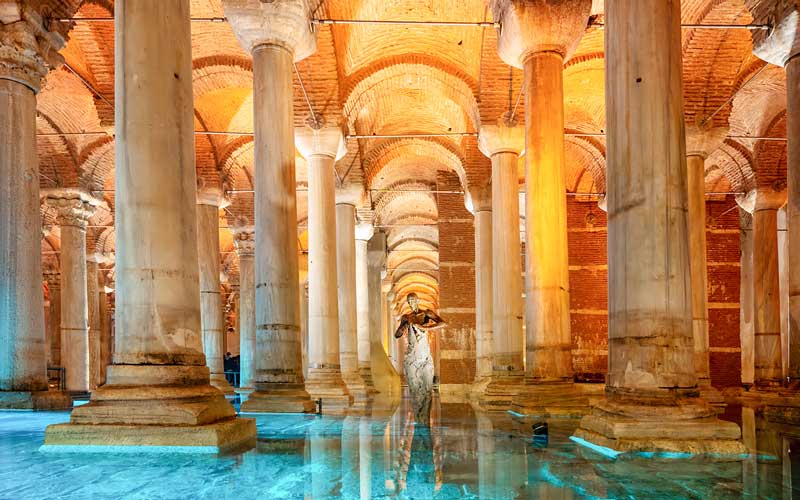
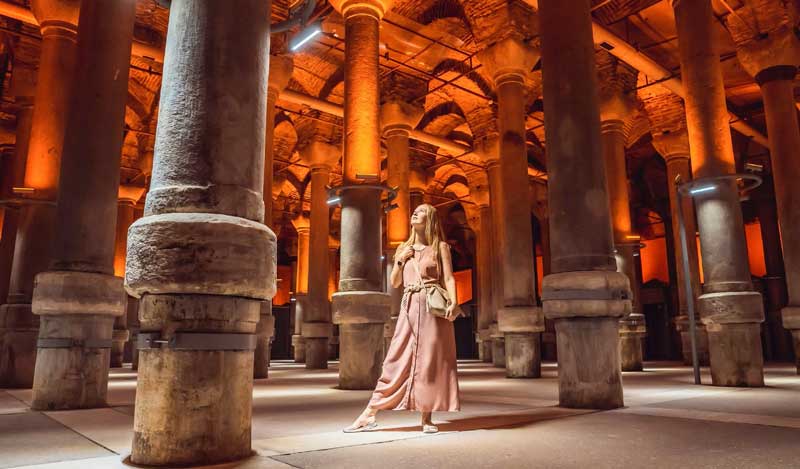
Since its construction, Basilica Cistern has been repaired and restored several times, the first of which was carried out in 1723, by Muhammad Ağa of Kayseri, a prominent Ottoman architect of the 18th century, during the reign of the Ottoman Sultan Ahmed III, while the second major repair was completed during the 19th century reign of Sultan Abdulhamid II, the 34th sultan of the Ottoman Empire. During the modern period, cracks in the masonry and damaged columns were repaired in 1968, with additional restoration in 1985 by the Istanbul Metropolitan Museum. During the 1985 restoration, 50,000 tons of mud deposits were removed from the cistern, and platforms were erected to replace the boats previously used for touring the cistern. The cistern was opened to the public on 9 September 1987, but underwent additional cleaning In May 1994. Subsequently, it was closed again in 2027, for restoration and earthquake-proofing, reopening to the public in 2022.
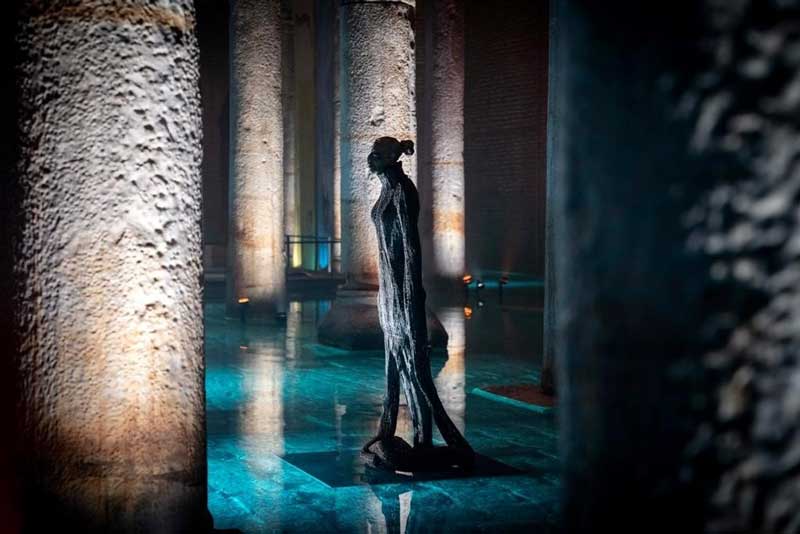
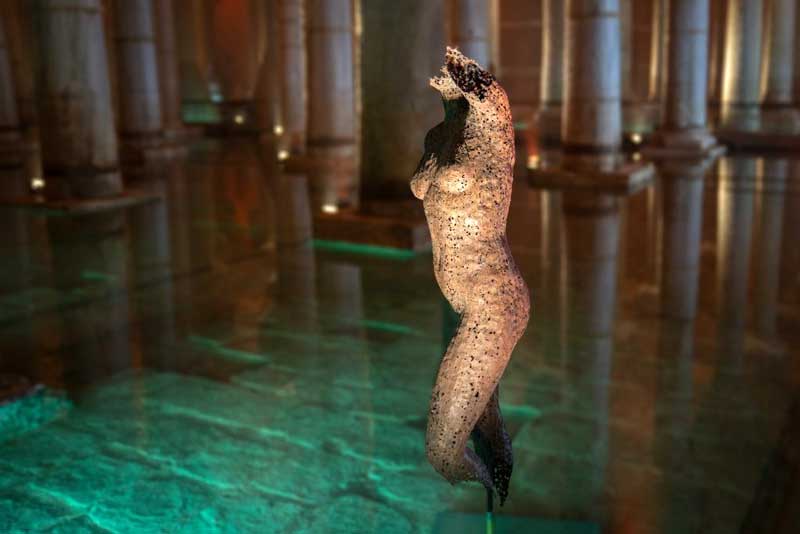
Recently, Basilica Cistern has become more popular for featuring a permanent, non-invasive contemporary art installation, titled Daha Derine or Deeper Beneath, a multisensory and digital art exhibition layers modern installations, featuring a 360-degree projection mapping, rotating and glowing the suspended sculptures that merge ancient Byzantine architecture with modern light and video art. All artworks are mounted on reversible infrastructure to protect the historic site, while mood lighting highlights the famous Medusa heads and the ancient forest of columns. The exhibition also showcases works of renowned contemporary and multidisciplinary visual artists like American digital artist Jennifer Steinkamp, along with works of several Turkish sculptors and artists known for creating unique, mixed-media installations, which include Ali Abayoğlu, Aslı İrhan, Ozan Ünal, Yasemin Aslan Bakiri, Berkay Buğdan, Malik Bulut, and many more.