FREE ASSISTANCE FOR THE INQUISITIVE PEOPLE













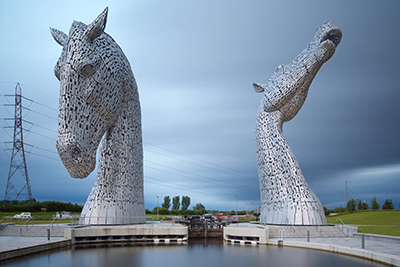
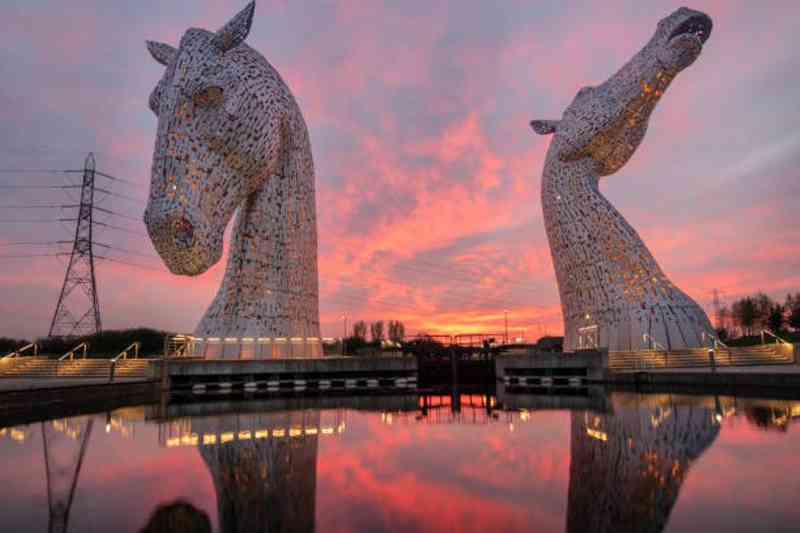
Located in the heart of Helix Park, in the Scottish town of Falkirk, looming at an impressive height of around 98 feet (30 m) above the Forth and Clyde Canal and forming a dramatic gateway to the canal entrance on the East Coast of Scotland, the titanic heads of two water horses or Kelpies, the first bowed in a submissive, calm gesture, while the second with muzzle pointed to the sky, is an iconic monument of the city. The unusual monument, depicting the heads of the Kelpies, is a tribute both to Celtic mythology, and to the horse-powered heritage across Central Scotland, representing the linage of the strong and big horses which once used to pull passenger boats, as well as cargo along the towpaths of the Forth & Clyde and Union Canals in their heydays.
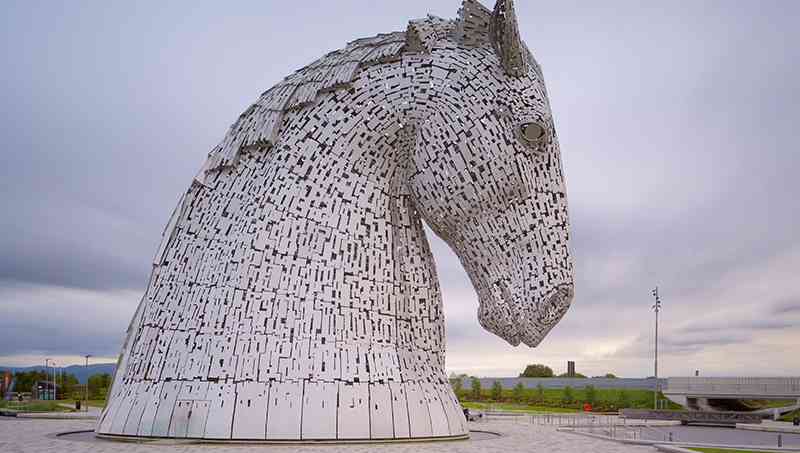
It is generally maintained by scholars that the word Kelpie is strongly associated with the Scottish Gaelic language and most probably originated from the words cailpeach or colpach, which stands for heifer or colt, referring to the mythical tale of a shape-shifting water spirit, which generally take the form of a horse and haunt rivers and streams. In the Celtic folklore the kelpie is also depicted as a malevolent aquatic spirit which often appears as a tame pony beside a river, particularly attractive to children. But once it takes a child on its back, its sticky magical hide will not allow the child to dismount, and the kelpie carries the kid, trapped on its back, into the depth of the river to devour as food. As if that is not enough, the Kelpies also had the ability to take human form and could appear as an alluring woman to seduce young men to their death, or could take the form of a ghastly-looking hairy human lurking by the river, ready to jump out at unsuspecting travellers and crush them to death in an iron-tight grasp.
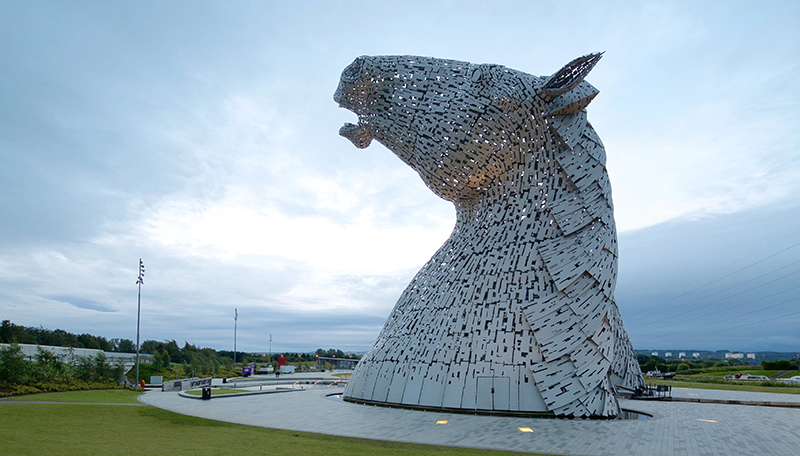
Andy Scott, the Scottish artist responsible for creating the huge art piece, modelled the heads of the two Kelpies after two real-life Clydesdale horses named Duke and Baron, and positioned them on either side of a specially constructed lock and basin, part of the redeveloped Kelpies Hub. However, before starting the actual project, Andy Scott created a 10 feet (3 m) high miniature version of the original in 2008, in his Glasgow studio, which was scanned by laser to help the steel fabricators create accurate full-scale components. Finally, construction of the Kelpies began in June 2013 and was complete by October 2013, followed by a gala opening celebration in November 2013.
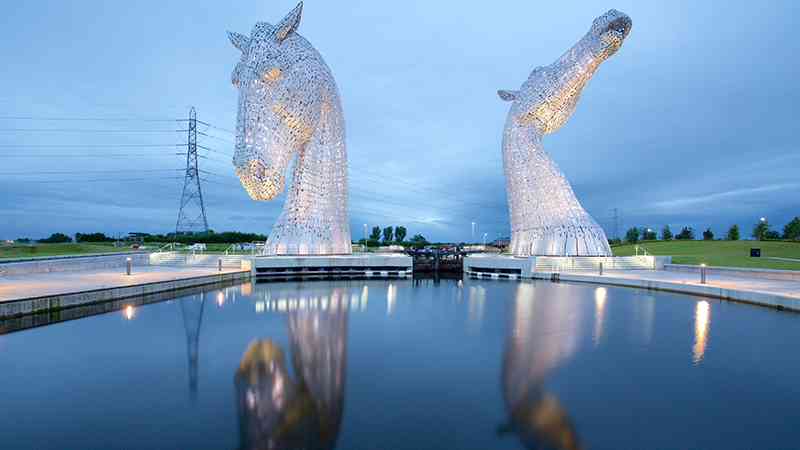
The massive monument is made of structural steel with a stainless steel outer layer, while each horse's head, weighing 330 tons, is constructed from 464 separate steel pieces that are arranged overlapping to one another, to create the impression of horsehair. The steel plates are perforated and hollow inside, and red lights emitting form the inside in the evening, give them a horrific, eerie and demonic look. Visitors can approach the large metal horses and even walk inside one of them.
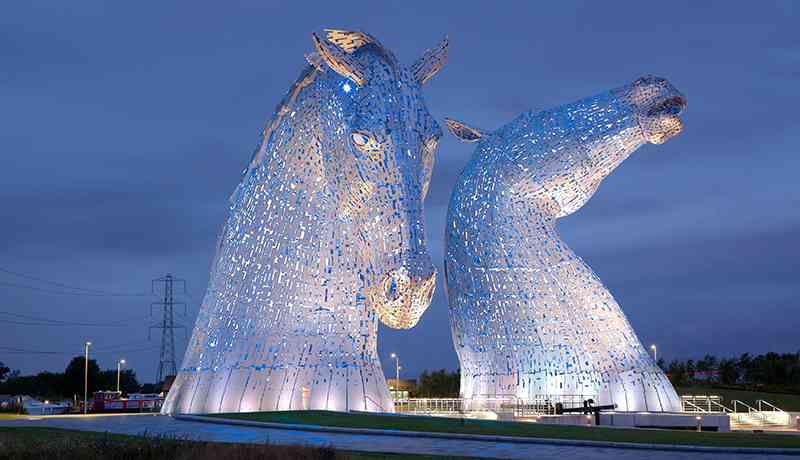
Helix Parkland, containing the Kelpies, is complete with a Visitor Centre which includes a café, gift shop and exhibition space, an adventure Play Park, splash play fountains, lagoon and miles of cycle paths. Facilities for paddling out onto the park’s lagoon on a pedal-boat, canoeing and kayaking are also available during local school holiday months, along with a play area with fountains and water jets, much to the delight of the visitors.