FREE ASSISTANCE FOR THE INQUISITIVE PEOPLE










Born on 22 October 1844, Sarah Bernhardt was the world’s first global superstar, revered as The Divine Sarah, and was renowned for her dramatic, boundary-pushing life, as well as an accomplished sculptor who created dark, theatrical works, including a famous self-portrait as a sphinx, and actively courted scandals to fuel her legendary persona. Although born Henriette Rosine Bernar, she took the name Sarah Bernhardt for her acting career, perhaps to celebrate her Jewish heritage at a time of rising antisemitism in France. She refused to conform to Victorian beauty standards, openly wore men's trousers, and made theatrical history playing male roles, including Shakespeare's Hamlet and Shylock. She cultivated a chaotic, rebellious, and scandalous lifestyle, including taking unrestrained hot-air balloon rides, and keeping untamed pets, including a cheetah, a lion, and an alligator, all the while maintaining a highly acclaimed parallel career as a sculptor, despite facing intense backlash from the male-dominated art world, including Auguste Rodin who believed an actress should stay in her lane. She kept her surrounded by artists and intellectuals like Victor Hugo, Oscar Wilde, and Alphonse Mucha, who turned her image into the visual symbol of the Belle Époque. Oddly enough, she famously slept in a satin-lined, velvet-covered coffin in her home, and used the rumours about her both to generate intense public intrigue and foster a gothic, larger-than-life mystique.
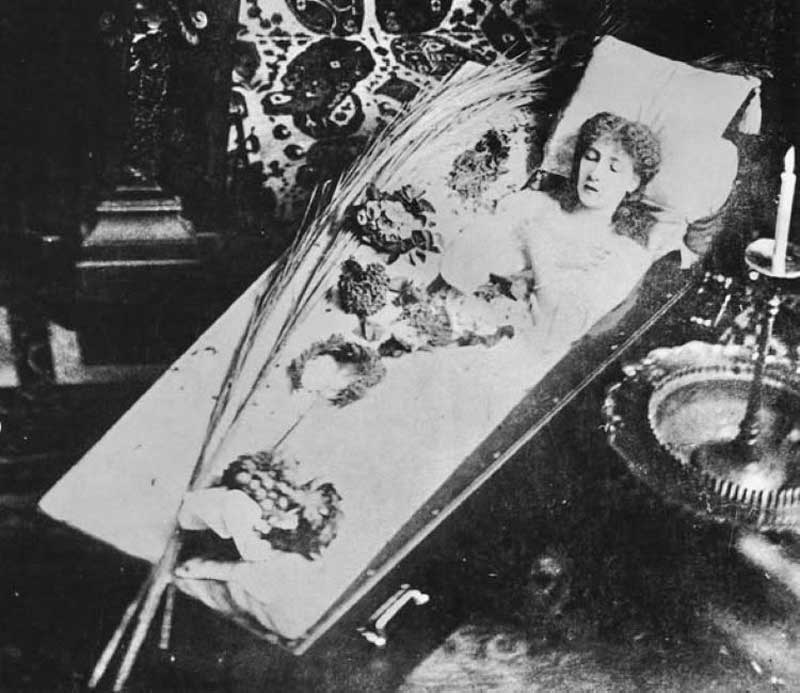
Sarah sleeping in her coffin-bed
Sarah Bernhardt was the illegitimate daughter of Julie Bernhardt, a well-known Dutch-Jewish courtesan in Paris, and her childhood was tumultuous, marked by the lack of a father figure and her mother’s frequent travels for work. Viewed as a burden by her mother, Bernhardt was sent to the Grandchamp convent school, beginning around 1855, where she first stepped onto the stage. During that time, she wished to be a nun, but was accused of sacrilege by the nuns after organizing a grand, full Christian burial and procession for her pet lizard. However, the course of her life changed when one of her mother's wealthy and powerful lovers, the French statesman Charles de Morny, arranged for her to enter the Paris Conservatoire at age 16, launching her a long, legendary theatrical career.
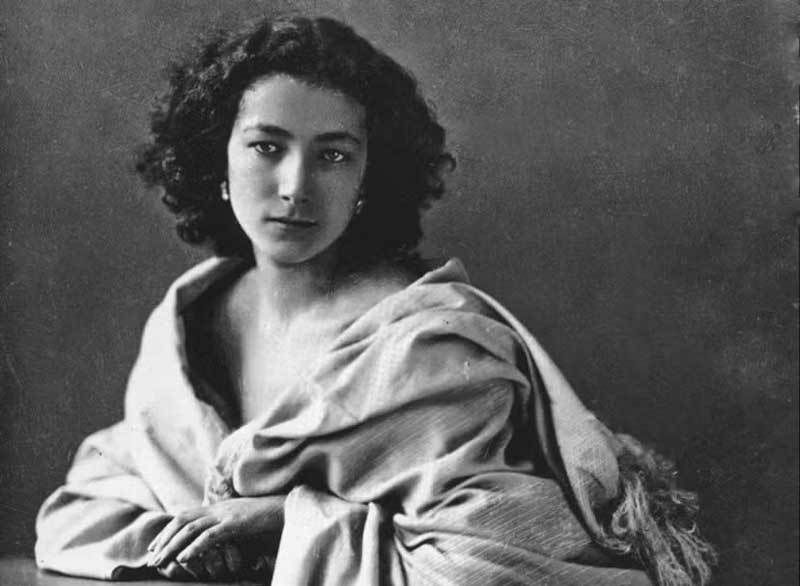
At 18, Sarah made her debut at the prestigious Comédie-Française, the only national theatre in France, in 1862, though the tenure was short-lived, because of an accumulation of bitter clashes with the theatre's management and fellow actors, stemming from resentment over her meteoric rise, alongside her famously volatile temperament. During that time, she became involved in an affair with the Belgian nobleman Charles-Joseph Eugène Henri, the 8th Prince de Ligne, whom she met at a masked ball in Brussels, and gave birth to an illegitimate son, Maurice, in 1864. However, she never initially discussed the child's parentage publicly, proudly gave Maurice her own surname, defiantly embracing her status as a single mother rather than yielding to the societal pressures of the era Years later, in 1885, by which time Bernhardt was an international superstar, the Prince travelled to Paris and offered to formally recognize Maurice as his son, which Maurice politely declined, choosing to remain simply the son of Sarah Bernhard.
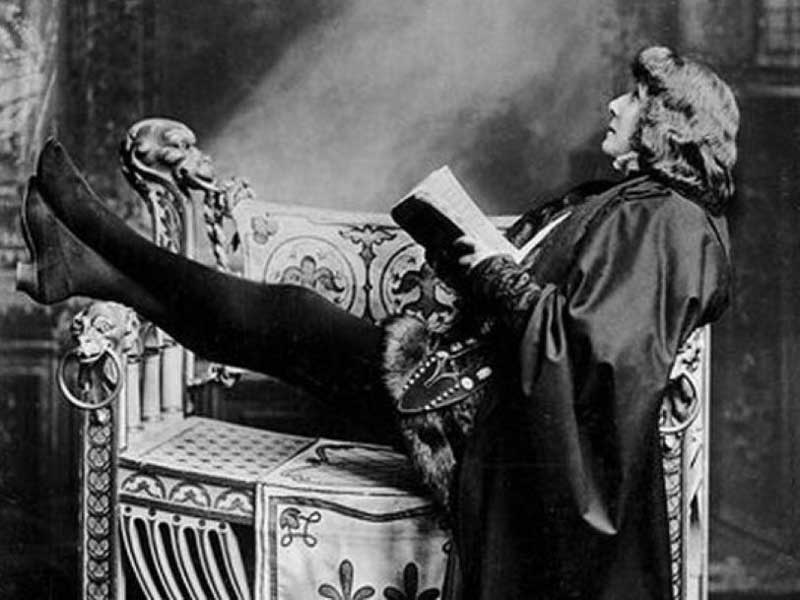
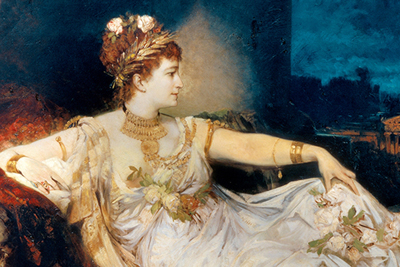
Renowned for her golden voice and dramatic intensity, Sarah starred in over 100 plays globally and pioneered early film acting. She toured worldwide playing on stage her signature role, the tragic heroine Marguerite Gautier in La Dame aux Camélias (1880), written by Alexandre Dumas fils, illegitimate son of the famous novelist Alexander Dumas, securing her international fame, and in 1899, she caused a massive international sensation and shattered gender barriers by playing the title role of Shakespeare's Hamlet at her own theatre in Paris, directed and produced by herself. Her ambitious, gender-bending performance in the role challenged traditional theatrical norms and she became an iconic figure in 19th-century theatre. Rather than portraying Hamlet as a weak or overly effeminate figure, she played the Prince with an intense, fiery masculinity and dynamic physical energy. Interestingly, in a nod to macabre history, she famously used an actual human skull, a gift from her lover, the novelist Victor Hugo, during the iconic graveyard scene of the play. Apart from the role of Hamlet, Sarah also played the role of the Duke of Reichstadt, Napoleon's son, in L'Aiglon (1900), specifically written for her by Edmond Rostand. However, her performance in the title role of Cleopatra, written by Victorien Sardou, who tailored the role precisely to Bernhardt's dramatic strengths, secured her status as the Divine Sarah across Europe and America.
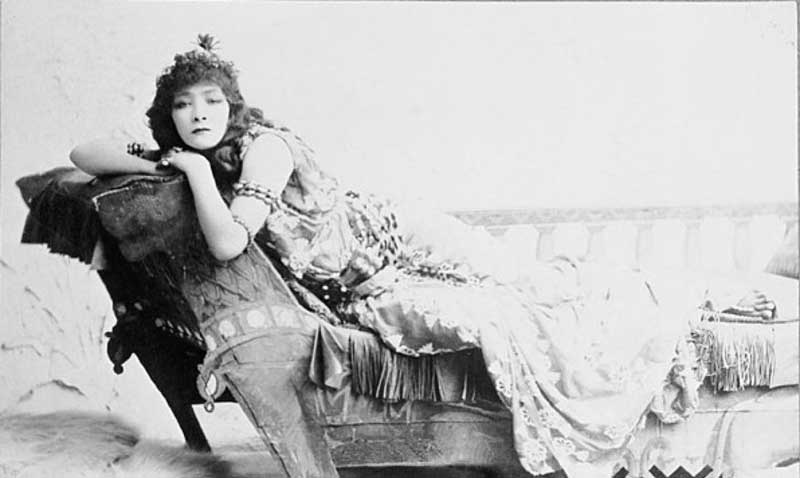
Sarah Bernhardt was a pioneer in early cinema, and one of the first major stage actresses to grace the silver screen, bringing her divine acting style of the 19th century directly to the silent screen. In Le Duel d'Hamlet (1900), a brief, two-minute film, she played the title role in a fencing scene from Shakespeare's Hamlet, allowing her to be recorded for future generations. In Les Amours de la reine Élisabeth (1912), also known as Queen Elizabeth, a three-reel landmark French silent film about the tragic romance between Queen Elizabeth I of England and the Earl of Essex, Sarah Bernhardt, aged 68, starred as the Queen, before famously describing her acceptance of the role as her last chance at immortality.
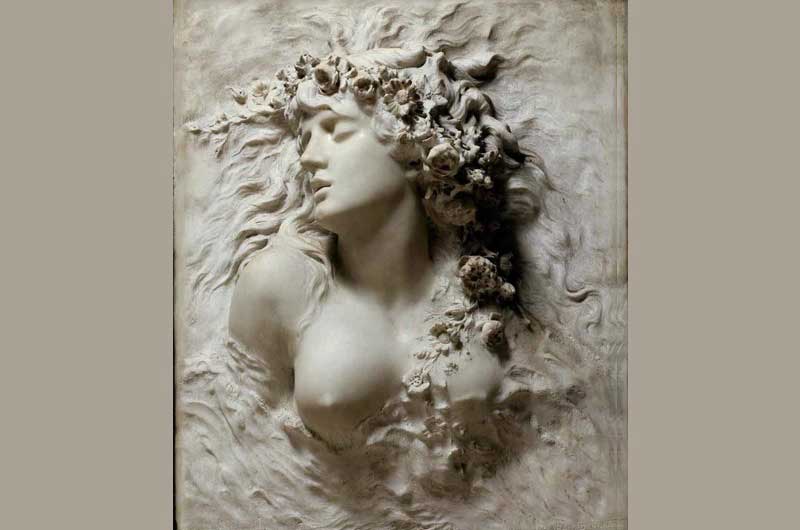
In addition of being a legendary actress, Sarah Bernhardt was also a highly accomplished sculptor. She took up sculpting in the late 1860s and produced numerous dramatic pieces, successfully exhibiting at the Paris Salon and even creating a commissioned work for the Opéra de Monte Carlo. Her Self-Portrait as a Chimaera (1880), a mythological symbolist bronze sculpture, featuring the artist’s face atop a winged, clawed, mythological monstrous creature, adorned with horns, is regarded as one of the few sculpted self-portraits by a 19th-century woman, while Après la tempête or After the Storm (1876), is a powerful white marble sculpture depicting a grieving woman holding the lifeless body of her son. However, Sarah frequently sculpted characters she either loved or wished to play on stage. Ophelia, created by her in 1880, captures the tragic young woman in her final moments. The 70 cm tall relief features a bust-form bust of Ophelia, with her eyes closed, and head turned, enveloped in water that merges seamlessly with her flowing hair, with a garland of flowers adorning her hair, and winding down to partially cover her exposed right breast. Interestingly, the model who posed for the languid, drowning bust of Ophelia was almost certainly Bernhardt herself.
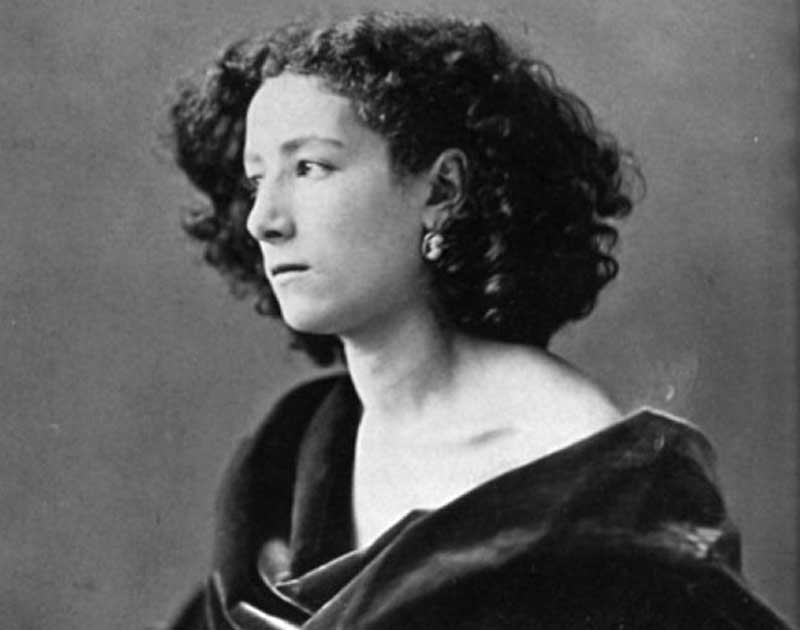
Sarah had a series of scandalous love affairs in her life. She was as famous for her dramatic performances, as for her turbulent off-stage romances. Embracing her bisexuality, she cultivated a long list of lovers that included European royalty to famous writers, artists, and her leading men. She had a highly publicized, long-running affair with the Prince of Wales, later King Edward VII, which spanned decades, and began when the future king was still Prince Bertie. Victor Hugo, the renowned author of Les Misérables, was famously captivated by her alluring beauty and maintained an affair with her, even when he was in his 70s. Apart from that, Edmond Rostand, the playwright of Cyrano de Bergerac, Jean Richepin and Jules Lemaître, prominent French authors and playwrights of the era, were in the list of her lovers. Among the celebrated artists, Sarah had a well-documented and celebrated relationship with Louise Abbéma, a prominent French Impressionist painter, and they maintained a lifelong friendship. French illustrator Gustave Dore and Orientalist painter Georges Clairin were also her lovers. Among her co-actors, she had tempestuous romances with a famous French actor Jean Mounet-Sully, and Lou Tellegen, a handsome Dutch actor who was one of her younger leading men. The only man Bernhardt officially married in 1882, was Jacques Damala, a Greek military officer turned actor, about 11 to 12 years younger than her, who was notoriously unfaithful and ultimately died of a morphine addiction.
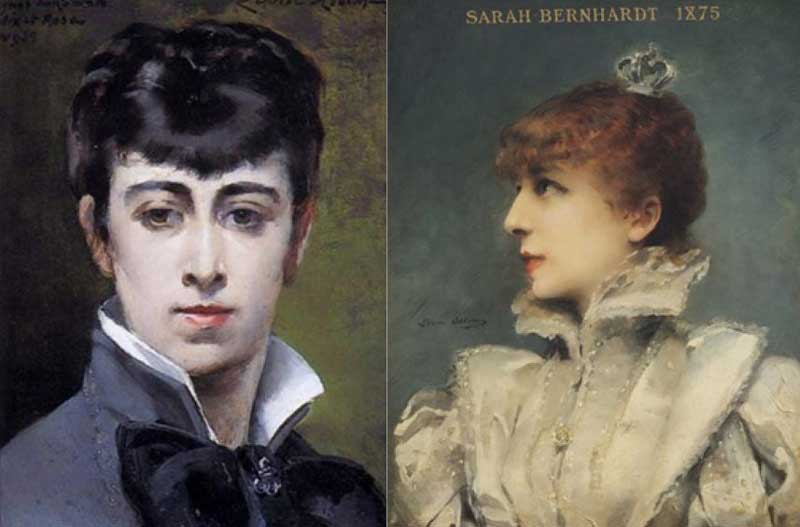
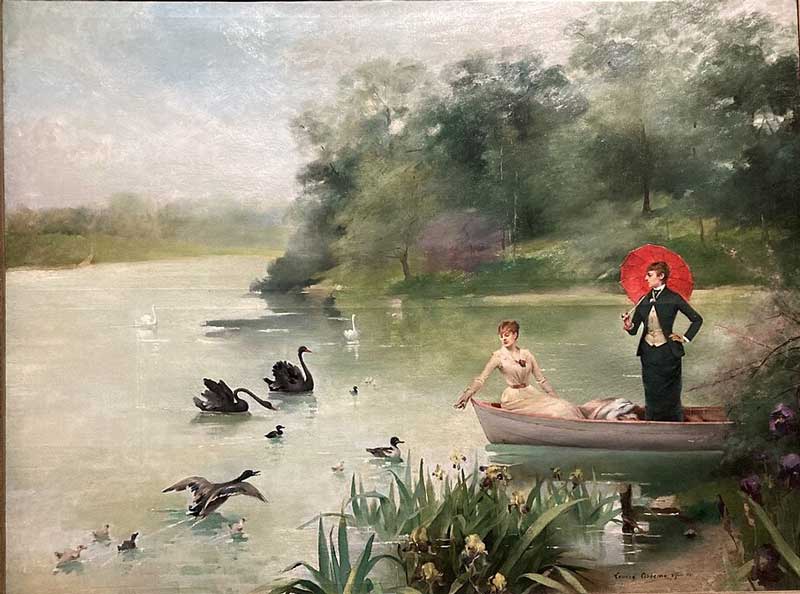
French painter Louise Abbéma and Sarah Bernhardt shared a profound, lifelong partnership. Beginning in 1871, Abbéma became Bernhardt's primary portraitist and muse, capturing her image repeatedly. Abbéma skyrocketed to fame with her painting Portrait of Sarah Bernhardt at the 1876 Paris Salon, while Sarah famously created a bust of Abbéma in 1879 which was widely exhibited, including at the 1893 World’s Columbian Exposition. Sarah also created a sculpture of their intertwined hands, signifying their deep devotion to each other, and Abbéma painted a picture of the two of them on a boat together on a lake, to celebrate the anniversary of their love. Believed to have been romantic partners, both women lived openly, boldly and confidently, with Abbéma famously wearing her hair short and dressed in men’s waistcoats and ties.
Sarah Bernhardt had her right leg amputated above the knee on 22 February 1915, due to severe, chronic inflammation and the onset of gangrene, which developed after she injured her knee during a stage accident in 1905. She died from uraemia on the evening of 26 March 1923.