FREE ASSISTANCE FOR THE INQUISITIVE PEOPLE











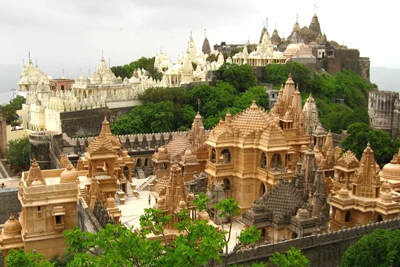
Nestled near the top of the Shatrunjaya Hill, located about two kilometres to the south of Palitana, a town in the Bhavnagar district of Gujarat, the huge complex of Palitana temples, houses around 900 shrines, of which 108 are large Jain temples, while the rest are small or tiny shrines, arranged in groups called Tonks or Tuks along various ridges of the hill. Surrounded by fortified walls, built by the Shantidas Jhaveri, the Nagarsheth of Ahmedabad of the 17th century, and covering about 20 acres of land and nine hilltops, the complex, built over a period of 900 years starting from the 11th century, is one of the most sacred sites of the Svetambara Jains, one of the two principal sects of Jainism. However, to reach the temple complex, the pilgrims and visitors have to follow a steep and arduous trail with upward and downward slopes and climb around 3.5 km involving approximately 3,500 stone steps, which starts in the southern part of Palitana town, equipped with a number of small temples, rest houses, shops, along with rest stops with supply of drinking water for the benefit of the pilgrims and visitors to sit and rest before resuming their trek. Interestingly, as the temple complex is believed to be an abode for the divine, no one is allowed to stay overnight, including the priests.

Although the Palitana temples accentuate the Maru-Gurjara architecture, primarily found in Gujarat and Rajasthan, the rebuilding of the Śvetāmbara Jain due to damage reflects the evolution in design principles over the period within the Solanki school, featuring an ornate style with the North Indian Nagara temples architecture, related to the innovations and developments that began in western India around the 10th century with the Kalyana Chalukya dynasty. The fusion of the Maru-Gurjara architecture and the Solanki School features the Shikhara or the tower of Nagara style temples, but distinctively features the ornate outer and inner walls, embellished with numerous reliefs, sculptures and open-pillared halls, along with Andolas, swinging or hanging ornamental arches, and Toranas or decorated gateways. However, the post-16th-century temples in Palitana also display lavishly decorated ceilings, ambulatories and pillars, while the domes in concentric shrinking circles help envelop more space and light.

The Adinath Temple, also known as the Adishwara Temple, located on the highest altitude on the far south side, and dedicated to Adinatha or Rishabhanatha, the first Tirthankara of Jainism, is a centrepiece of the Palitana Temple Complex, as well as the largest and perhaps one of the most spectacular temples, reflecting display of exquisite sculpture. The temple houses a 7-feet-1 inch (2.16 m) tall iconic image of Adinatha with crystal eyes, carved in a single piece of white marble, and sitting in Padmasana, a classic cross-legged yoga posture where each foot rests on the opposite thigh. Apart from that, the huge complex of the Palitana Temples contains several hundreds of temples, of which the most important ones are housed within nine important enclosures, locally called Tonks or Tuks, named after the individual or family who commissioned the particular construction. Each of those Tuks typically houses a main temple and a cluster of smaller shrines. Seven of the said nine enclosures are located on the northern summit, while the other two are in the valley. While the names of the Tuks slightly differ in some of the other lists, a comprehensive list of the nine Tuks contains the Narshi Keshavji Tunk, also known as Sheth Narasinh Keshavji Tuk, dedicated to the fourth Tirthankara, Abhinandananatha. The Chaumukhji Tuk, named after its main temple, and also dedicated to Adinath, features a unique chaumukh or four-faced image of Adinath, facing the four cardinal directions. The other enlisted Tuks in the complex are known as Chhipavasahi Tuk, Sakar Vasahi Tuk, Hema Vasahi Tuk, Bala Vasahi Tuk, Motisha Sheth Tuk, Modi Tuk, named after its principal temple, the Temple of Modi Premchand Lalaji, built by a person named Modi Premchand of Ahmedabad, and Ghety Bari Tuk. However, although included in some of the lists, Nandishwar Tuk is not one of the main or commonly listed temples at the Palitana complex.

There are three primary clockwise circumambulation routes of the temples, an essential ritual for the pilgrims of the Indian regions, known as Parikrama or Pradakshina, the first of which includes the foot-idols under the Rayan tree, known as the Rayan Pagla, believed to be the exact spot where the first Jain Tirthankara, Rishabhanatha, also known as Adinath, is said to have delivered his first sermon. The second route passes the temples on Shatrunjaya Hill, representing the sacred cosmic Mount Meru, from Jain cosmology, while the third route, the most extensive of the three, encompasses the temples of Ashtapada and the Chaumukh.

Among the main temples of the Palitana Temple Complex, the Adishvara Temple, dated to the 16th century, constructed of white marble and decorated with intricate and elaborate carvings, along with an ornamented spire, is dedicated to Adinath, the first Tirthankara, and houses a large and beautiful idol of Adinath. Located on the sacred Shatrunjaya Hill, and sponsored by the wealthy Jain merchant Vimal Shah, the square structure of the Vimal Shah Temple, adorned with towers, is a prime example of Jain architectural mastery. The Kumar Pal Temple, another stunning architectural structure, with intricately carved pillars and walls displaying ancient stories, is dedicated to the 12th-century King Kumarapala, a devout follower of Jainism, who despite not being a Tirthankara, played a significant role in promoting Jainism. The Samavasaran Temple, designed to reflect the equality of all forms of life in Jain philosophy, is the divine assembly hall where Tirthankaras deliver their teachings to humans, as well as to the animals, and celestial beings. The Sahasra Kuta Temple, also known for its intricate and elaborate carvings, is dedicated to the 23rd Tirthankara, while Ashtapadh temple is a depiction of Ashtapadh or Mount Kailash, where Adinatha is believed to have attained moksha, the ultimate freedom from the eternal cycle of life, death, and rebirth, contains large figures of Mahavira, sitting like Buddha, with feet crossed in front, on a pedestal. Apart from the above, several other important temples in the complex are the Bhaktamar Temple, dedicated to Bhaktamara, a revered figure in Jainism, the Neminatha Temple, dedicated to Neminatha, the 22nd Tirthankara, the Saraswati Devi temple, Narsinh Kesharji temple, a temple dedicated to Hingraj Ambikadevi or Hinglaj Mata, a Jain Yakshini or attendant deity, believed to be the presiding deity of the hill, and the Samavasaran temple, containing 108 life-sketches in sculpture.

Strangely, there is a tomb of a Muslim named Hengar, also called the Durgah of Angarsa Pir or Angar Pir, on the summit of the Shatrujaya hill, located near the entrance of one of the fort walls, which does not have any Islamic record. It is believed by many that when Hengar threw a mace in an attempt to damage a statue of Adinath, he was struck dead in the attempt, after which the Jain priests buried his bones and entombed him. However, according to the caretaker of the dargah, although Hengar was a pious Muslim, he argued with the Sultans on behalf of the Jains and prevented damage to the Palitana temples during the Muslim invasions.