FREE ASSISTANCE FOR THE INQUISITIVE PEOPLE















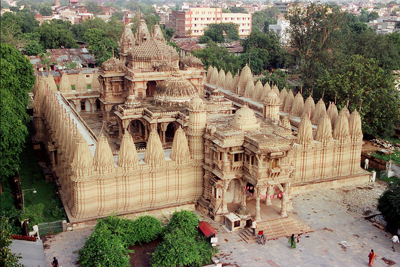
Located near the Delhi Darwaza or Delhi Gate in Ahmedabad, Gujarat, with its main entrance situated on Shahibaug Road, Hutheesing Jain Temple, constructed from exquisite white marble, and reflecting a harmonious blend of traditional Maru-Gurjara architectural style and Mughal haveli characteristics, like jali windows or latticed screen, and arched balconies, is a symbol of devotion, resilience, and heritage. Commissioned by an affluent Jain trader, Sheth Hutheesing Kesarisinh, the temple was built during a severe famine in Gujarat in 1848, employing hundreds of skilled artisans from the Sompura and Salat communities for the project, and thus supporting them for a period of two years. Unfortunately, Sheth Hutheesing, died at the age of 49, and could not see his dream come true. But following his death, the construction of the edifice was supervised and completed by his third wife, Shethani Harkunwar, in 1848, two years after its foundation, at a huge cost of around 10,00,000 Indian Rupees, which is equivalent to 75 crore rupees or US$ 8.9 million in 2023, and was named after its founder, Sheth Hutheesing Kesarisinh. Designed by architect Premchand, and constructed by artisans famed for their craft skills in stone carvings and sculpting, Hutheesing Jain Temple, built with intricate carvings and marble lattices without any mortar, and considered an architectural masterpiece built in white marble, was dedicated to the 15th Tirthankara, Dharmanath, the son of King Bhanu Raja and Queen Suvrata Rani of Ratnapur, said to have attained moksha or salvation at Shrikanji.
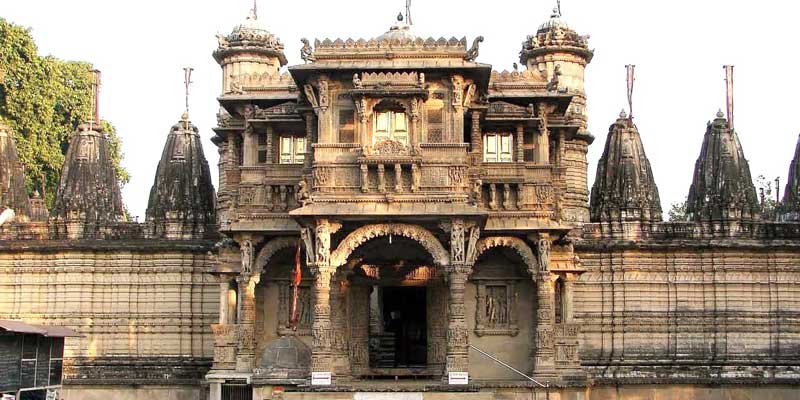
The main gateway porch of the Hutheesing Jain Temple features architectural elements of wooden haveli, which includes intricately decorated walls, carved balustrades, expansive overarching balconies, chabutras or raised platforms, and jalis or latticed screens. The west-facing main temple of the complex, the 52.5 m (around 172 feet) tall two-storey building with dome-shaped sections at both the front and rear, and built on a large platform, is a nirandhara-prasada type of temple that lacks a circumambulatory passage or pradakshina patha around the main shrine, an enclosed walkway for devotees to perform traditional rituals. The main temple comprises three sanctuaries in a row, namely a garbhagriha or sanctum sanctorum, an octagonal-shaped gudhamandapa, which is an enclosed shrine hall, equipped with porches, and crowned with a large ridged dome, supported by twelve elaborately designed pillars, a vestibule or an entrance hall, serving as a transitional space between the outside and the main sanctuary, and a sabhamandapa, an assembly hall. Each of the three sanctuaries are topped with shikhara, the towering, spire-like superstructure above the sanctum sanctorum. The protruding porches are adorned with ornamented columns and brackets, featuring figures on three outer sides, while the walls, columns, and ceilings are embellished with intricate carvings, illustrating dancers, musicians, animals, and floral designs.
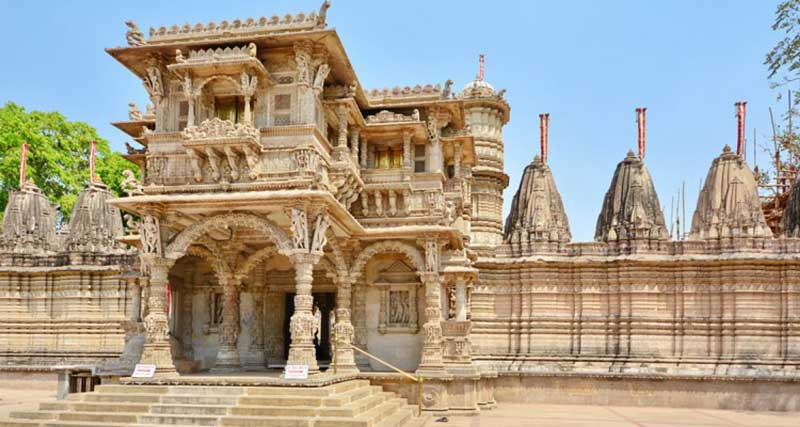
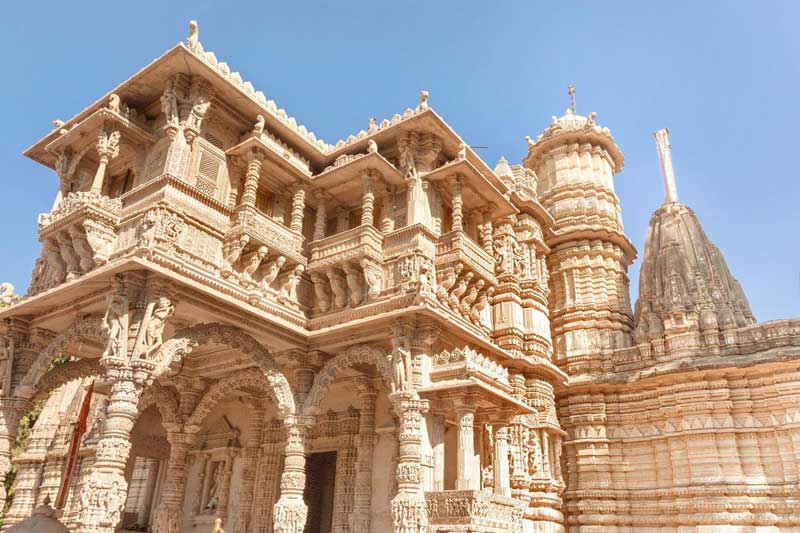
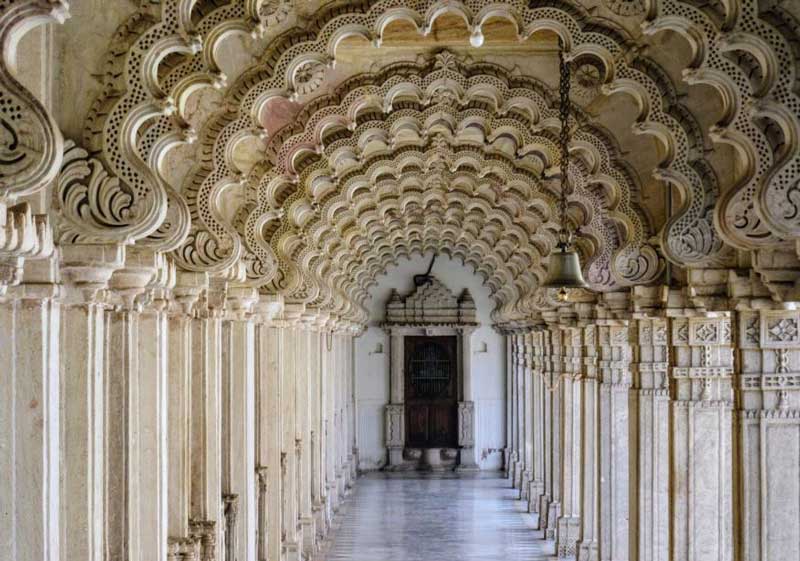
The garbhagriha or the sanctum sanctorum of the main temple houses an impressive marble image of Dharmanath, the 15th Tirthankara, to whom the temple is dedicated. In addition to that, the temple also houses eleven other deities, of which five deities in three bay structures and six deities in the two sub shrines in the basement. The principal temple is surrounded by an open courtyard with a colonnaded covered walk, complete with 52 devakulikas or small secondary shrines, each containing an impressive idol of a Tirthankara.
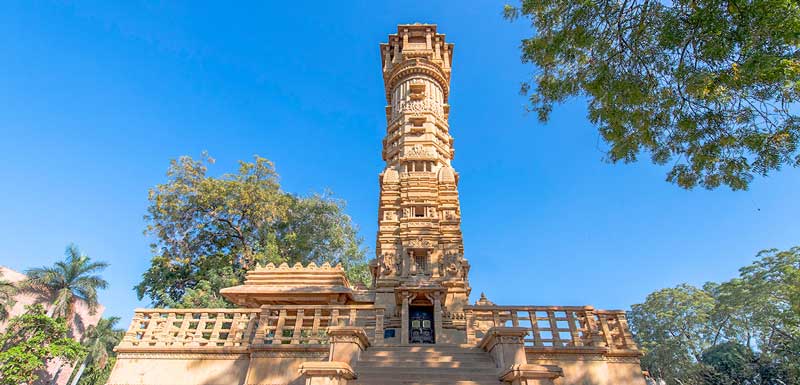
Standing opposite the main entrance of the Hutheesing Jain Temple, the 78-feet-tall, six-storey Manasthamba, also known as Kirti Stambh or pillar of honour, enshrining an idol of Lord Mahavira, was built in 2003 to celebrate the 2500th birth anniversary of Lord Mahavira, regarded as the founder of Jainism in the Indian subcontinent around the 6th century AD. Modelled after the 12th-century Kirti Stambh at the Chittorgarh Fort in Rajasthan, and serving as a powerful symbol in Jainism intended to help devotees shed their pride before entering the sacred space, the pillar features intricate carvings, including figures of the Dikpals, often called the Ashta-Dikpalas, guardians of the eight directions in Hindu mythology, on its exterior walls.
The Hutheesing Jain Temple celebrates a variety of festivals with grandeur, which include Gyan Panchami, Posh Dashami, Maun Ekadashi, Kartik Purnima, Diwali, Paryushana Parva and Mahavir Jayanti. Among the festivals, Paryushana Parva, a festival of spiritual purification and self-discipline, is one of the most important annual holy events for the Jains, celebrated in August or September, and continues for eight to ten days. The festival is marked by fasting, prayer, and meditation, and culminating in Samvatsari, a day of forgiveness for any harm or sin that may have caused, knowingly or unknowingly and reaffirming the commitment to the five main vows of Jainism, namely non-violence, truthfulness, non-stealing, celibacy, and non-possession. Another important festival is the Mahavir Jayanti, celebrated on March 29th, commemorating the birth of the 24th Tirthankara, Lord Mahavir, which includes elaborate decorations of the temple with flags and flowers, Abhishek or ceremonial baths of idols with chanting of prayers, listening to sermons on Jain philosophy and Mahavira's teachings, and participation in charitable activities like distributing food and clothes to the needy.