FREE ASSISTANCE FOR THE INQUISITIVE PEOPLE













The Pont du Gard, a magnificent example of Roman Engineering works, was constructed shortly before the Christian era, probably in the first century AD, to carry water across the River Gardon, over 50 km to the city of Nimes, formerly known as Nemausus. The bridge, constructed of soft yellow limestone blocks quarried from a local quarry bordering the river, is equipped with three tiers of arches that stands 160 feet (48.8 m) high and descends by only 41 feet (12.6 m) in height over its entire length, indicating the great precision of the ancient Roman engineers. Built mostly without using mortar, like many other Roman constructions, the first tier of the bridge consists of six arches of 51 to 80 feet (15 to 24 m) wide is the largest of the three, while the second tier is composed of eleven arches of the same dimensions. The third tier, carrying the conduit, comprises 35 smaller, 15 feet (4.7 m) wide arches.
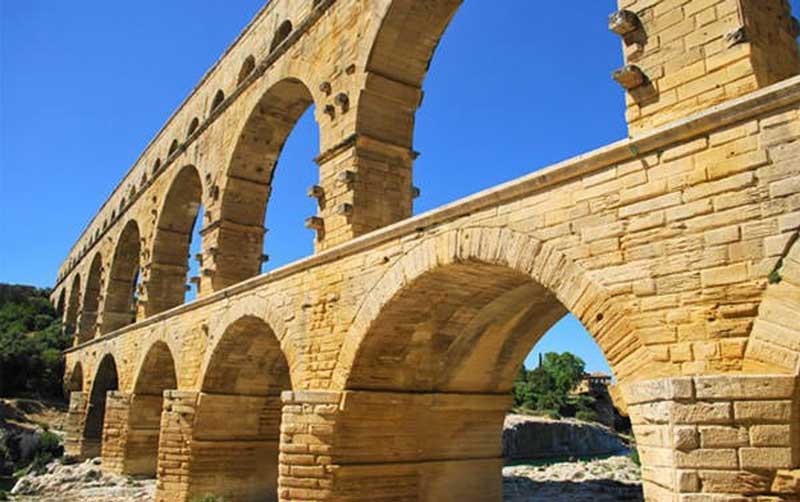
Although the construction of the Pont du Gard aqueduct has long been credited to Marcus Vipsanius Agrippa, the son-in-law of the Roman emperor Augustus around the year 19 BC, excavations suggest the construction was probably executed only between 40 and 60 AD. Constructed largely without mortar, the Pont du Gard contains around 50,400 tons of limestone blocks. The stone blocks, some weighing up to six tons, were precisely cut to fit perfectly to eliminate the need for mortar.

At the time of construction, a special type of scaffold was erected to support the bridge and large stone blocks were left protruding from the bridge to support the frames and scaffolds used during construction. Like the other typical Roman aqueducts, much of the Pont du Gard aqueduct was built underground by digging a trench in which a stone channel was built and enclosed by an arched roof of stone slabs, which was then covered with earth. However, unlike the rough and coarse of the Pont du Gard, proper care was taken to ensure the evenness and smoothness of the interior of the water conduit for the unobstructed flow of water. While its walls were constructed of dressed masonry, the floor was made of concrete, and both were covered with stucco, mixed with shards of pottery. It is estimated that the aqueduct supplied around 40,000 cubic metres of water to the city every day.
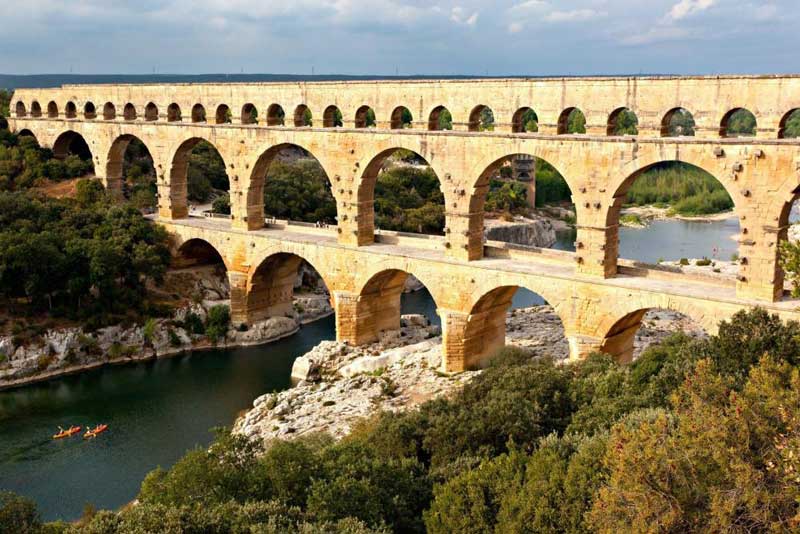
It was long believed that the Roman engineers had deliberately designed the upper levels of the bridge slightly curved in the upstream direction to strengthen the structure of the bridge against the flow of water. However, a minute scientific study in 1989 indicated that the bend was created over the century due to the fluctuating heat of the sun, causing the natural expansion and contraction of the stones by about 5 mm (0.20 in) a day.
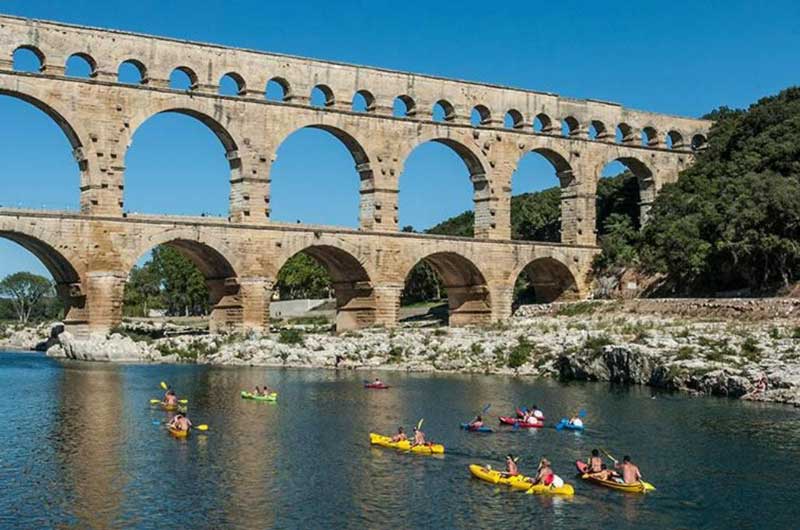
Unfortunately, from the 4th century, the maintenance of the aqueduct was neglected as the successive invaders disturbed the otherwise peaceful region. It became clogged with debris, plant roots, layers of dirt, and organic materials. Although it was initially estimated that it had continued to supply water to the city until as late as the 9th century, but recent investigations suggest that possibly it had gone out of use by the sixth century, though parts of it may have continued to be used for a significantly longer period.

The bridge suffered serious damage during the 1620s when it was used to transport the artillery. While it was renovated by the local authorities, a new bridge was built in 1743-1747 next to the arches of the lower level for the use of the traffic.
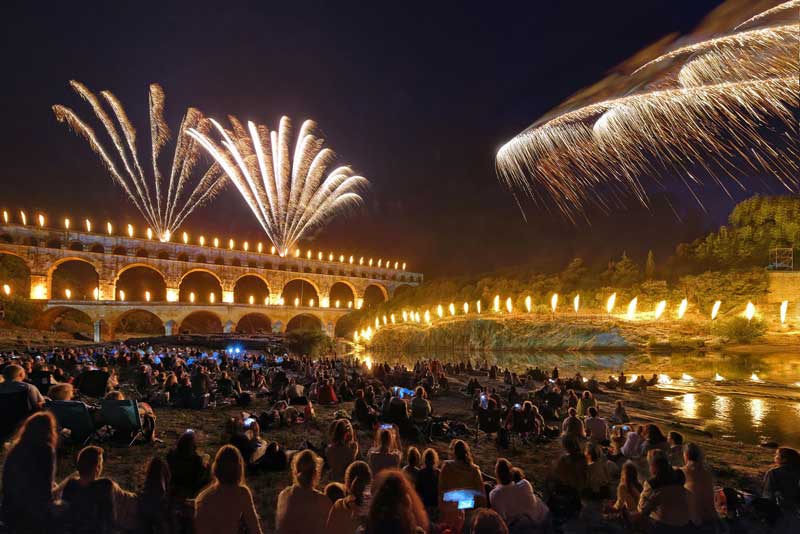
The Pont du Gard aqueduct, one of the most beautiful Roman constructions in the region, is a true masterpiece of ancient architecture and it was added to UNESCO World Heritage Site in 1985 for its historical importance.