FREE ASSISTANCE FOR THE INQUISITIVE PEOPLE


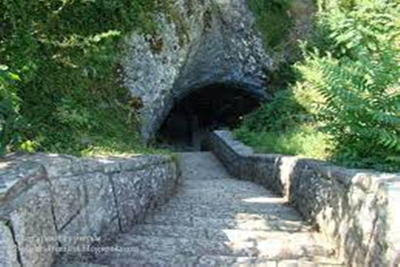













Located between the rivers Catarrhactes and Cestrus, 19 km east of Antalya, on the southwestern Mediterranean coast of Turkey, Perge was an ancient and important city of Pamphylia. The legendary origin of Perge dates back to the 13th century BC when after the Trojan War the Greek immigrants led by Calchas and Mopsus arrived Pamphylia after traversing Asia Minor. The first settlement in the Perge area developed on the acropolis hill, dated to the end of the fifth millennium BC, and the oldest traces of continuous settlement begin in the third millennium BC.

After the death of Alexander in 323 BC, Pamphylia was ruled by the Ptolemaic and then Seleucid Dynasties. In 188 BC, when Seleucids were expelled by the Romans, their lands in Anatolia were given to the King of Pergamum, Eumenes II. While in the first century BC the Romans took action against the Cilician pirates and set up the province of Cilicia in 43 AD, The Roman emperor Claudius combined Pamphylia with Lycia and formally incorporated in the Roman Empire. In the second century BC, the city experienced the first period of prosperity and started minting its own coins with the image of Artemis, whose temple stood on a hill outside the town. During that time, Perge was a centre of culture and was a seat of the worship of Queen Artemis, an Anatolian nature goddess.
Christianity was introduced to the inhabitants of Perge, when in 46 AD St Paul the Apostle, along with Barnabas and John Mark, touched Perge on his way to Pisidian Antioch by the sea route, and on the way back stayed in Perge for a longer time, preaching and teaching. It is considered that the first church in Perge was erected during that time. Today, that ancient journey of Paul the Apostle is commemorated in the form of a hiking trail that starts in Perge and leads all the way to Pisidian Antioch. Gradually, Perge became an important centre of Christianity in the first half of the 4th century, during the reign of Constantine the Great, which soon became the official religion of the Roman Empire.

The third and last period of prosperity of the city of Perge came in the 5th and the 6th centuries AD, when the city had a rank of a bishopric. After that, it started to become weak and ultimately declined by the persistent attacks by the Arabs when most of the inhabitants moved away from the city after the seventh century. In 1078 Perge was occupied by the Selcuk Turks and the Ottomans took its hold in 1392. Finally, the glorious city of the past was abandoned and ultimately ruined.
Although the first systematic archaeological excavations in Perge were conducted in 1946 and between 1953 and 1957 and resumed again in 1967, excavations are still ongoing under Professor Haluk Abbasoğlu as the team leader. The archaeological area of the ancient city of Perge is vast, and the Roman Theater and the Stadium, the best-preserved buildings of the city, are located on the access road to Perge.
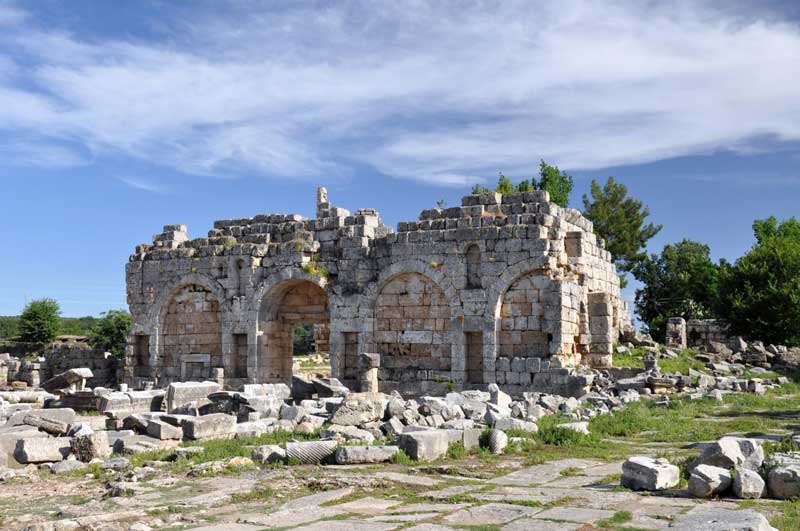
Perge was divided into four districts by two main 20 m wide colonnaded streets that cross at the centre of the city. One of these streets, with a length of 300 m, leads from the Antique Gate to the foot of the Hellenistic Acropolis. There is also a nicely preserved colonnade running along this street, and among the columns, three are decorated with reliefs, depicting Artemis of Perge, Tyche, the goddess of fortune, and one of the mythical founders of the city, and Calchas. Both sides of the street were once lined with shops, and their scanty remains can still be seen while walking to the acropolis. The second main street in Perge, linking the east and west gates, crossed at right angles. The canals that used to supply water to the fountains and baths ran in the middle of both streets.
During the 3rd century rings of walls were built to surround the city of Perge with rectangular towers placed at even intervals. Some long sections of these walls are still standing, retaining their original height, especially on the eastern side of the city. The excavations near the eastern section of the city walls revealed the remains of residential houses consisting of several rooms arranged around an atrium, each equipped with a water cistern and a toilet, evidencing existence of a sewage system in the city.
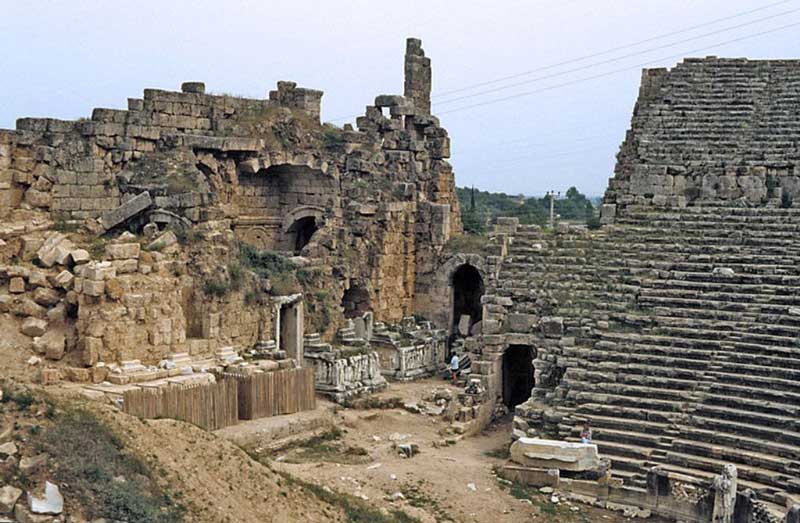
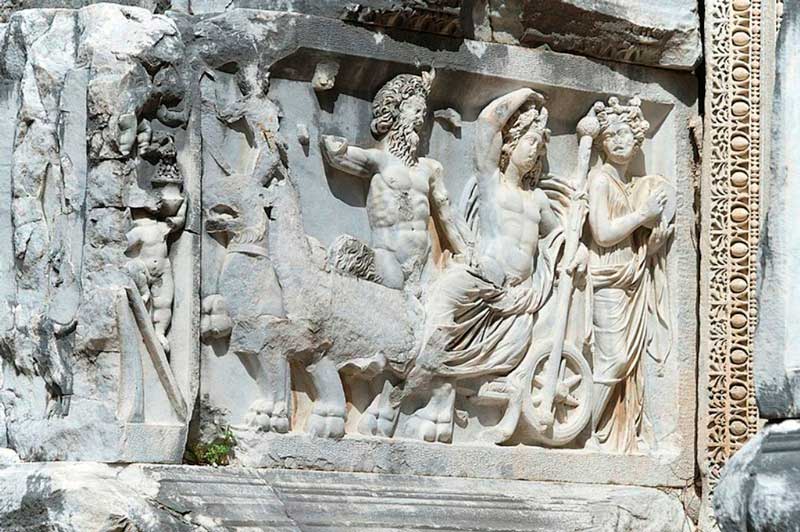
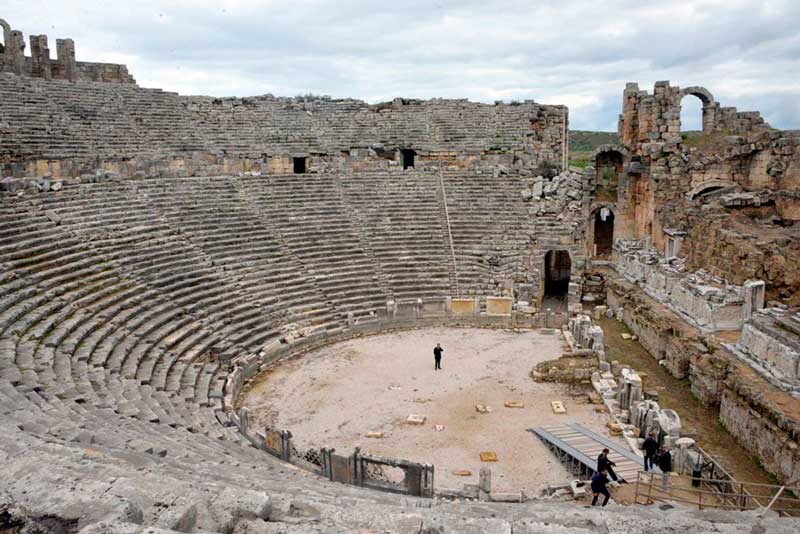
The impressive building of the ancient theater, with the capacity to accommodate around 15000 spectators was probably built around 120 AD, and stands on the slope of a hill, on the western side of the road to Perge. It evidences a combination of Greek and Roman features, and its shape exceeds a semicircle. However, the two-storey and richly decorated skene Building, the structure at the back of a stage, was built in the second half of the 2nd century AD and was decorated with reliefs depicting mythological scenes, including the episodes from the life of Dionysus. Later, these reliefs, along with the other sculptures found in the theater, were shifted to the Archaeological Museum in Antalya.
The ruins of the 234 meters long and 34 meters wide ancient Roman Stadium of Perge, with the capacity to accommodate 12000 spectators, is considered as one of the largest of its kind. Supported on a barrel-vaulted construction, the auditorium consisted of 12 rows of seats. While the longer side of the stadium had thirty vaults, the northern end had nine, and every third vault was open, leading directly to the arena. The inscriptions inside some of the vaults indicate that they served as shops. An arena for gladiatorial combat was discovered on the northern side of the stadium. A low wall separated it from the audience to keep it hidden from their view.

The fountain of Hadrian, a beautiful nymphaeum, consecrated to the nymphs, that stands at the northern end of the colonnaded street, was erected on a U-shaped plan with the dimensions of 21 by 9 meters at its base. The two-storey structure equipped with two entrances and a façade decorated with a statue of Cestros, the god of River Kaistros, was once used as a gateway to the acropolis. The nymphaeum has partly collapsed, but it still holds the statue in its place.

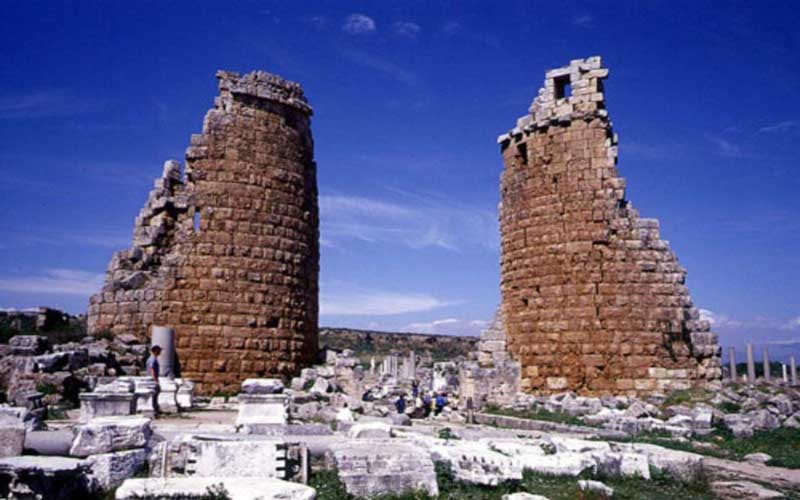
Probably, the most iconic symbol of the city of Perge is the twin tower Hellenistic gate in the ramparts, built of hewn stones, and standing on both sides of the city gate. The alcoves between the columns of the upper story held the statues of Perge's legendary founders, Mopsos and Calchas, while the statues of Greek deities, including Hermes, Aphrodite and Pan, were placed on the lower level.

Among the other important sites, the remains of the Tomb of Plancia Magna, priestess of Artemis and Mother of the Gods and Demiurge, is located on the right side of the Late Antique. The Roman baths, consisting of a sequence of rooms with windows opening up to the south stand on the west side of the Hellenistic gate. While the remains of a church from the 6th century AD, with an apse located on its eastern side, lies in the southern part of the city of Perge, the ruins of a three-nave basilica, dates back to the 5th or 6th century AD, can be found in the centre of the city.