FREE ASSISTANCE FOR THE INQUISITIVE PEOPLE










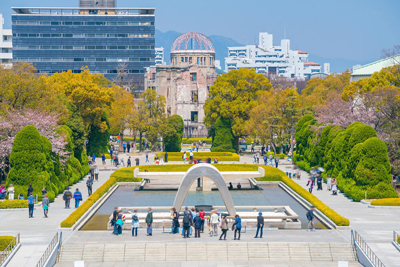
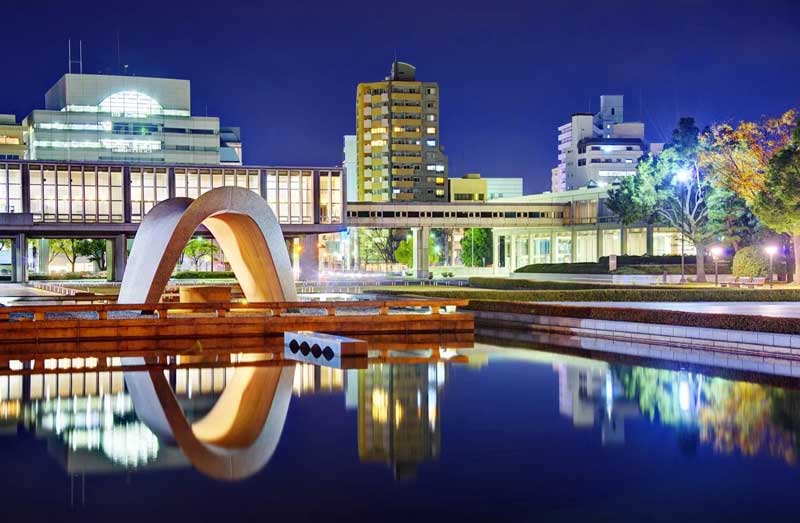
Covering a huge area of 12-hectare (120,000 sq m) serene, green public space in the centre of Hiroshima, Japan, and built on the former site of the city’s bustling downtown district, the unique Hiroshima Peace Memorial Park is dedicated in remembrance of Hiroshima as the first city in the world to suffer a nuclear attack at the end of World War II, and also to the memory of the victims of the attack on 6 August 1945, the day in which the United States dropped an atomic bomb on the Japanese city of Hiroshima. On that fatal day, a single atom bomb indiscriminately killed tens of thousands of innocent people, while profoundly disrupted and completely changed the lives of the survivors. The location of Hiroshima Peace Memorial Park was once the city's busiest downtown commercial and residential district, and four years to the day after the bomb was dropped, it was decided that the area would not be redeveloped, and would be devoted as a site of a peace memorial. Planned and designed by Kenzō Tange, a Japanese Architect, and built on an open field that was created by the explosion, Hiroshima Peace Memorial Park, containing a number of memorials and monuments, museums, and lecture halls, today draws more than a million visitors annually, as a remembrance of the horror of nuclear weapons, as well as advocating world peace.
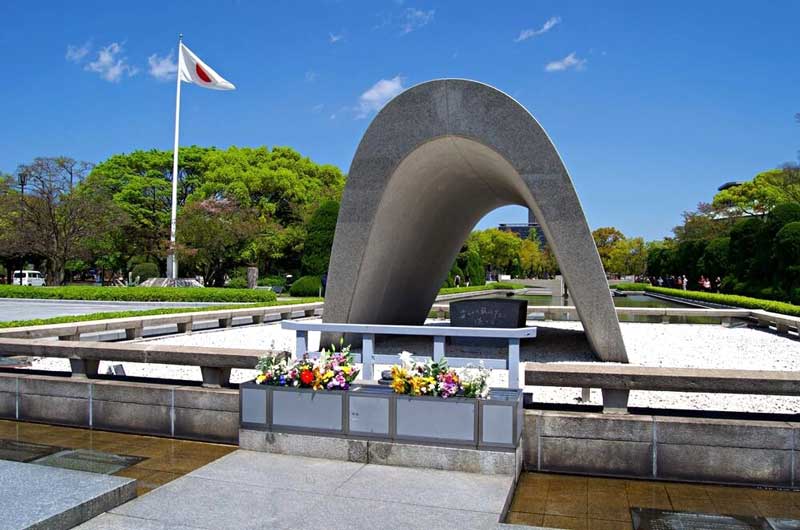
Located near the heart of the park stands the Memorial Cenotaph, a saddle-shaped concrete monument, sheltering the names of all the victims of the atom bomb, kept in a stone chest holding volumes listing the names of more than 3,50,000 people. The cenotaph carries an epitaph written in Japanese, which means, please rest in peace, shall not repeat the error. The cenotaph, one of the first memorial monuments built on an open field on 6 August 1952, is perfectly aligned to frame the Atomic Bomb Dome, and also the Peace Flame through its central arch, which has burned continuously since it was lit in 1964 and will remain lit until all nuclear bombs on the planet are destroyed, and the planet is free from the threat of nuclear annihilation.
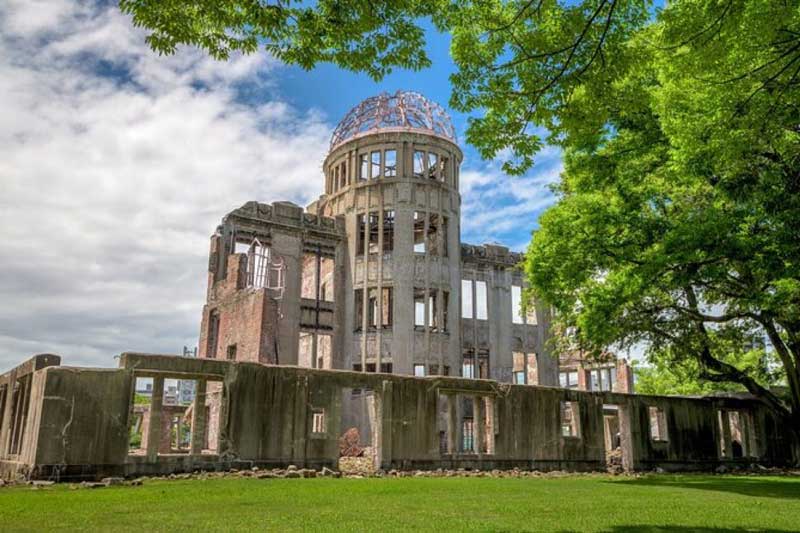
Situated at the northern tip of Hiroshima Peace Memorial Park, along the Motoyasu River, and in a distant ceremonial view that is visible from the Memorial Cenotaph, the Hiroshima Peace Memorial, known as Genbaku Dome or Atomic Bomb Dome, is the only structure left standing near the hypocentre of the first atomic bomb which exploded on 6 August 1945. Completed in 1915, and initially known as the Hiroshima Prefectural Commercial Exhibition Hall, the building was renamed the Hiroshima Prefectural Industrial Promotion Hall in 1933. As the explosion was almost directly overhead, the building kept its shape even after the massive explosion due to its stone and steel structure, and preserved in the same state as immediately after the bombing. Designated as a UNESCO World Heritage Site on 7 December 1996, the Dome has undergone two minor preservation projects to stabilise the ruin, notably between October 1989 and March 1990, and stands as it was after the explosion, as a stark reminder of the 1945 atomic bombing and a profound symbol of world peace.
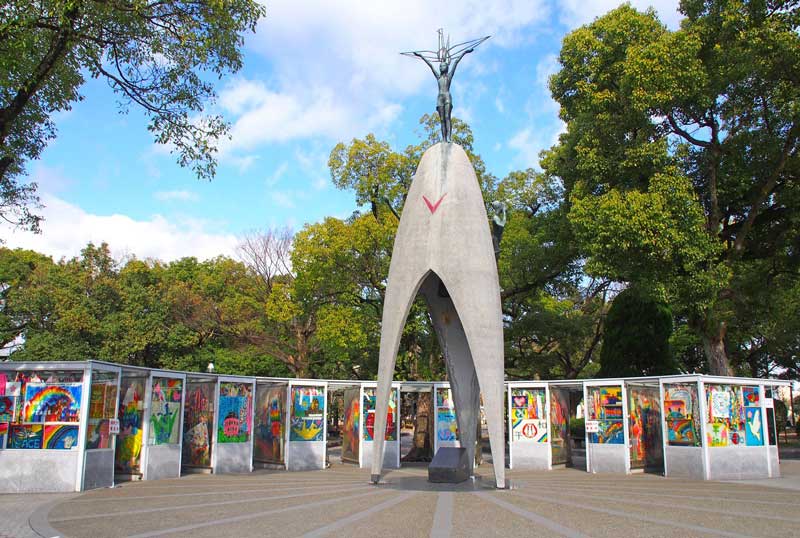
The 29.52 feet (9 m) high Children's Peace Monument, located at the northern end of the park, crowned with a bronze figure of a girl standing at the apex and holding a gold origami crane high above her head, Is dedicated to Sadako Sasaki and thousands of children who died from the atomic bomb. Suspended inside the domed pedestal is a golden crane that acts as a wind chime, donated by Nobel laureate Hideki Yukawa. The monument was inspired by Sadako Sasaki, who was two years old during the 1945 bombing disaster and developed leukaemia a decade later due to radiation exposure. Believing in a Japanese legend that folding 1,000 origami cranes would grant her a wish to heal, she folded hundreds of cranes, but passed away in October 1955, before completing the required number. Unveiled on 5 May 1958, it is continuously adorned with thousands of origami paper cranes signifying global peace.
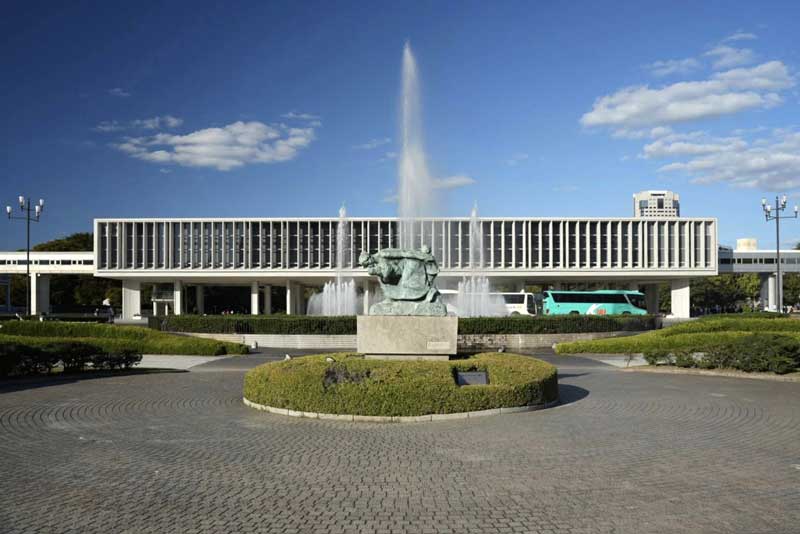
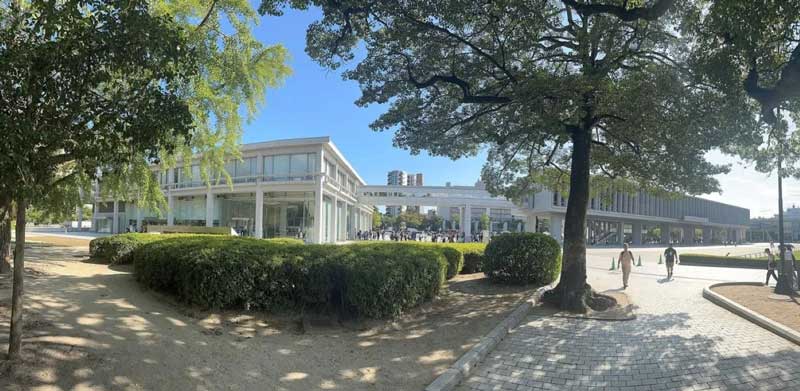
With the collection of the belongings left by the victims, testimonies by the survivors, bombed artefacts and related materials, the Hiroshima Peace Memorial Museum, located in the Hiroshima Peace Memorial Park, is dedicated to conveying the world the horrors of nuclear weapons and spreading the message of world peace. The museum building consists of two parts, the Eastern Wing and the Western Wing. The newly added Eastern Wing features the history of Hiroshima City before the bombing, the lives of Hiroshima citizens during and after World War II, the nuclear age and efforts for international peace, along with a model showing the damage done to the city, while Western Wing, the original portion of the museum, displays the damage caused by the fatal bombing, exhibiting the haunting personal belongings recovered from the victims, such as tattered clothing, melted watches, timepieces frozen at exactly 8:15 am, the exact moment the atomic bomb detonated over the city, eyeglasses, and school uniforms. It also displays the horrific medical and physical effects of the blast, including burn scars, the impact of the black rain, and the generational toll of radiation, added with photographs of the destruction. Earlier, the museum also contained a large replica of the damaged Atomic Bomb Dome, which was removed during the renovations of the museum building.
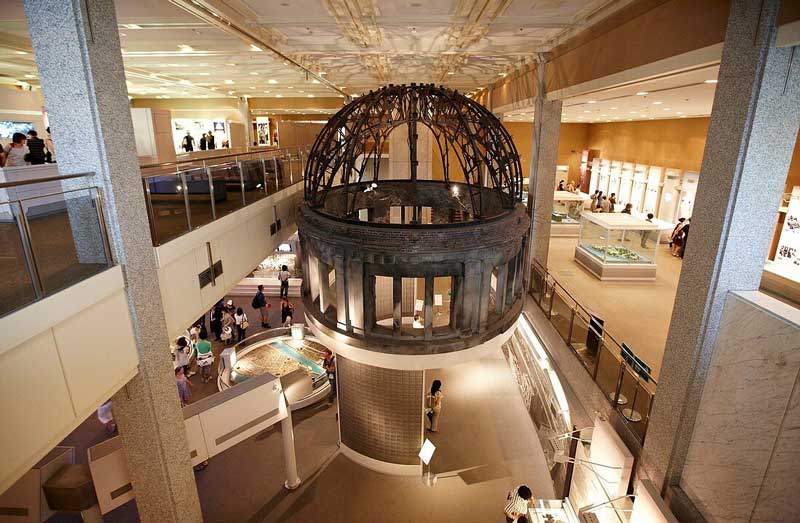
The replica of the damaged Atomic Bomb Dome in Peace Memorial Museum
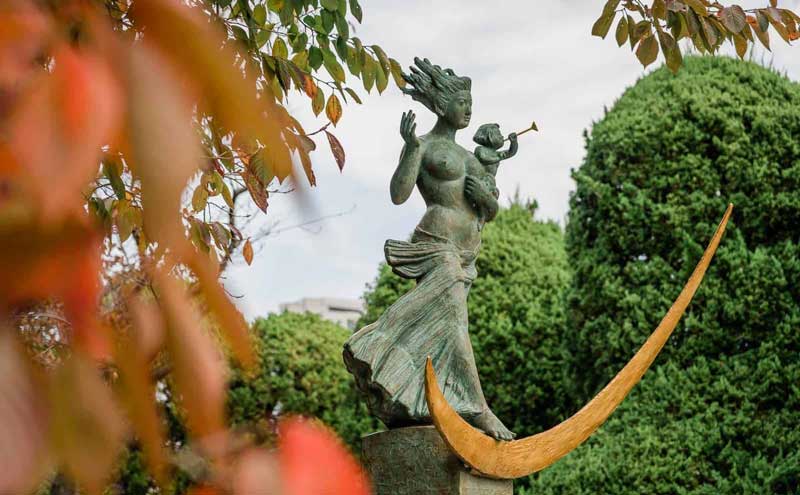
Apart from the above, the Hiroshima Peace Memorial Park contains several other monuments which include the Prayer for Peace, a bronze statue created by the Japanese sculptor Katsuzo Entsyba, and located in the eastern section of the park, featuring a mother holding her child, framed by a crescent moon, symbolising the earnest hope for world peace. The Gates of Peace, consisting of ten 9-metre-tall (28.52 feet) glass and steel gates, carrying the inscription of the word "peace" in 49 different languages on the glass surfaces, and stretching along Peace Boulevard, were added to the park in 2005, to mark the 60th anniversary of the atomic bombing in the city. The three Peace Bells are actually three distinct monuments located at different spots across the park, of which the famous Main Peace Bell stands near the Children's Peace Monument and consists of a large Japanese bell hanging inside a small open-sided structure that visitors are encouraged to ring for world peace. The Peace Clock Tower Bell, located further south in the park, features chimes that ring out every morning at 8:15 a.m. to mark the exact time the atomic bomb exploded, while the smaller, historic Ceremony Bell is kept inside the East Building of the Peace Memorial Museum, and moved outdoors only once a year to be used during the official Peace Memorial Ceremony on 6th August, every year.
As an added attraction, the 50-metre-tall (1640.42 feet) Hiroshima Orizuru Tower with a rooftop observation deck, located next to the Atomic Bomb Dome, offers a spectacular 360-degree panoramic view of Hiroshima Peace Park and the city, to the delight of the visitors.