FREE ASSISTANCE FOR THE INQUISITIVE PEOPLE









Tucked away in the lush forests of northern Lazio, just over an hour’s drive from Rome, the capital city of Italy, the Park of the Monsters, officially named Bosco Sacro di Bomarzo and simply called Sacro Bosco, is an unusual monumental complex, containing dozens of sculptures of bizarre mythological creatures and huge animals from a fantasy world, along with small sculptures, making it a curious realm of awesome grotesque creatures. Situated in a wooded valley beneath the castle of Orsini, the garden, colloquially called the Garden of Bomarzo, was commissioned in 1552 by Pier Francesco Orsini, also known as Vicino Orsini, the eccentric lord of Bomarzo and a connoisseur of art, and was designed by Pirro Ligorio, a famous Italian architect, known for his work in Vatican, as well as for designing the elaborate gardens and fountains of the Villa d’Este in Tivoli, while the weird volcanic rock sculptures are generally attributed to Simone Moschino, an Italian Renaissance sculptor and architect.
It is believed that Vicino Orsini created the complex as a tribute to his wife, Giulia Farnese, who died prematurely. He married Giulia Farnese, a great-niece of Pope Paul III, soon after inheriting Bomarzo in 1542, and was taken prisoner in the early 1550s while fighting in France. Unfortunately, Giulia died in 1560, within a short time after Orsini was released and returned to Bomarzo, and much of the Sacro Bosco was completed after her death. It is speculated by many that the garden served as a way for Orsini to cope with the intense personal grief following the death of his beloved wife, and several grotesque sculptures in the park conjure the underworld, which was a reflection of his grief. A small octagonal temple, located at the highest elevation of the wood with its ceiling decorated with roses, and known as The Temple of Eternity, is considered the most direct memorial to Giulia. However, currently the structure houses the tombs of Giovanni Bettini and Tina Severi, who restored the garden in the twentieth century.
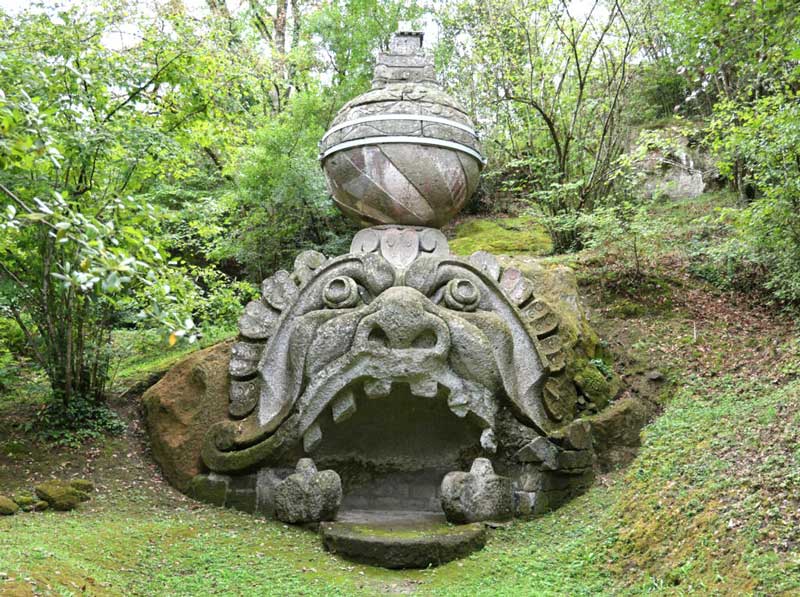
Often interpreted as a theatrical or intellectual puzzle designed to confuse or amaze the viewers, the Park of the Monsters, is a curious realm of frightening creatures that stimulates the imagination of the viewers, generating a variety of subjective responses, and specially loved by children for its aura of mystery in the midst of a natural environment immersed in an unfamiliar world. Perhaps the most popular gigantic structure in the typical gardens of the Italian Renaissance, situated directly alongside villas and laid out in an orderly, geometric manner, is the sculpture of Orcas, a god of the underworld, with its mouth wide open, with an inscription on its upper lip, reading “Ogni pensiero vola”, an Italian phrase, which means ‘Every thought flies’, signifying the ephemeral, fleeting nature of thought, and illustrated by the fact that the acoustics of the mouth mean that even whispers made inside the mouth is clearly audible standing at the base of the steps. Widely known as the Hell Mouth, it is only a fragment of a whole body, which makes it grotesque.
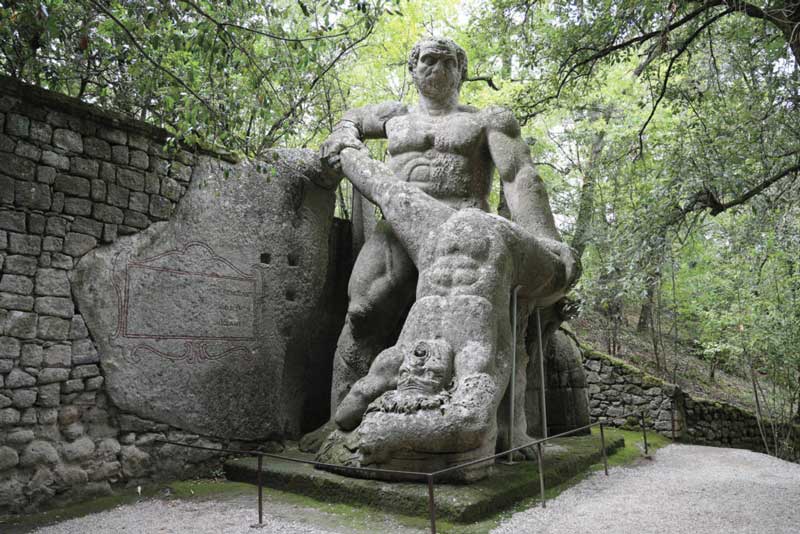
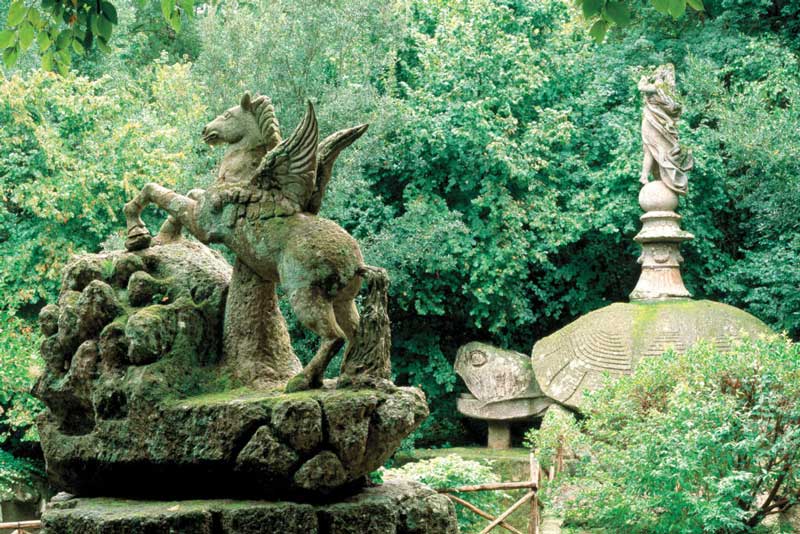
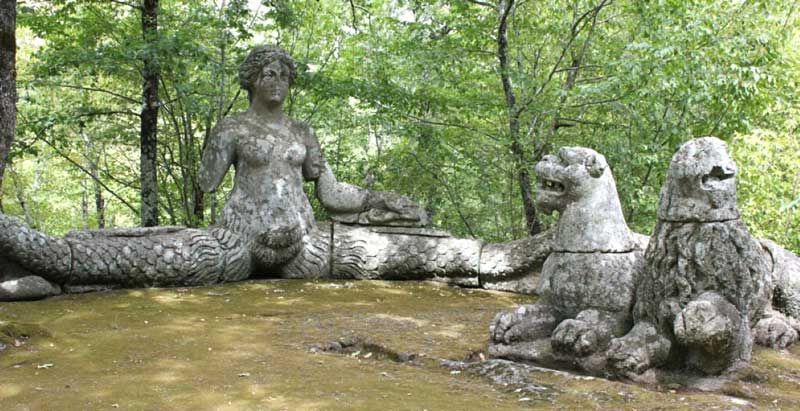
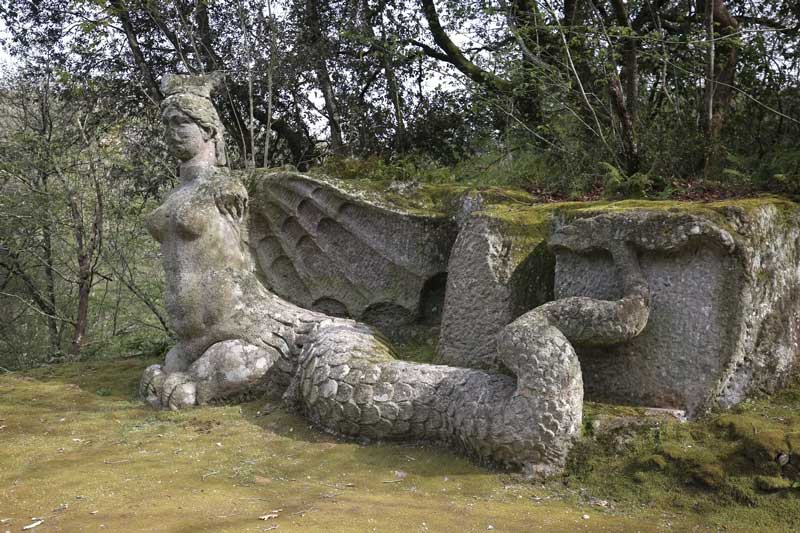
The largest sculptures in the park also include the Gigantomachy or the Battle of the Giants, a pivotal conflict in Greek mythology between the Olympian gods and the Giants, represented by Hercules and Cacus, a fire-breathing, half-human giant and son of Vulcan, the statue of Nike, the Goddess of Victory, standing on a huge turtle, the statue of Pegasus, the immortal winged white horse in Greek mythology, and located by its side, the enormous sculpture of a double-tailed Siren, flanked by a pair of lions, and a winged harpy with a snake's tail representing Echidna.
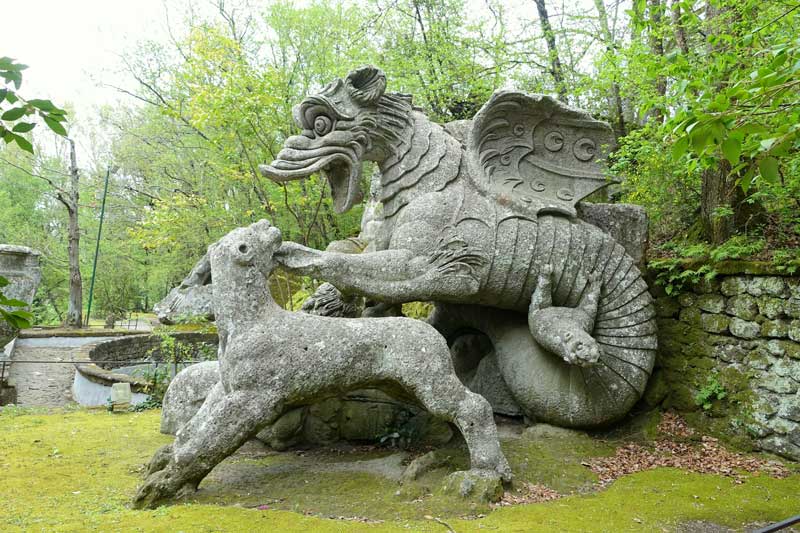
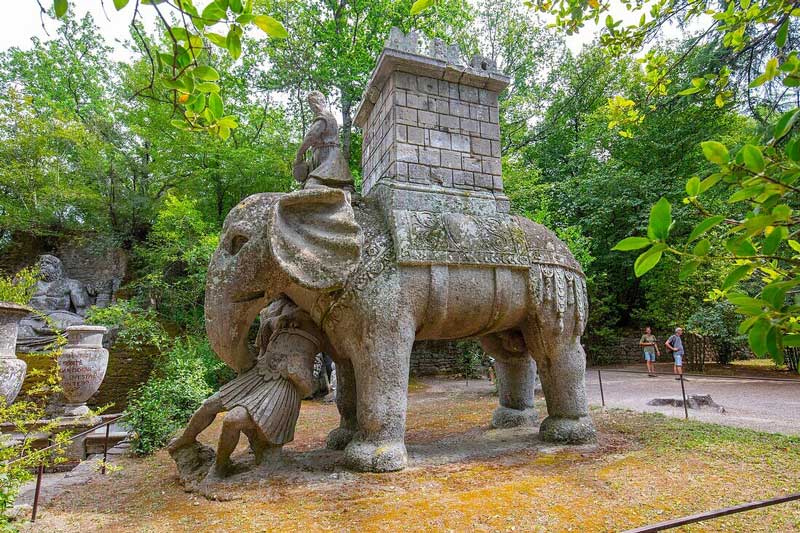
Apart from the statues of divinities such as Saturn and Janus, and a statue of Neptune, the god of the Ocean and horses, reposing in a wide basin, the other sculptures in the garden include Cerberus, the three-headed dog guarding the Underworld, an enormous bug-eyed dragon, fending off the attack by a pair of lions, a huge mask of a monster with its wide mouth agape, surmounted by a globe, along with an elephant, holding a Roman legionary with its trunk, surmounted by a small tower-like structure.
The famous Spanish surreal painter, Salvador Dalí, was captivated by the grotesque statues in the garden when he first visited the park in 1938, although by that time, the park was largely abandoned for centuries and became overgrown due to lack of maintenance, which started from the early 19th century. Dali visited the park several times, before making a short film about the park and its unusual monstrous sculptures, in the 1950s. The film played a pivotal role in bringing international attention to the site, and encouraged by its newly earned attention, Giovanni Bettini, a real estate developer, purchased the property and started a programme of restoration for the seven-acre garden in the 1950s, which lasted throughout the 1970s, and consequently, although a private property, the Park of the Monsters with its bizarre and fascinating sculptures has become a major tourist attraction.