FREE ASSISTANCE FOR THE INQUISITIVE PEOPLE












Situated on the southern slope of the Turó del Carmel hill, part of the Collserola mountain range, overlooking the city of Barcelona in Spain, Park Güell is a well-maintained complex of parks and gardens, widely known for its stunningly colourful mosaics, unusual curvy architecture, and expansive cityscapes. Decorated with quirky vibrant mosaics, waving balcony and the colourful Guard’s House, added with the imposing Barcelona skyline and the Mediterranean Sea in the background, the park is one of the most delightfully charming iconic landmarks of the city, a colourfully magical wonderland where imagination and vibrant design transform an attractive public space into an exceptional masterpiece. Officially opened in 1926, the park was originally designed as part of a garden city project at the beginning of the 20th century, intended to bring together modern urban living for wealthy families and the beauty of nature, which was never completed as planned. However, the incomplete project was declared as a World Heritage site in 1984, for its historical, architectural and artistic uniqueness, where the boundaries between art and landscape dissolve.
Park Güell was the brainchild of local businessperson and Count Eusebi Güel, who commissioned the Catalan architect Antoni Gaudí, widely known as the greatest exponent of Catalan Modernisme, also known as Catalan art nouveau, to design a residential area for wealthy families, which included sixty triangular plots for luxury homes with modern conveniences, within an estate with over 17 hectares. As his idea was to recreate the popular British condominiums, he named it Park Güell, instead of Parc Güell, in the Catalian language spoken in parts of Spain. Construction of the park began in 1900, during Gaudí’s naturalist stage, when he perfected his personal style, inspired by the organic forms of nature, but the project was abandoned in 1914 because they never managed to sell the different plots of land. Eventually, Park Güell became a big private garden, and Güell decided to give it up for public functions. However, after the death of Eusebi Güell in 1918, his heirs sold the park to the Barcelona Council, and it became a public park in 1926. Much later, the historical, architectural and artistic uniqueness of the park, along with other Gaudí buildings in Barcelona, was recognised by the Spanish state in 1969, and was declared a Monument of Cultural Interest.
Only two out of sixty planned houses had been built, before the project was abandoned, and persuaded by Eusebi Güel, Antoni Gaudí purchased one of those two, built as a show home in 1904, and moved in with his father and niece in 1906. The building, designed by Francesc Berenguer i Mestres, a Spanish Modernisme architect from Catalina, became the Gaudí House Museum in 1963, and was declared a national monument in 1969, as a part of the Park Güell.

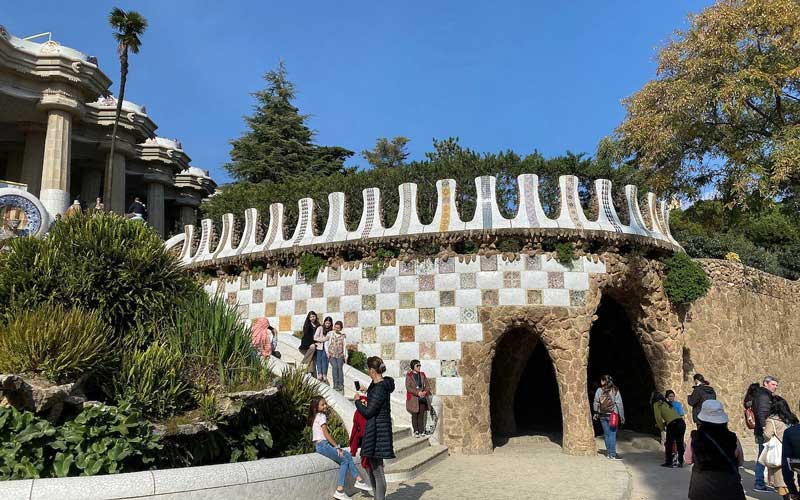
Park Güell reflects Gaudí's distinctive artistic sensibilities and visual language, marking a specific phase in his development, and his study of nature and organic forms led to innovative structural solutions based on geometric analysis, which in turn gave rise to his imaginative and ornamental style, exhibiting structural richness and freedom from the rigidity of classical norms. The majestic entrance to the park, loaded with strong symbolism, with allegories and references to industrial development, the Catalan bourgeoisie and religion, is marked by the Olot Pavilions, two gatehouses at the park's main entrance, inspired by the fairytale Hansel and Gretel, Pavelló de Recepció or The Reception Pavilion in the left, and the Casa del Guarda or the Guard’s House with a spire in the right, famous for their mushroom-like roofs, vibrant trencadís mosaics, created with broken ceramic tiles, and ornate spires, serving as a whimsical welcome to the Modernista masterpiece. Today, the Reception Pavilion serves as a small exhibition of the relationship between Güell and Gaudí, and how the Park came about, while the Guard’s House houses a souvenir shop.
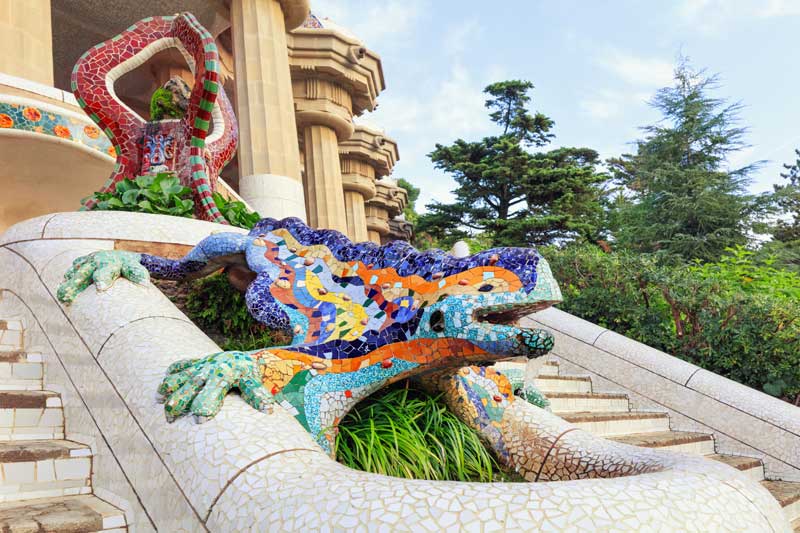
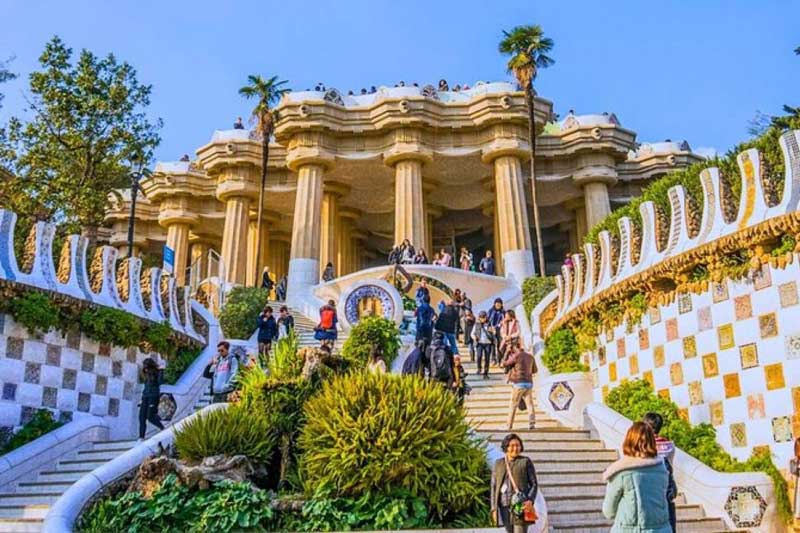
The entrance leads to the magnificent stairway, called Escalier du Dragon or Staircase of the Dragon, featuring perhaps the most fascinating item in the park, the huge 7.87-feet-long (2.4 m) dragon or salamander, guarding the staircase, along with a fountain covered with Gaudí’s technique of trencadís. The staircase leads to the Sala Hipòstila or Hypostyle Hall, an awe-inspiring space, supported by 86 Doric columns, designed to be the marketplace for the residential community that never happened. The ceiling of the hall is decorated with colourful medallions of mosaics, and in addition, Gaudí placed four large circular panels in the form of rosettes, 3 m in diameter, representing the four seasons of the year, with drawings of suns with 20 points of different colours in the free space left in the ceiling There is an expansive terrace above the hall, framed by a serpentine bench, covered in multicoloured mosaics and curving in organic waves, offering visitors to leisurely pass time, enjoying the sweeping views of Barcelona stretching all the way to the Mediterranean Sea.


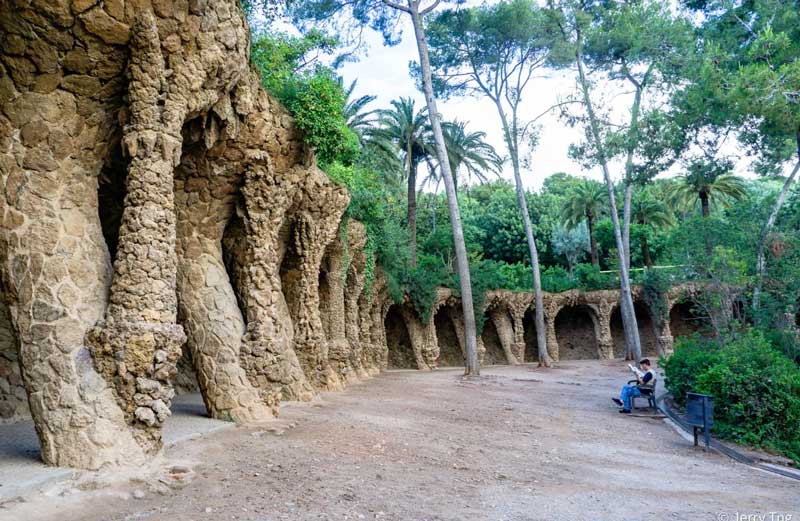
Designed by Antoni Gaudí to blend with nature and serve as a sheltered walkway, The Pòrtic de la Bugadera or the Portico of the Laundrywoman, located on the eastern side of Nature Square, is a whimsical, naturalist-style architectural structure in the Park Güell, known for its sloping columns resembling palm trees or laundry poles, and earned its curious name, the laundrywoman, as a particular column was sculpted to imitate a woman with a laundry basket over her head. Another important feature of Park Güell is Plaça de la Natura or the Nature Square, the large central terrace, known for its iconic undulating mosaic bench, designed by Josep M. Jujol, and known as Banc de Trencadís, offering panoramic city views and serving as a focal point for Gaudí's modernist architecture. Originally called the Greek Theatre for planned open-air shows, this vibrant space sits atop the Hypostyle Room and is a prime example of Catalan Modernism. The highest point of the park is a hill with steps leading to El Turó de les Tres Creus or Hill of the Three Crosses, one of which points skyward; the other two mark the cardinal directions. From the site, visitors can view the Sagrada Família, a church under construction, Torre Glòries, a phallic shaped 38-storey skyscraper, and the blue Mediterranean.