FREE ASSISTANCE FOR THE INQUISITIVE PEOPLE





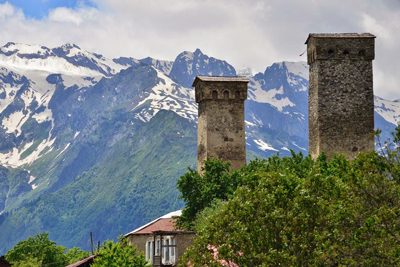








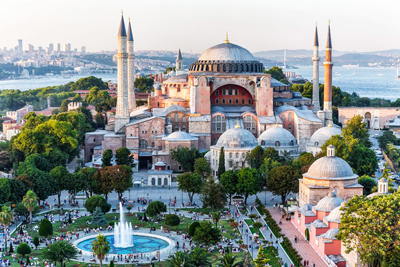
Originally built as a Christian basilica nearly 1,500 years ago, Hagia Sophia is a long-enduring iconic symbol and an enormous architectural marvel in Istanbul, the largest city in Turkey. Anchoring the Old City of Istanbul, and serving for centuries as a landmark for both the Orthodox Christians, as well the Muslims, it has a long chequered history behind it. Initially it was inaugurated as a basilica for the Greek Orthodox Christian Church on 15 February 360, by Byzantine Emperor Constantius II, and then converted into a mosque by the Ottomans, led by Emperor Fatih Sultan Mehmed on 27 May 1453. However, after serving as a mosque for nearly 500 years, it became a museum in 1935, before being officially reconverted back into a mosque in July 2020.
History says, originally known as Magna Ecclesia or the Great Church, it was inaugurated on 15 February 360 AD, as a basilica for the Greek Orthodox Christian Church, by Byzantine Emperor Constantius II. During those days, Istanbul was known as Constantinople, named after Constantine I, the first ruler of the Byzantine Empire and the father of Constantius II. The original building of Magna Ecclesia had a wooden roof, which was unfortunately completely devoured by a devastating fire in 404 AD, during the riots that took place in Constantinople, due to the political conflicts within the family of the then Emperor Arcadious, who had a turbulent reign from 395 to 408 AD.
The second building of Magna Ecclesia or the Great Church, commissioned by the Roman Emperor Theodosius II, the successor of Arcadius, was completed in 415 AD, and was officially renamed Hagia Sophia, which stands for Holy Wisdom. The new structure, consisting of five naves and a monumental entrance, was also covered by a wooden roof. Strangely, a little more than one century later, that structure was also gutted by fire during the Nika riots, the most violent riots in the history of Constantinople against Emperor Justinian I, triggered by high taxation and the arrests of chariot faction members, operating as professional stables. Nevertheless, as the structure was irreparable, Emperor Justinian I ordered to demolish the ruined structure in 532 and commissioned renowned architects Isidore of Miletus and Anthemius of Tralles to build a new basilica, the third building of Magna Ecclesia, which was completed in 537 and the first religious services in the new building, were held on 27 December 537.
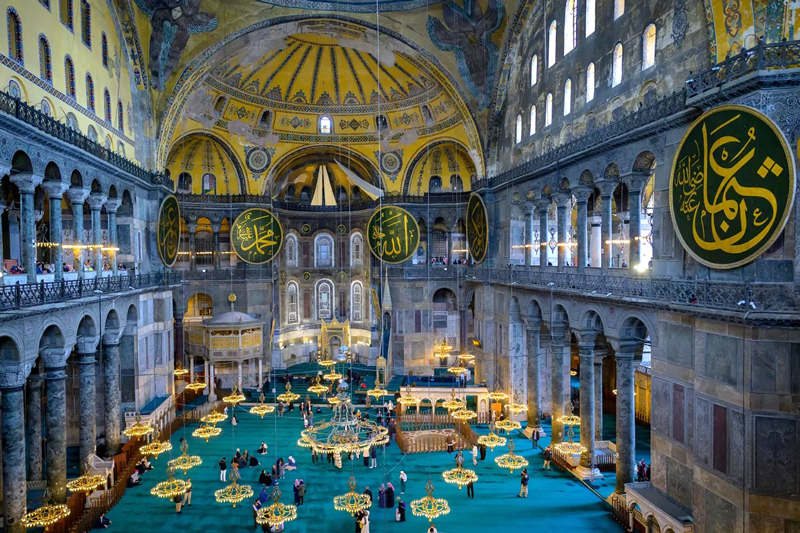
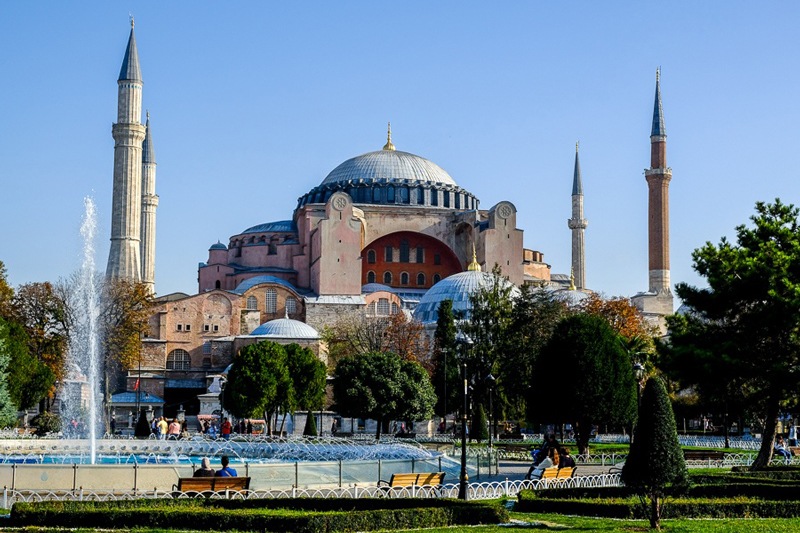
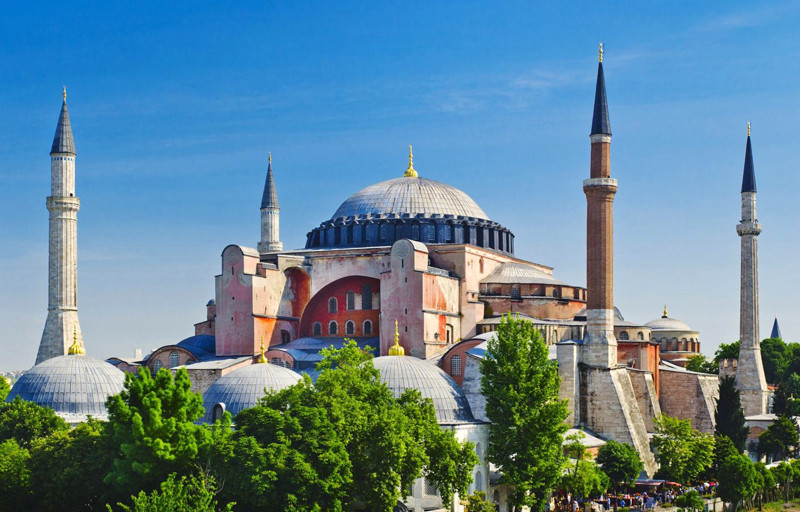
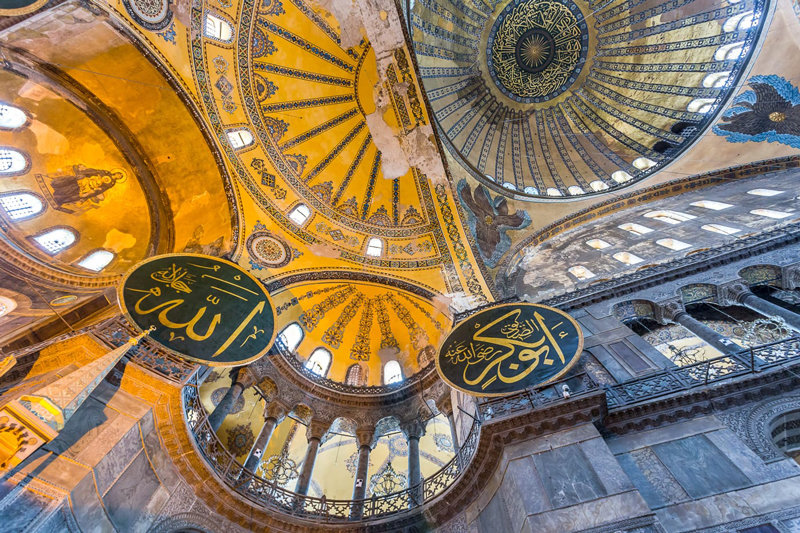
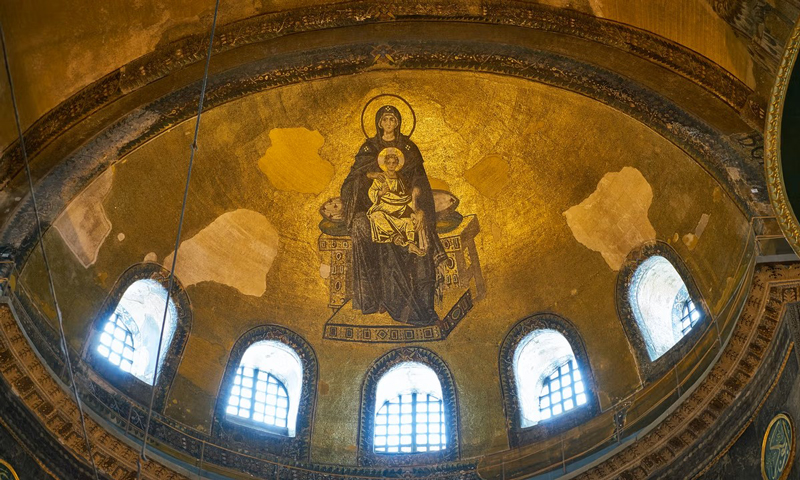
The third building, renamed Hagia Sophia, which still stands gracefully, is a remarkable structure complete with the traditionally designed elements of an Orthodox basilica with a huge dome on the top and a semi-domed altar with two narthex or porches. The supporting arches of the dome are covered with mosaics of six winged angels, known as hexapterygon. The central dome, which rests on a ring of windows, is supported by two semi-domes and two arched openings to create a large nave. The walls of the nave were originally lined with intricate Byzantine mosaics made from gold, silver, glass, terracotta and colourful stones, portraying well-known scenes and figures from the Christian Gospels.
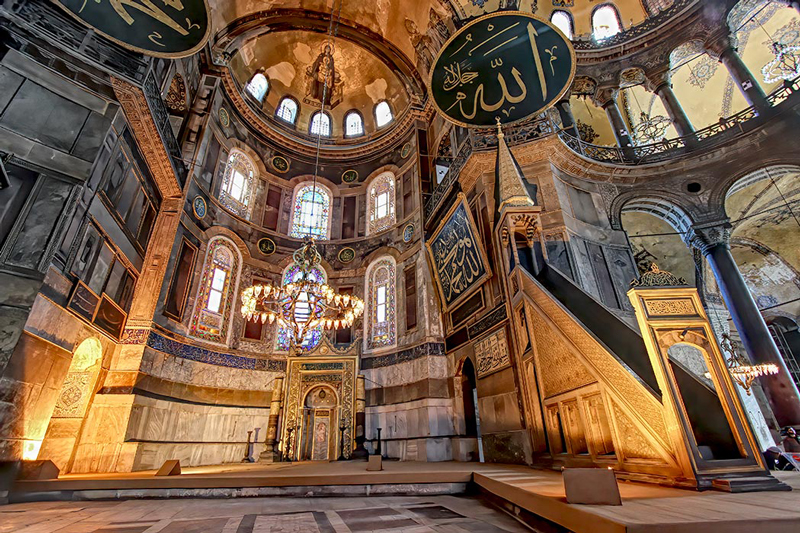
The massive structure of Hagia Sophia, measures about 269 feet in length and 240 feet in width, while the domed roof stretches some 180 feet into the air at its highest point. In 557, the first dome suffered a partial collapse and its replacement was designed by Isidore the Younger, the nephew of Isidore, who was one of the original architects. The marble used for the floor and ceiling of Hagia Sophia came from Anatolia and Syria, while its 104 columns were imported from the Temple of Artemis in Ephesus, located in present-day Greece, as well as from Egypt. The interior of the building is lined with enormous marble slabs, which are designed to create the illusion of moving water.
For the major part of its first 900 years of existence, the gracious Hagia Sophia served a pivotal role in Byzantine culture and politics. As Greek Orthodox was the official religion of the Byzantines, Hagia Sophia was considered the central church of the faith, and thus it became the place of automatic choice, where new emperors were crowned. Unfortunately, Hagia Sophia was severely damaged during the days of the Crusades, when the city of Constantinople was under Roman control, for a brief period in the 13th century. However, the damage was repaired when the Byzantines once again took control of the surrounding city.
In 1453, the Ottomans, under the leadership of Emperor Fatih Sultan Mehmed, alias Mehmed the Conqueror, captured Constantinople and renamed it Istanbul. They also renovated the Hagia Sophia into a mosque and covered many of the original Orthodox-themed mosaics with Islamic calligraphy, designed by Kazasker Mustafa Izzet Efendi, known as one of the masters of Ottoman calligraphy. Even, the mosaic in the main dome, which is believed to be an image of Christ, was also covered by gold calligraphy. To indicate the direction towards Mecca, one of the holy cities of Islam, a mihrab or nave was installed in the wall, as is tradition in mosques. Later, two bronze lamps on each side of the mihrab were installed by Ottoman Emperor Kanuni Sultan Süleyman, who reigned between 1520 and 1566. Apart from that, four minarets were also added to the original building during that period. Till the construction of the nearby Sultan Ahmed Mosque, the Blue Mosque of Istanbul in 1616, it was the principal mosque of Istanbul.
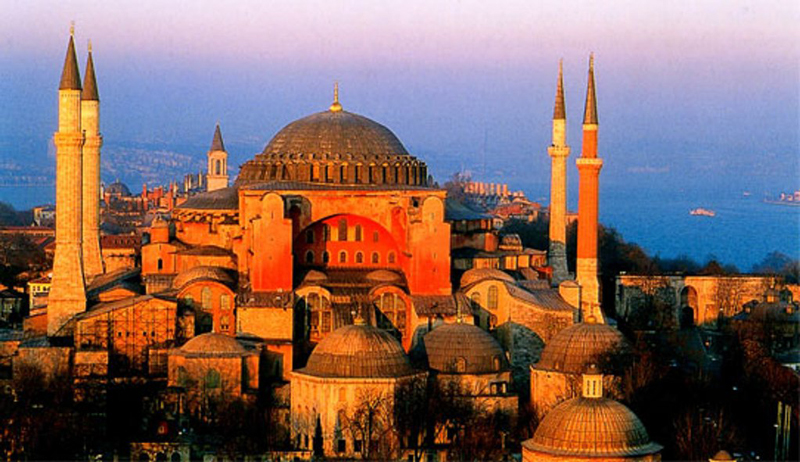
However, Hagia Sophia is neither a church, nor a mosque today. The Turkish President, Kemal Ataturk, secularized the building in 1934 and in 1935, it was made a museum. It is enlisted in UNESCO World Heritage Site as the Historic Areas of Istanbul, which includes the other major historic buildings and locations of the city.