FREE ASSISTANCE FOR THE INQUISITIVE PEOPLE
















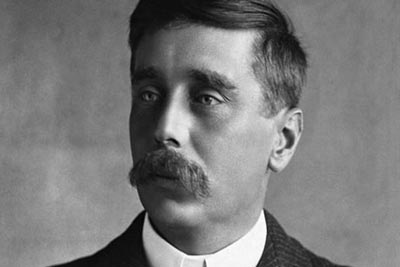


Hedy Lamarr, an Austria-born American actress, born as Hedwig Eva Maria Kiesler, in Vienna, Austria on 9 November 1914, to Jewish parents Gertrud Lichtwitz, from Budapest, and Emil Kiesler, a banker from Lemberg, is regarded as the co-inventor of a radio guidance system, known as frequency hopping, with composer George Antheil that would block enemy ships from jamming torpedo guidance signals to defeat the threat of Nazi power. Although the technology was not adopted by the US Navy until the 1960s, she pioneered the technology that was later incorporated into the basis for today’s Bluetooth, GPS and Wi-Fi communication systems.
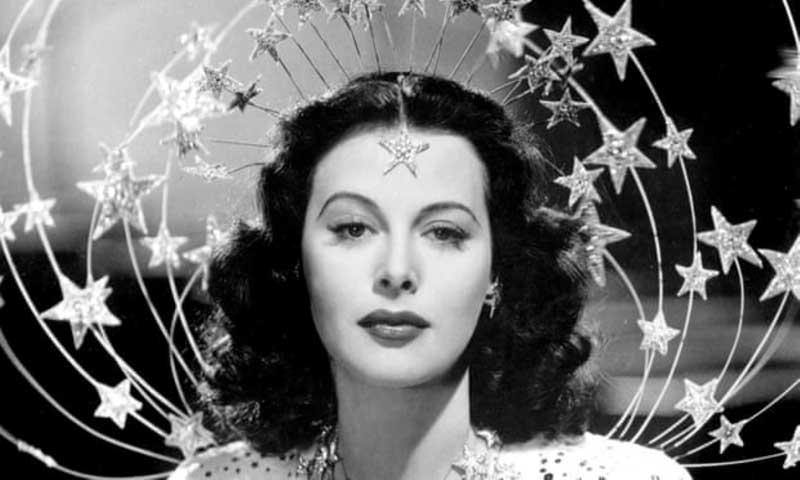
As the only child of a well-to-do Jewish family, she received a great deal of attention from her father, who inspired Hedy to look at the world with open eyes. During long walks with his daughter, he often used to explain to her the inner workings of different machines, like the printing press or streetcars, which prompted her to take apart and reassemble her music box at the tender age of five, to understand how the machine operated. However, her brilliant inquisitive mind was ignored, and her beauty took centre stage when she won a beauty contest in Vienna at the age of 12, decided to drop out of school and started attending acting classes in Vienna. She made her first screen appearance in the bit of role a young woman at a nightclub table in the German film Money on the Street in 1930, and as she was attractive and talented, she got the opportunity to appear in three more German productions in the next year.
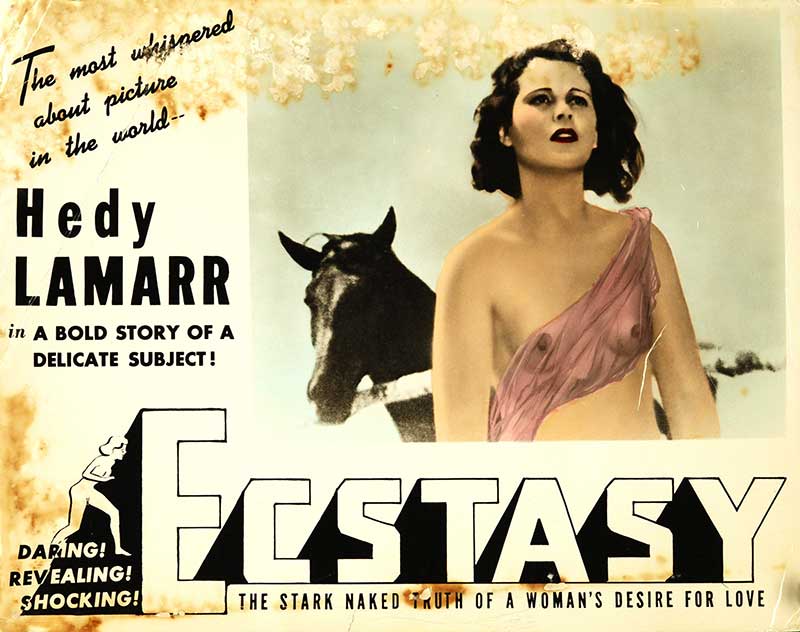
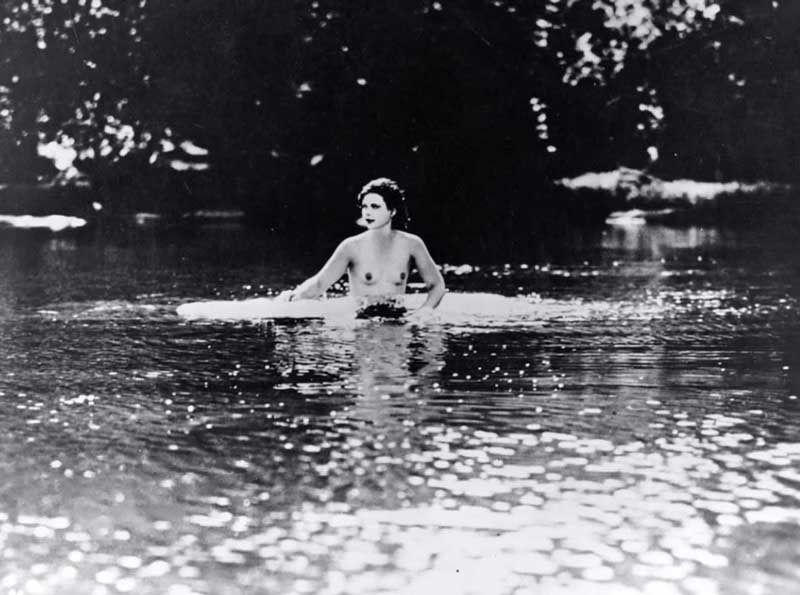
But her career was boosted by her fifth film, Ecstasy (1933), in which she appeared with her screen name Hedy Kiesler, playing the role of Eva Hermann, the frustrated young wife of an indifferent older man, who eventually finds fulfillment in an illicit affair with a young soldier. The film became path-breaking and notorious, as Lamarr appeared nude in some scenes and her face was shown in close-up in the throes of orgasm, probably for the first time in a film. Although Hedy Lamarr claimed that she was duped by the director and producer and her movements in the love scene were prompted by the shouting instructions of the director, who used high-power telephoto lenses, her claims were contested by other people related to the film. The film was banned in the US, but screened illicitly in the country for years together and Lamarr came to be known as the Ecstasy girl.

At the early age of 18, Hedy Lamarr married the 33-year-old Austrian munitions dealer and a prominent Austrian fascist Fritz Mandl on 10 August 1933, who was attracted by her beauty and became one of her adoring fans, when he saw her in the play, Sissy. Fritz Mandl. Fritz Mandl had close social and business ties with the Italian government, selling munitions to the country, and he tried to buy up all the prints of Ecstasy, reportedly spending approximately $280,000, to suppress its distribution, to ensure no one else could watch the film containing his wife performing female orgasm in nude. But he failed and lots of prints of the film are floating around the world even today. It is said that Italy’s fascist dictator Benito Mussolini had a copy of the film and he refused to sell it to Mandl. However, he was an extremely controlling husband, who prevented her from pursuing her acting career and kept her almost as a prisoner in his castle home. However, she was forced to play the smiling host among the friends and scandalous business partners of her husband, some of whom were associated with the Nazi party. Besides, she was also compelled to accompany him to his business meetings, where he conferred with scientists and other professionals involved in military technology. Although those conferences introduced her to applied science and nurtured her latent talent in science, the marriage soon became unbearable to Lamarr. She became incredibly unhappy as she knew she could never be an actress while she was Mandl’s wife. Finally, she escaped from the grasp of Fritz Mandl and fled to London in 1937, equipped with the knowledge of wartime weaponry she gathered from the dinner-table conferences of Mandl with the scientists and other professionals.
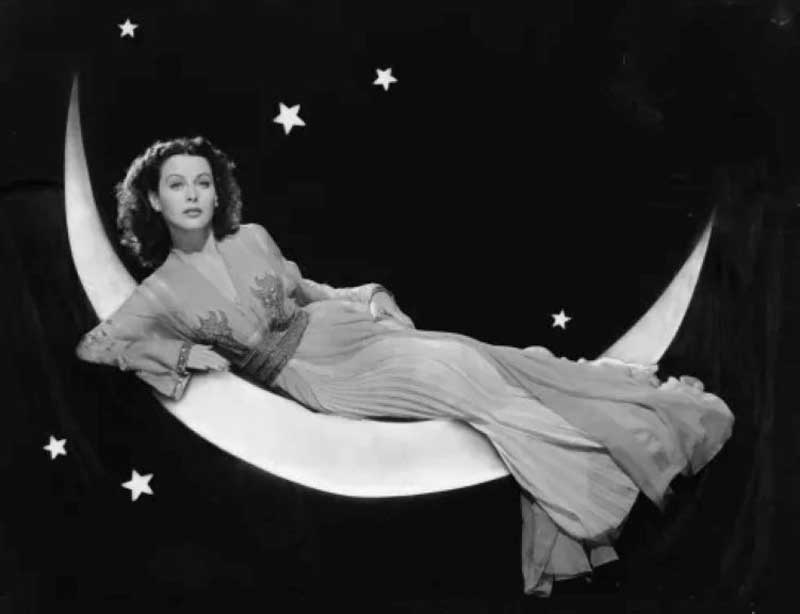
While she was in London, the notoriety of Ecstasy brought Hollywood to her door, when she was brought to the attention of Lois B Mayer, the head of MGM. He signed her to a contract and to distance herself from her real identity, he persuaded her to change her name to Hedy Lamarr, after the silent-era beautiful film star Barbara La Mar. She was brought to Hollywood in 1938 and the company began promoting her as the world's most beautiful woman. She made her American film debut as Gaby in Algiers (1938), billed as an unknown but well-publicized Austrian actress, opposite Charles Boyer and her beauty took one's breath away. Her other films included Boom Town (1940) with Clark Gable and Spencer Tracy; Come Live with Me (1941) with James Steward; Crossroads (1942) with William Powel and a seductive native girl, a siren of alluring beauty, called Tondelayo, in the adventure drama film White Cargo (1942), which was a huge hit. Unfortunately for Hedy, she turned down the leading roles in Gaslight (1940) and Casablanca (1942), which created marks in the history of the film industry. However, she was reunited with Powell in a comedy The Heavenly Body (1944), and was also teamed with Robert Walker in the romantic comedy film Her Highness and the Bellboy (1945), her last film under her MGM contract, playing a princess who falls in love with a New Yorker, which proved to be very popular.

During that time, MGM branded Hedy Lamarr as one of the most ravishing stars of the Hollywood Golden Age, but she took it coolly by saying that any girl can look glamorous, only by standing still and looking stupid. In fact, despite proving herself as the ultimate silver-screen siren, when she dazzled on the screen with her sizzling appearance in Cecil B DeMille’s epic film Samson and Delilah (1949), she had much more in her head than her stunning dark locks, translucent fair skin and sparkling green eyes. Bored by the kinds of movies she was offered, Hedy Lamarr, with her natural inclination to science, dreamed up a tablet that would dissolve in water to create a cola-flavoured carbonated drink. Not only that, despite working throughout the day for film shoots, she stayed up all night at home, practising her favourite hobby of inventing something new. Interestingly, she did not have to work on ideas, as they came to her naturally. Her success in the field of inventions included streamlining racing aeroplanes for her lover, Howard Hugh, a businessman and a pilot, who took her to his factories to show how planes were built. His dream idea of creating faster planes that could be sold to the US military inspired Lamarr to innovate. She bought a book of fish and a book of birds and looked at the fastest of each kind, combined the fins of the fastest fish and the wings of the fastest bird, to sketch a new wing design for Hughes’ planes, which made Howard wonder-struck.

Hedy Lamarr met George Antheil, known for his film scores and experimental music compositions, in 1940 over a piano at a dinner party. They talked about a variety of topics, especially about the Great War, when Lamarr expressed her deep concern about the sinking of the SS City of Benares in September 1940, which had been carrying 90 child evacuees from Britain to Canada. She believed the Allies could defeat Germany by sinking enemy ships with radio-controlled torpedoes and inventing a device to block enemy ships from jamming torpedo guidance signals. Eventually, working together on the idea, they came up with an extraordinary new communication system involving the use of frequency hopping amongst radio waves, with both transmitter and receiver hopping to new frequencies together. In other words, it was a way for the radio guidance transmitter and the torpedo’s receiver to jump simultaneously from frequency to frequency, making it impossible for the enemy to locate and block a message before it had moved to another frequency. Although the approach, known as frequency hopping, received a patent in 1941, the US Navy engineers decided against the implementation of the new system, as they considered the idea impractical and too cumbersome to adopt. However, during the Cuban Missile Crisis in 1962, the US ships on a blockade line around Cuba were armed with torpedoes guided by a frequency-hopping system. Even then, Lamarr was neither recognised as the mother of the invention, nor benefited financially from the use of the invention by naval ships.
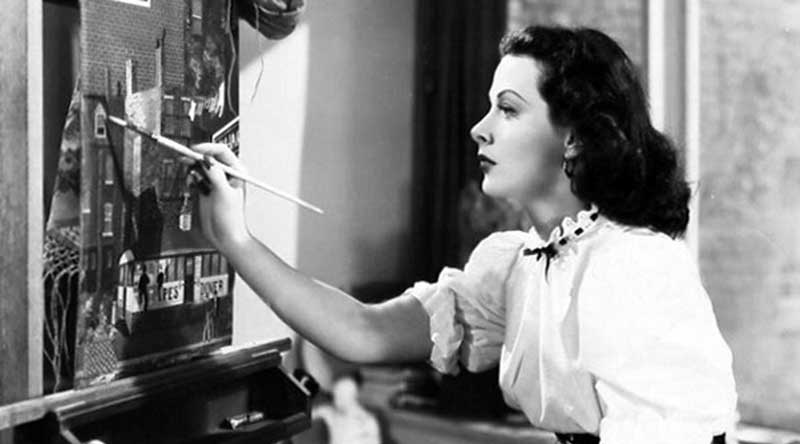
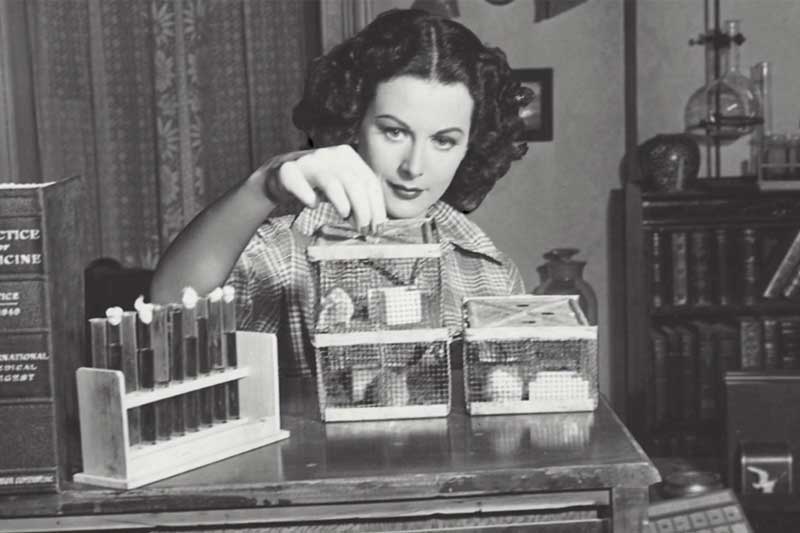
Unfortunately, Americans were aware of the six marriages of Hedy Lamarr, but few had any knowledge about her level of intelligence or the urge to appreciate her capability as an inventor. It was only three years before her death at the age of 85 in 2000 that she was jointly awarded, along with Antheil, by the Electronic Frontier Foundation with their Pioneer Award in 1997. During the same year, she also became the first female recipient of the prestigious BULBIE Gnass Spirit of Achievement Award, often regarded the Oscar of Inventing, for her co-invention of frequency-hopping spread spectrum technology, which forms the basis of modern Wi-Fi, Bluetooth, and GPS. Long after her death, Hedy Lamarr was inducted into the National Inventors Hall of Fame in 2014, for the development of her frequency hopping technology, which has led her to be dubbed as the mother of Wi-Fi and other wireless communications like Bluetooth and GPS.