FREE ASSISTANCE FOR THE INQUISITIVE PEOPLE























Lion, the proverbial king of beasts, a large, powerfully built big cat, is second in size only to the tiger. It has a muscular, deep-chested body, powerful forelegs, teeth and jaws for pulling down and killing prey, rounded head, round ears, and a hairy tuft at the end of its tail. While its fur varies in colour from light buff to silvery grey, yellowish red and dark brown, the outstanding characteristic of an adult male is his shaggy manes that give it a majestic appearance. The manes vary in shades from blond to reddish-brown to black and grow downwards and backwards, covering most of the head, neck, shoulders, and chest. However, young lions have light-coloured spots on their brown coats that disappears as they grow.

Lions stand between 3.5 and 4 feet (1 and 1.2 m) tall at the shoulder, grow to lengths of 10 feet (3 m) and have a 2 to 3 foot (60 to 91 centimetres) tail. The males weigh from 150 to 250 kilograms (330 to 550 pounds), while the slightly smaller, females that grow to 9 feet (2.7 m) long, weigh between120 to 179 kilograms (265 and 395 pounds).
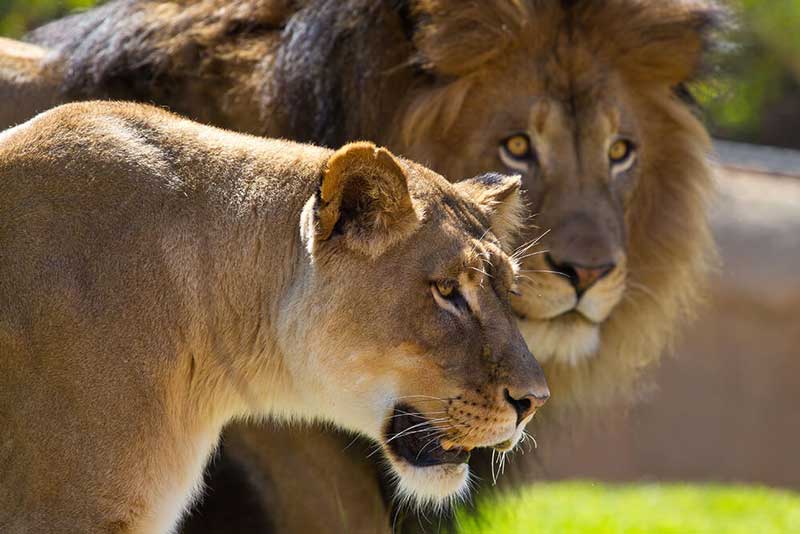
Although the lions inhabit a wide range of habitats, from open plains to thick brush and dry thorn forest, they are conspicuously absent from equatorial areas dominated by moist tropical forest. However, except for an isolated population of about 650 Asiatic lions that live under strict protection in the Gir National Park and Wildlife Sanctuary in Gujarat, western India, lions now live only in sub-Saharan Africa, from the Sahara's southern fringe to northern South Africa.

Unfortunately, populations in African countries have declined by about 43% since the early 1990s, and although the cause of the decline is not fully understood, it has been listed as Vulnerable on the International Union for Conservation of Nature (IUCN) since 1996.
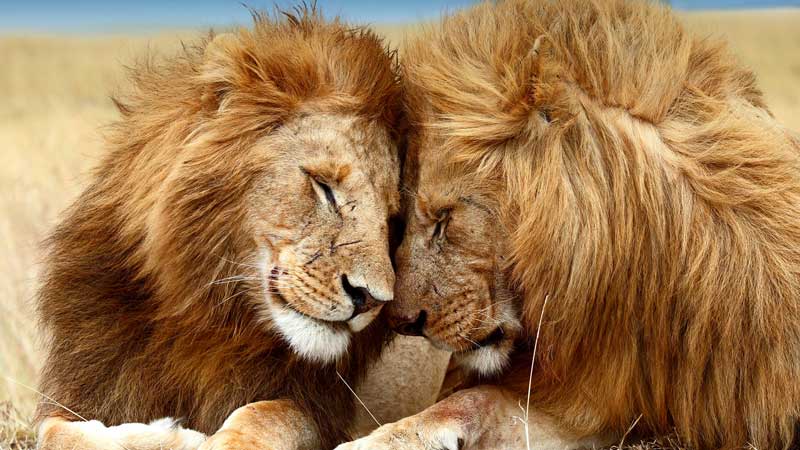
Typical for a big cat, lions remain inactive for almost twenty hours a day and spend an average of two hours a day walking and fifty minutes eating. In open savanna, usually lionesses do most of the hunting, while males typically appropriate their meals from the female’s kills. However, male lions are also proficient hunters and in some areas, they hunt frequently. But lions are not particularly known for their stamina, they run quickly only in short bursts and try to get close to their prey before starting the attack. Their attack is short and powerful and usually pull it down by the rump and kill by a strangling bite to the throat of the victim. Their prey consists mainly of big mammals, with a preference for Zebra, African Buffalo, Antelope and giraffe.

However, they usually avoid small prey like monkeys and hare and fully grown adult elephants, hippopotamus and rhinoceroses. Strange it may seem, but they often steal the kills of cheetahs and leopards, kill their cubs and even adults. However, sometimes they also lose their own catches to hyena groups. Typically, lions consume prey at the location of the hunt but sometimes drag large prey into cover. The large kills are shared more widely among the members of the group. While a lion requires about 7 kg (15 lb) of meat per day, a lioness requires an average of about 5 kg (11 lb).

Lions are the most social felines and they live in groups, called pride, comprising of several lionesses, most of whom were related, no more than two adult males and their cubs. Each pride consists of as few as 4 or as many as 40 members and has a well-defined territory, which could cover up to 400 square km or as small as 20 square km, strictly defended against intruding lions. They mark the pride area by urinating, defecating and rubbing against bushes leave different scent markings and their distinctive roars. While the females usually live with their pride for life, the males often go off on their own after two to four years or are evicted by other interested males. When a new male becomes part of the pride, it usually kills all the cubs, probably to ensure all future cubs will be of his genes.

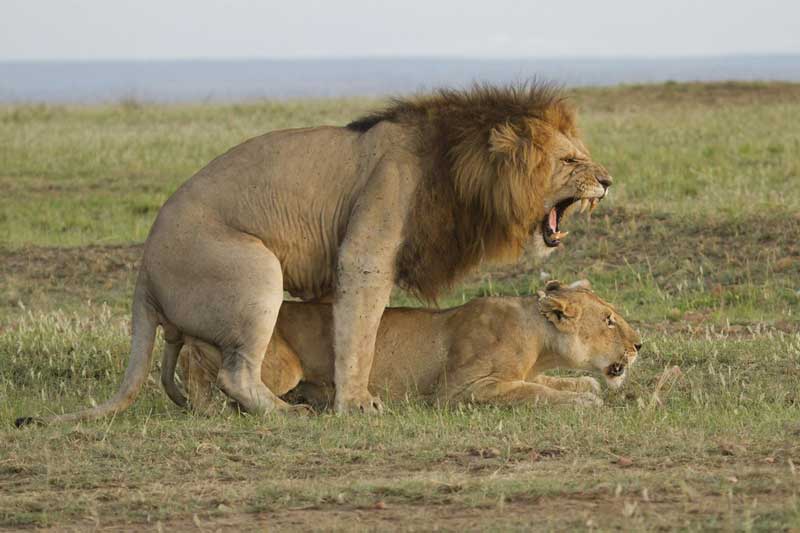
By nature, both male and female lions are polygamous, but lionesses are usually restricted to the one or two adult males of their pride. Within a widely variable reproductive cycle, lionesses are receptive to mating for three or four days, during which a pair generally mates every 20 to 30 minutes, with up to 50 copulations per 24 hours. It is found that the extended copulation often stimulates ovulation and at the same time, it also secures paternity for the male. Apart from that, the lion’s penis has penile spines that point backwards and during withdrawal, the spines rake the walls of the vagina, which mostly trigger ovulation.
After a normal gestation of around 100 to 110 days, the female gives birth to a litter of between one and four cubs in a secluded and safe place, usually away from the pride. The cubs are almost helpless, born blind and their eyes open around seven days after birth, can follow their mothers at about three months of age and are weaned by six or seven months. Although they begin participating in kills even before the completion of the first year of their lives, probably cannot survive on their own until they are two years old. While they become sexually mature at three or four years of age, male cubs are expelled from the pride at about three years of age and become nomads, until they take over another pride. It has been found that in captivity lions may live around 20 years, but in the wild, while a lioness may live up to 16 years, the males rarely live past the age of 12, chiefly because of illegal hunting and attacks by other lions or the effects of kicks and bites from intended prey animals.