FREE ASSISTANCE FOR THE INQUISITIVE PEOPLE




















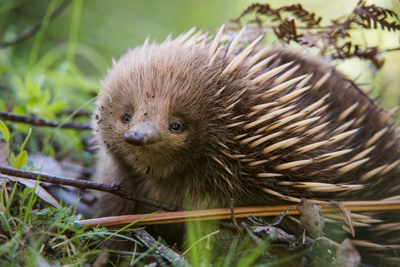
Echidnas are egg-laying mammals from Australia, Tasmania and New Guinea, evolved between 20 and 50 million years ago, but is still considered quite enigmatic by the researchers and scientists. The strange animal owes its name from a half woman, half snake creature from Greek mythology of the same name, known as the Mother of Monsters, as the animal was assessed to have qualities of both mammals and reptiles. In fact, the Echidnas are the only animal in the world, equipped with a beak like a bird, spines like a porcupine, a beak like a bird, a pouch like a kangaroo and they lay eggs like a reptile. Outwardly, they resemble the hedgehogs, but the animal belongs to completely different mammalian orders and they can be distinguished by their spines, the number of claws on their feet and by the shape and length of their beaks.

Though the Echidnas are often classified as long or short-beaked, actually they do not have beaks at all. They have meaty noses that can be long or rather short. They eat and breathe through their bald tubular beak like noses, protruding from a dome-shaped body covered in spines. They have beady eyes and mere slits for the ears and at the end of their so called beaks they have two small nostrils and a tiny mouth. As their jaws are toothless, they use their slender snouts and strong claws to tear open logs, ant hills and other food sources and use their long sticky tongues, which can reach up to 7 inches (18 cm) long when extended, to scoop up the food like, ants, termites, worms and insect larvae. Echidnas can be active throughout the day or night, probing along the ground slowly and deliberately as they search for prey. However, as they have an unusually low, but variable body temperature of 29-32 °C (84-90 °F), they cannot tolerate extreme heat and take shelter in burrows or cool caves to avoid the extreme midday heat.

Echidnas are usually between 12 and 17 inches long and weigh between 4 and 10 pounds. They have sharp spines covering the back of their short, stocky bodies, which can grow up to 2 inches (5 cm) long and the fur between their spines provides the necessary insulation. In the hot northern regions, Echidnas are light brown, but they become darker with thicker hair further south and in Tasmania, they look black.

The male echidnas are equipped with spurs on their hind legs that secrete a milky substance from the spurs during breeding season, which serves as a means of scent communication. On the other hand, the female echidnas do not have nipples to feed their babies, but instead of nipples, they have special glands in their pouches, called milk patches, that secrete milk, which the puggle, the young echidna, laps up.

Echidnas typically breed between July and September and their mating is quite unusual. It starts with the males line up behind a single female, forming a train of up to a dozen individuals, the youngest echidna trailing last, that follow the female and attempt to mate. Male echidnas have a four-headed penis and the females have a two-branch reproductive tract.

The penis is 2.8 inches (7 cm) long when erect and its shaft is covered with penile spines, which may be used to induce ovulation in the female. During sex, two heads of the male penis shut down, while the other two grow bigger to fit into the two-branched reproductive tract of the female partner and each time it copulates, it alternates heads in sets of two.
Sometimes, a male echidna wake up early from hibernation, sneak into the female burrows and mate with a hibernating female. It often results in the female echidna waking up pregnant, without having any clue about the consequence.

The female echidna lays a 1.5 to 2 gm soft-shelled egg 20 days after mating directly into a pouch and hatching takes place after ten days of gestation, when a half inch (12 mm) baby echidna, called a puggle, is born. The baby stays in the mother’s pouch for another 45 to 55 days, when it sucks milk from the two milk patches of the mother and it starts to develop the spines. After the end of the period, the mother digs a nursery burrow for the baby, returning every five days to feed it, until about seven months.
Echidnas can live up to 50 years in captivity and possibly 45 years in the wild, though there is no definitive proof about that.