FREE ASSISTANCE FOR THE INQUISITIVE PEOPLE














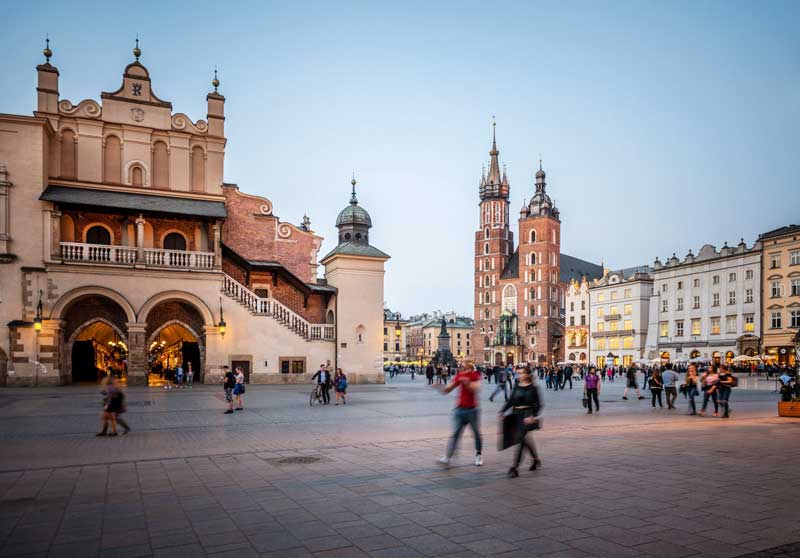
Locatedon the Vistula River, at the centre of Krakow, in the historical Old Town region in the south and southeast Poland and covering an area of more than 40,000 square feet, Rynek Glowny or the main market square is the principal urban space of the city. Considered the largest medieval town square in Europe, it is lined with numerous pubs and cafés, music bars and souvenir shops, punctuated with the historic townhouses and churches, landmarks and magnificent middle age brick buildings with a neoclassical look. While the tall Gothic towers of St.

Mary's Basilica predominate the sky above the square, the centre of the square is dominated by the Cloth Hall, rebuilt in 1555 in the Renaissance style, topped by a beautiful attic or Polish parapet decorated with carved masks, rising above the square.
Kraków, traditionally regarded as one of the leading centres of Polish academic, economic, cultural and artistic life, lost much of its glamour and glory in the 1330s.By the time, when Casimir attained the throne in 1333, the kingdom was depopulated, exhausted by war and the economy was ruined. But Casimir gradually rebuilt the country, strengthened its defence system, fortified about 30 towns and constructed around 39 castles, ensuring stability and great prospects for the future of the country. During his reign, the city of Kraków flourished again as an important European metropolis, as the capital of the Kingdom of Poland and a member of the Hanseatic League.
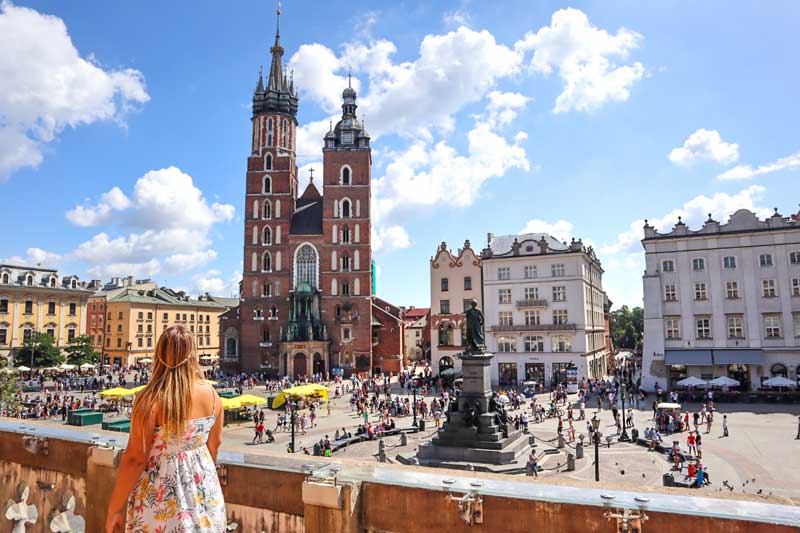
The Rynek Glowny, which dates back to the 13th century, was originally meant for commerce and contained low market stalls and administrative buildings, complete with a ring road running around it and was connected to the Wawel Royal Castle. However, it was rebuilt in 1257, after the city was completely destroyed by the Mongol invasion in 1251, when it was designed in its current form with each side repeating a pattern of three and the evenly spaced streets set at right angles to the square.

Later, King Casimir, who reigned as the King of Poland from 1333 to 1370, commissioned the original Gothic building of the Cloth House and the Town Hall that covered about a quarter of the square.
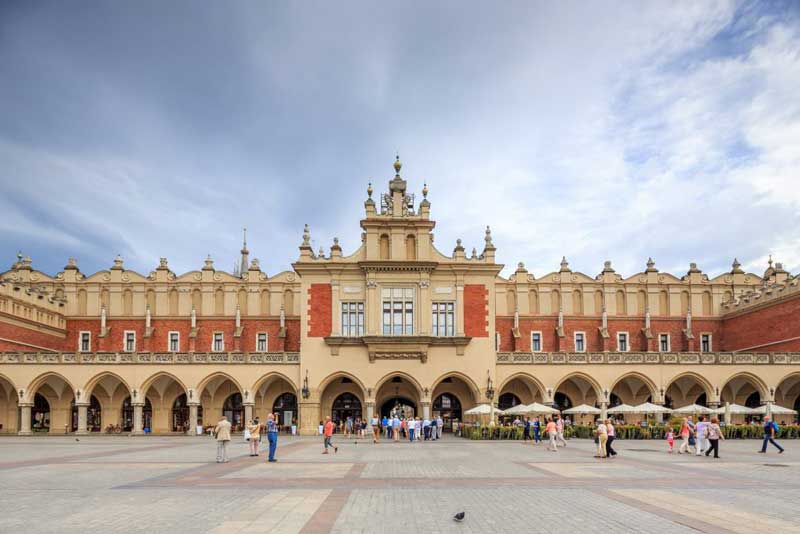
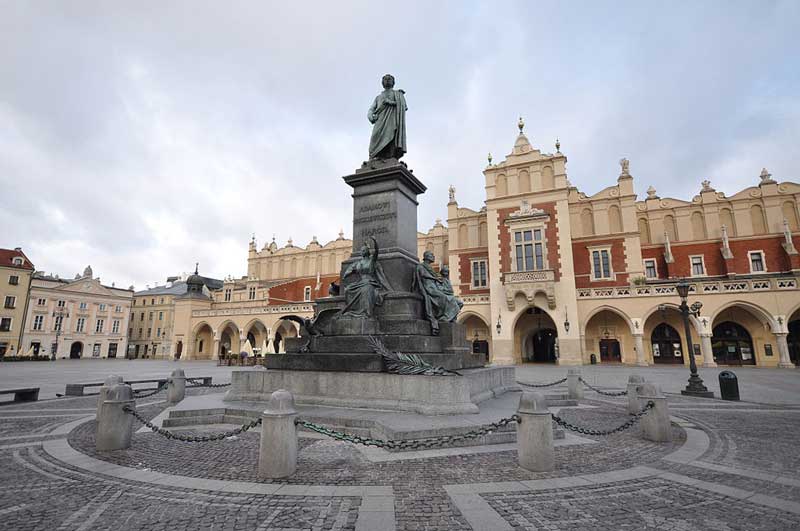
Originally designed in the 14th century as a centre for cloth trade, the Cloth Hall, locally known as Sukiennice, is the central feature of the main market square and is regarded as one of the most recognisable icons of Kraków. It runs neatly through the entire length of the square from north to south, having the effect of dividing the RynekGlowny into two equally sized sections, one on the east, and the other on the west.During its golden age in the 15th century, it was once a major centre of international trade, where the travelling merchants used to meet and discuss business and barter, while the hall was full of a variety of exotic imports from the east, which included spices, silk, leather and wax. It was ravaged by a devastating fire in 1555 and rebuilt in the Renaissance style by Giovani il Mosca from Padua. However, its decline started at the end of the 16th century with the move of the capital to Warsaw, hastened by wars and politics leading to the Partition of Poland at the end of the 18th century. Based on the design of Tomasz Prylinski, the Cloth Hall was successfully renovated during the early part of the 1800s, when the arcades were added.
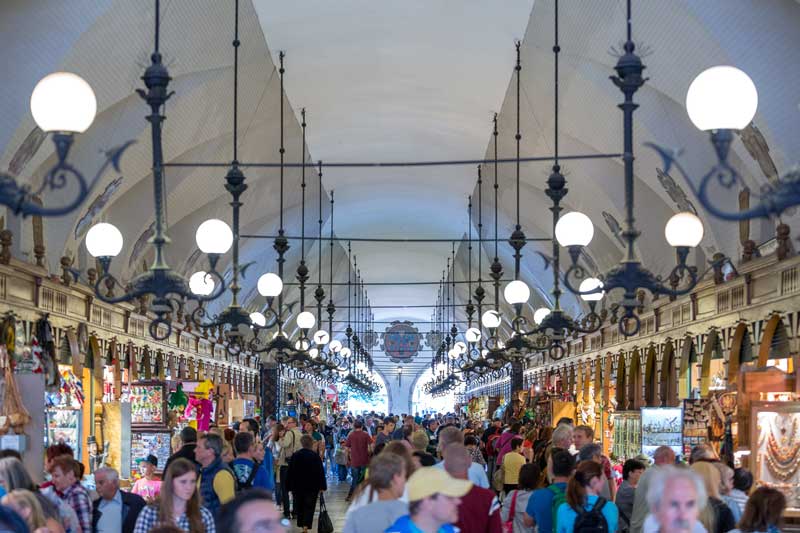
Over the centuries, the Cloth Hall has hosted numerous distinguished guests, even balls were held here on special occasions and is still used to entertain monarchs and dignitaries like Charles, Prince of Wales and Emperor Akihito of Japan.

Today, it houses the stalls of local tradesmen selling handicrafts and cloth products, while its upper floor houses the Gallery of 19th-Century Polish Art at Sukiennice, a division of the National Museum, Kraków, displaying the 19th-century Polish painting and sculpture in four grand rooms.
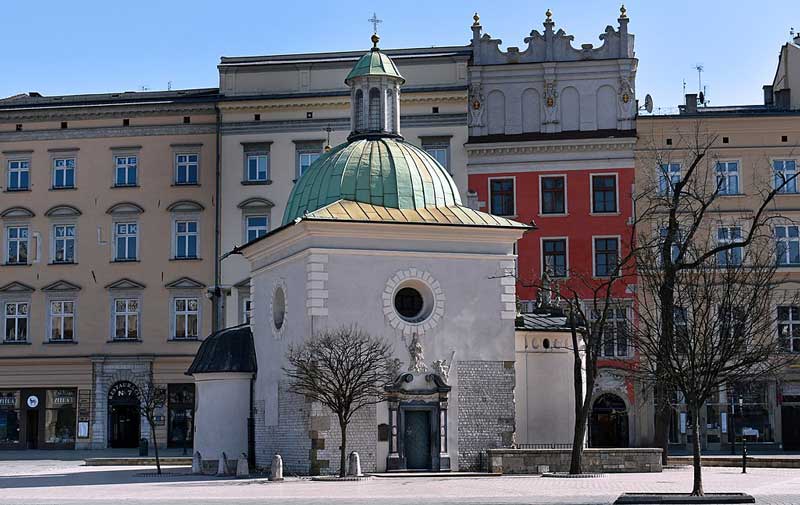
Rynek Glowny does not have a Town Hall,but on one side of the Cloth Hall stands the 230 feet (70 m) tall, massive Gothic Town Hall Tower, the only remaining part of the old Kraków Town Hall, which was built at the end of the 14th century and knocked down in 1820 as part of the city plan to open up the Main Square. As the original Gothic helmet adorning the tower was destroyed by fire caused by a bolt of lightning in 1680, a new Baroque helmet took its place in 1686. However, as the new helmet began to crumble in 1783, it was replaced by a smaller structure. While the entrance to the tower is guarded by a pair of stone lions carved at the beginning of the 19th century, the tower serves as one of the branches of the Historical Museum of the city of Kraków, displaying the photographs of the Market Square Exhibition. The top floor of the tower is equipped with an observation deck, offering a wonderful panoramic view of Krakow for visitors.Apart from that, the square also contains the Church of St. Adalbert, also known as the Church of St. Wojciech, one of the oldest stone churches in the country.
The Gothic edifice of St. Mary’s Cathedral, standing 262 feet (80 M) tall with its two majestic towers of different heights, dominates the landscape of Rynek Glowny. Originally built in the 1220s, the cathedral was rebuilt in brick Gothic style, following its destruction during a Tatar raid, which was completed in 1347 during the reign of Casimir III the Great. Apart from its impressive exterior, the interior of the cathedral is ornately decorated with its main altar carved from wood. Traditionally, every hour on the hour, a trumpeter plays a tune called the Hejnal Mariacki, a plaintive melody that stops abruptly midstream in commemoration of the bugler, killed by Mongols as he was alarming the people just before they attacked the city.

Originally the market square consisted of several other structures, which included the Great Weigh House and Small Weigh House, standing next to the Cloth Hall and existed until the 19th century. The foundations of the weigh houses were later incorporated into an underground museum, when excavated in the early 21st century. The square has several underground passages linking some of the basements, including the one that connects the Town Hall Tower with the Cloth Hall.
Despite mainly used to serve the purpose of trading and commerce, Rynek Glowny or the main market square witnessed many historical events, as it was used as a place of regal ceremonies, frequented by diplomats and dignitaries. It was also used to stage public executions of prisoners held in the city's Town Hall. Although the capital of the Polish-Lithuanian Commonwealth was shifted to Warsaw in 1596, Kraków remained the place of coronations and royal funerals. The square was renamed Adolf Hitler-Platz in 1939, during the occupation of Poland by Nazi Germany, when the beautiful Adam Mickiewicz Monument was destroyed, along with all the commemorative plaques from the other buildings at the square. However, the monument was reconstructed after the end of the Great War.
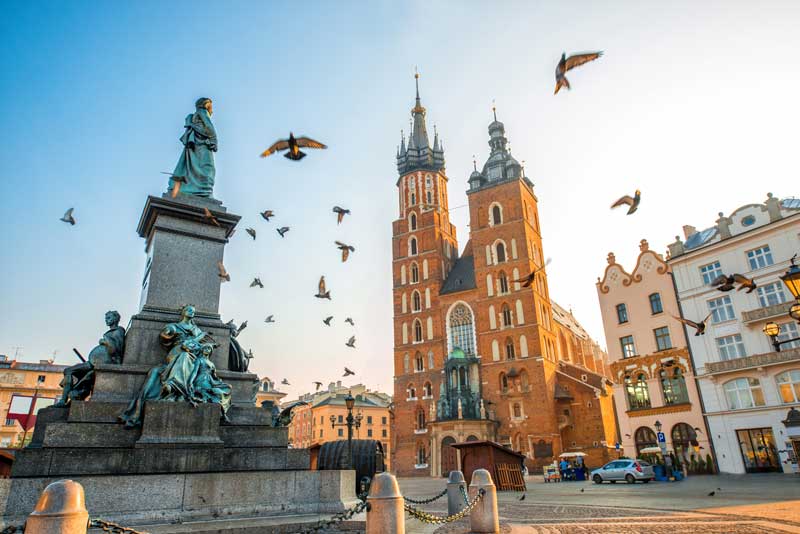
As part of the Old Town Kraków, the Rynek Glowny or the market square was enlisted in UNESCO World Heritage Site in 1978.Today, considered an attractive spot by the locals and the tourists alike, the square remains lively and crowded year-round. Like the Trafalgar Square in London and many other town squares, it is also known for its large population of rock pigeons, florist stalls, gift shops, beer gardens and horse-drawn vintage carriages. The restaurants and cafés on the eastern side of the square, having a front row view of the Cloth Hall’s broadside, seem to be more popular among tourists, which also faces the massive Town Hall Tower, the city’s answer to Pisa’s leaning tower, resulting from a storm in 1703.